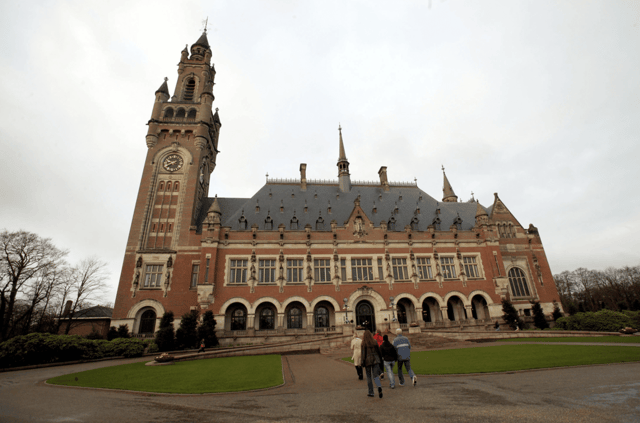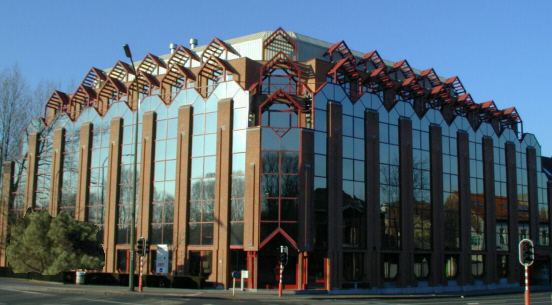
Cover image: The Secretariat of the Energy Charter located in Woluwe-Saint-Lambert, Brussels, available under a Creative Commons Attribution 3.0 Unported license.via Wikimedia Commons
African countries rich in fossil fuels and critical minerals are being courted to sign-up to a controversial investment treaty that champions the interests of international investors at the same time the treaty is being abandoned by European countries concerned that it blocks climate action.
The Energy Charter Treaty (ECT) is a multilateral framework created in 1994, which was billed as a way for states to attract and protect foreign investments in the energy sector, in order to promote energy security and increase competitiveness for their citizens.
Like hundreds of other trade and investment agreements, the ECT requires signatories to submit to a quasi-judicial process called Investor-State Dispute Settlement (ISDS) should foreign investors decide the state has breached the agreement in ways that negatively impact their investment. The system effectively allows foreign investors to sue governments for damages in an international tribunal in response to the passage of laws or regulations, or even the outcomes of court cases, that adversely impact their business interests.
Since coming into force in 1998, around 50 countries have ratified the ECT, mostly in Europe. And scores of private companies have filed claims against national governments to the tune of billions of dollars claiming “loss of profit” over changed laws and regulations, especially those aimed at tackling climate change.
In response, several European countries have withdrawn from the ECT over the last two years amid growing recognition of the treaty’s negative consequences on democratic governance and climate action.
As European countries abandon the treaty, internal documents reviewed by Drilled show that the ECT leadership is now pursuing African governments, despite widespread concerns that the treaty risks infringing on a state’s ability to enact laws for the betterment of their people, like those concerning the environment, health and climate change.
“The expansion efforts by the ECT Secretariat have included inviting African countries to participate in conferences, enticing them [with investment opportunities] and talking to them about [treaty] modernization efforts,” said Herbert Kafeero, programs and communications manager at Southern and Eastern Africa Trade Information and Negotiations Institute (SEATINI) in Uganda. SEATINI is a civil society organization that works on issues like trade, livelihoods and sustainable development.
The ECT is currently undergoing a ‘modernization’ process, ostensibly aimed at alignment with international climate goals.
Nonetheless, in 2024, the European Union (EU) withdrew from the treaty as a bloc, stating the incompatibility of fossil fuel investments with climate goals. Individually, countries including Spain, Germany, Denmark, Italy, France, Netherlands, Poland and Slovenia have also withdrawn from the treaty, as has the United Kingdom.
Meanwhile African countries including Uganda, Morocco, Nigeria, Burundi, Eswatini, Kenya and Senegal have now acquired observer status to the ECT, allowing them to engage with the treaty—attending meetings, accessing reports and engaging in ‘capacity building’ activities like learning about energy investments—without any legal obligations. Drilled has learnt that many of these countries have taken steps towards ratifying the ECT, a process that is notoriously opaque with almost no scope for public scrutiny. Among them, countries like Burundi and Eswatini are in the process of ratifying the treaty while countries like Uganda, Kenya, Gambia and Senegal are preparing accession reports to formally join the treaty.
“There is always the risk of final ratification [by African countries to the treaty] because government officials can get swayed.” Kafeero told Drilled. Fossil fuel projects promise billions of dollars and new jobs that are hard for politicians to turn down. “If the proponents, the original founders of the treaty [in Europe], are withdrawing, then resource-constrained settings like Africa should be more cautious. Getting embroiled in legal cases can cause a lot of economic suffering and divert resources from the delivery of public services and other development necessities. Global South countries don’t have a lot of money to spend on such arbitration,” he said.
The Energy Charter Treaty is driving investor-state disputes
There are currently 42 countries signed up to the treaty including Afghanistan, Azerbaijan, Ireland, Japan, Jordan, and Ukraine.
The ECT grants foreign investors access to private arbitration mechanisms, known as Investor-State Dispute Settlement (ISDS), that go far beyond protections to private property under national laws. Effectively, this system allows foreign private investors to file claims against the national government in private tribunals in cases where laws and policies formulated by the government, or legal cases adjudicated by the courts, adversely affect their interests. ISDS tribunals usually comprise three private arbitrators: one selected by the state, one selected by the company and one selected at random. According to an earlier study by the International Institute for Sustainable Development (IISD), the average fee paid to a three-arbitrator ISDS panel is USD 1.28 million per case. Some judges of the International Court of Justice (ICJ) have also worked as ISDS arbitrators.
And while the EU has withdrawn from the treaty, some countries in the EU like Finland, Austria, Sweden, and Hungary remain signatories to the ECT. Recently, the EU urged the remaining countries to withdraw from the treaty.
Switzerland, a major international investor which is not a part of the EU, has a keen interest in treaties like the ECT and remains a signatory as well.
Japan, which has substantial investments in oil and gas at home and overseas, is also a major advocate of the ECT. Japanese government officials have actively participated in treaty reform efforts and the current Secretary General of the ECT Secretariat, Atsuko Hirose, a lawyer and a member of the Chartered Institute of Arbitrators in London, who previously worked with the Japanese government and with various development banks, is from Japan.
In addition to the ECT, there are hundreds of bilateral investment treaties and free trade agreements like the United States-Mexico-Canada Agreement (formerly known as NAFTA) that include ISDS provisions. Contracts governing large fossil fuel development projects often include an ISDS provision as well.
Why does it matter?
The 2021 Intergovernmental Panel of Climate Change (IPCC)’s Sixth Assessment report (AR6) identified “investor-state dispute settlement mechanisms designed to protect the interests of companies engaged in high-carbon energy supply from national policies” as a “key gap and weakness” in the section on international cooperation on climate mitigation. A research paper published in the journal Science in 2022 concluded that ECT is “the greatest contributor” to investor dispute claims which are blocking or potentially preventing states contributing claims that could lead to states refraining from phasing out oil, gas and coal.
Fossil fuel giants such as the British multinational Shell and the Italian Eni have cost Nigeria billions of dollars in ISDS cases. Recent claims include the British oil and gas company Rockhopper, which filed a case against the Italian government for denying permits for oil production and the German energy company Uniper, which has filed a claim against the Dutch government for enacting a law to phase-out coal power.
In addition, the ECT’s ‘modernisation’ plan is arguably incompatible with international law. Last year the ICJ ruled that states are legally obliged to exercise “due diligence” in ending fossil fuel extraction, consumption, licenses and subsidies. This duty extends to an obligation to regulate private businesses responsible for emissions and other significant harms to the climate system operating within their borders, and a state’s failure to do so could constitute an internationally wrongful act susceptible to legal consequences.
Yet the proposed ECT includes various shortfalls like the sunset clause, which implies that existing investments in fossil fuels will be protected for another 20 years.
Experts warn that the expansion of the ECT and other such treaties in Africa could lead to many more claims, further crippling cash-strapped governments and blocking decarbonization efforts in countries facing the brunt of climate breakdown.
“We see that nations around the world are suffering because of the financial penalties accruing from the cases filed under the ECT. The treaty is targeting to expand in Africa with a guise of offering a legal buffer for mainly fossil fuel projects, yet there are many associated environmental risks and communities could suffer like what we see with the East African Crude Oil Pipeline,” said John Peter Okwi, programs coordinator at Environment Governance Institute (EGI) - a non-profit non-government organization that advocates for sustainable management of natural resources and a just energy transition in Uganda.
“The ECT protects investors within the fossil fuel sectors which means they cannot be held accountable in matters concerning climate change policies and commitments. This has far-reaching consequences,” added Okwi, noting that Uganda, with its public debt soaring to a tune of $32 billion which is about 52% of its GDP, should reconsider its intention to join the ECT, a move that could give rise to further financial distress.
Courting by the ECT Secretariat
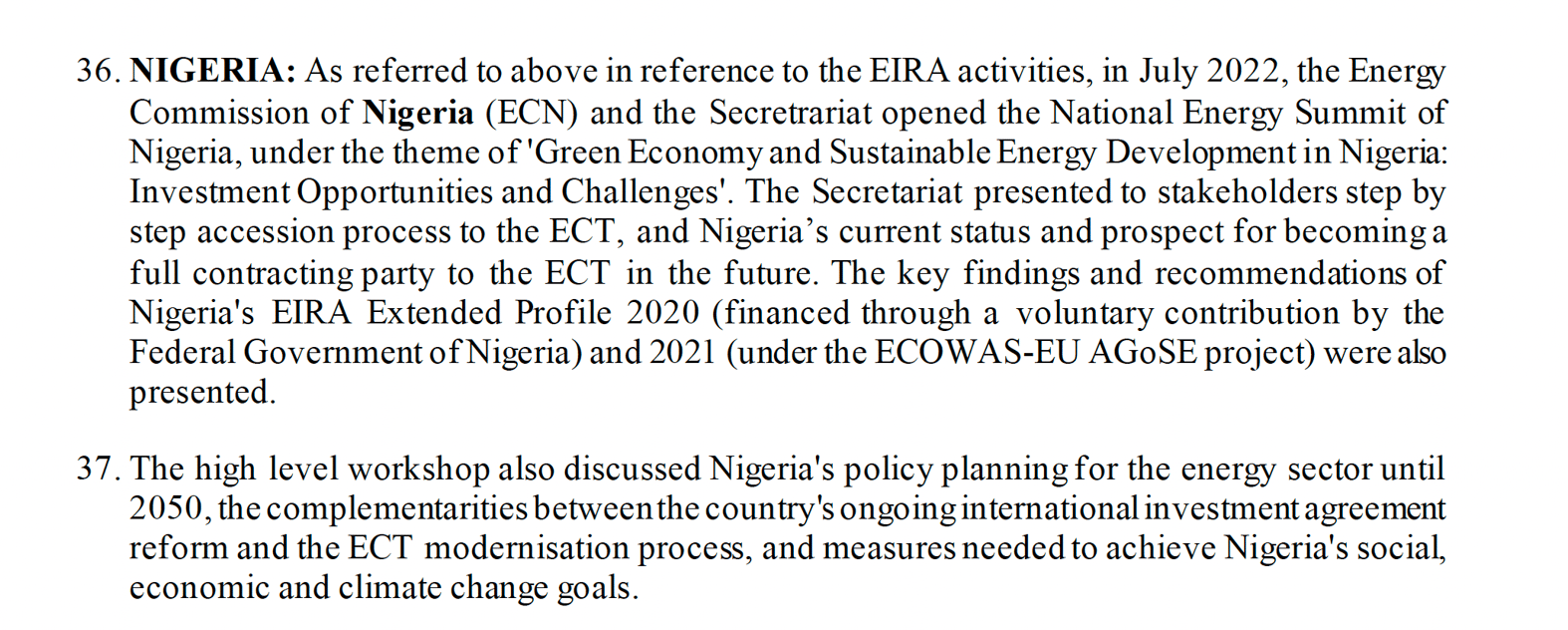
Internal ECT documents reviewed by Drilled reveal efforts by the Brussels-based Secretariat to engage with observer countries in Africa and promote their ratification of the treaty. This includes the Secretariat organising meetings with high-level ministerial and government representatives of various ministries and agencies in Nigeria, The Gambia, Senegal and Eswatini.
Nigeria
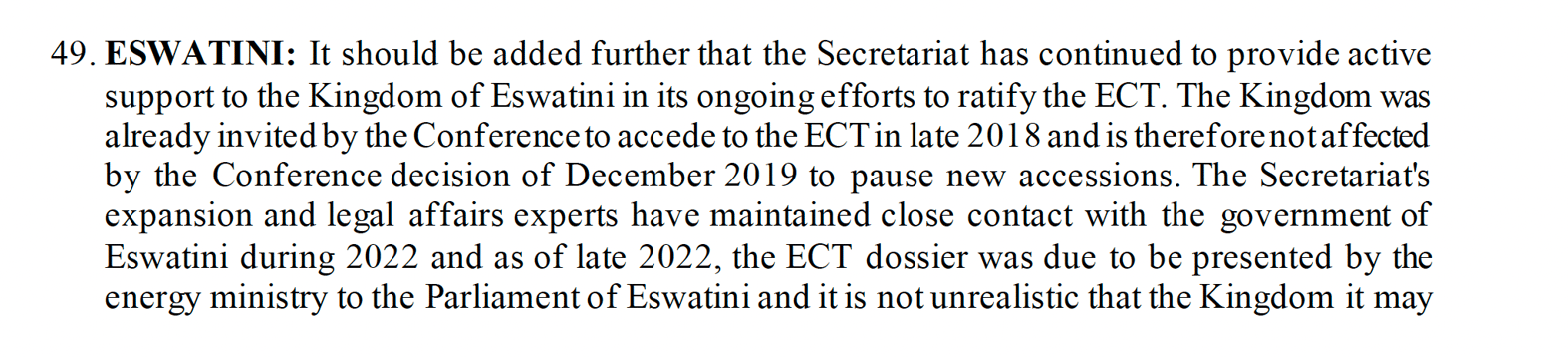
Eswatini
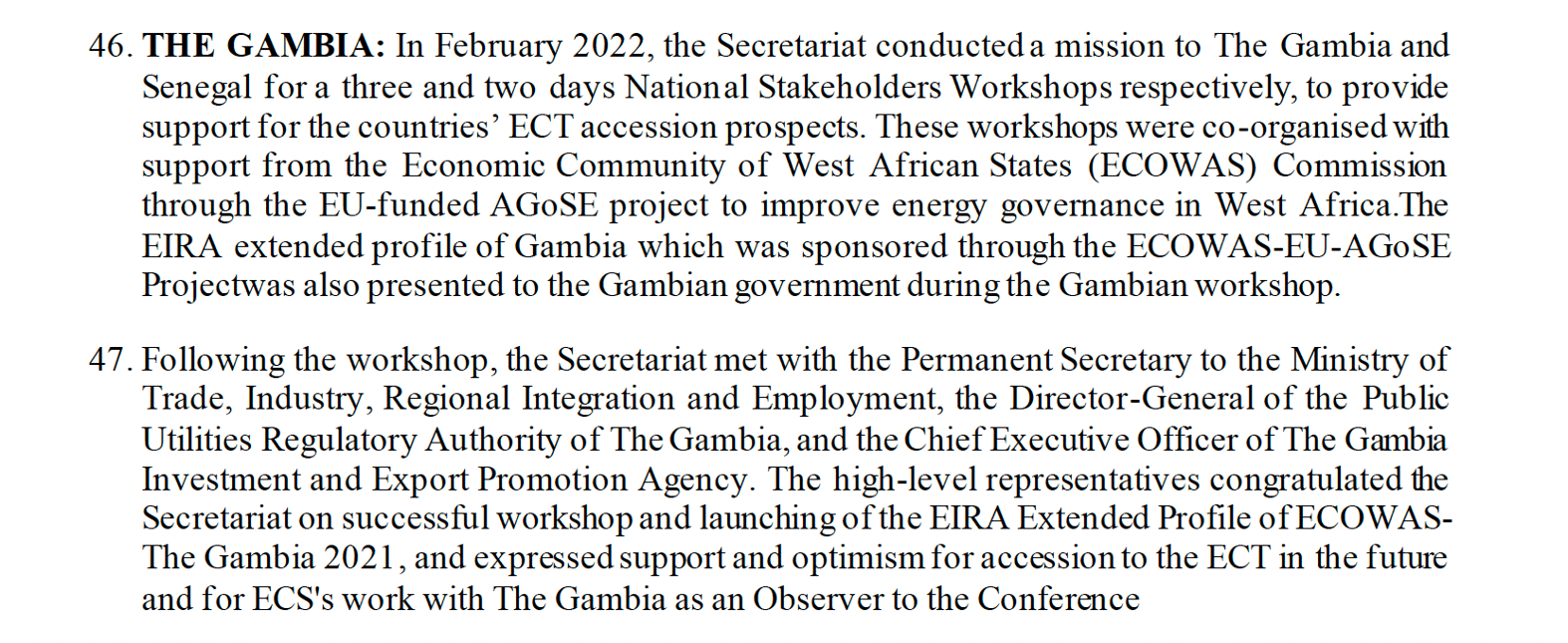
The Gambia
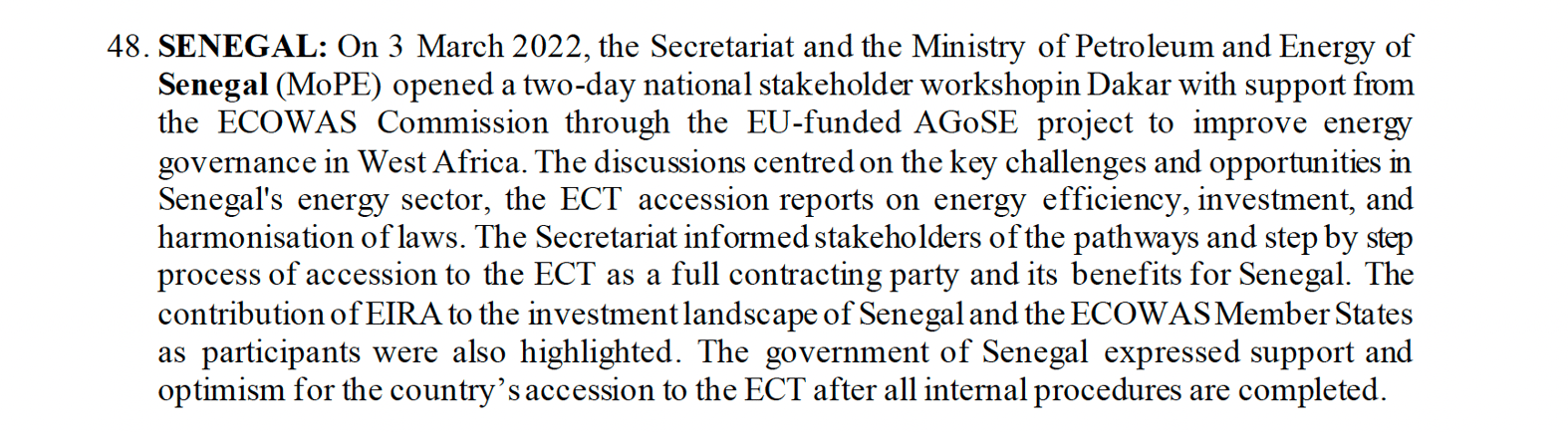
Senegal
Gallery Caption: Screengrabs from an official document of the ECT Secretariat titled ‘Report by the Secretary General on the Activities in 2022’
Official ECT representations by The Secretariat also claim that ratification of the ECT is the way “to overcome energy poverty” in Africa.

Caption: Screengrab from an official representation of the ECT Secretariat titled ‘Africa and the Energy Charter: the bountiful continent and the energy conundrum’
The Secretariat has also tried to expand the treaty to the Organization of Petroleum Exporting Countries (OPEC), official documents show.
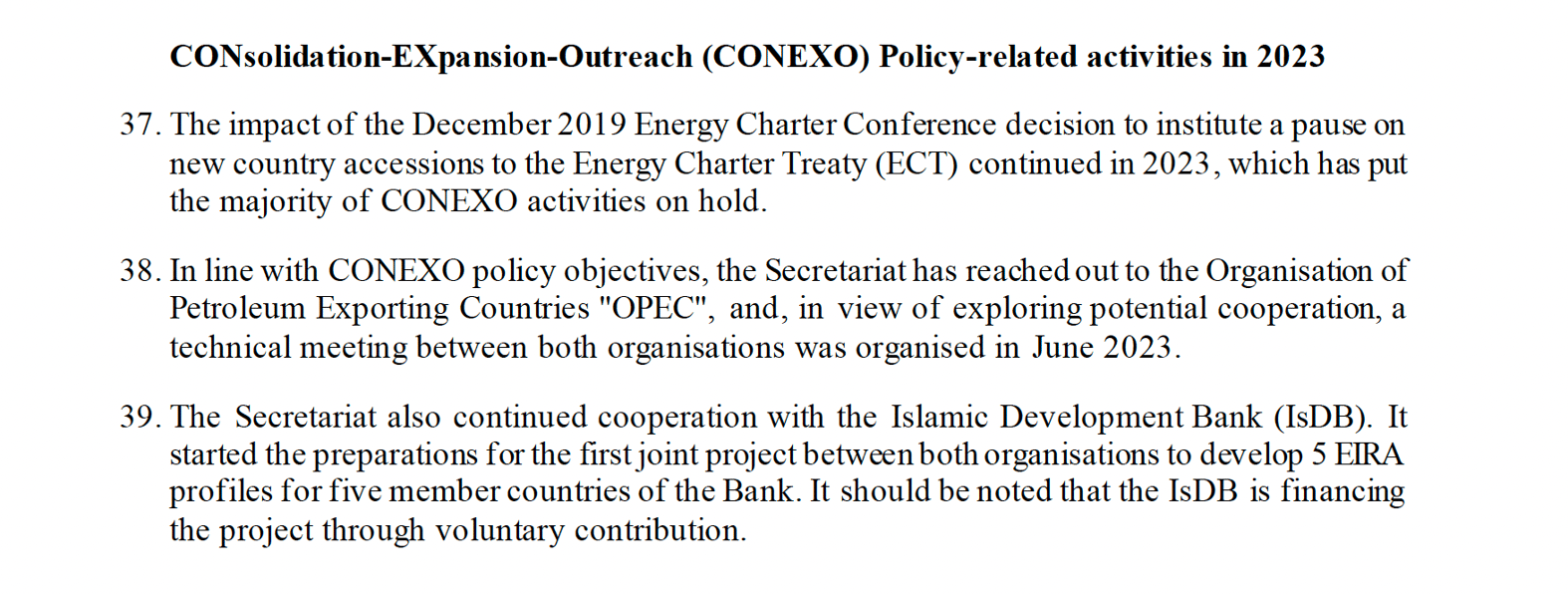
Caption: Screengrab from an official document of the ECT Secretariat titled ‘Report by the Secretary General on the Activities in 2023’
Opposition to the ECT expansion
In 2021, Ugandan NGOs SEATINI and EGI were among some 400 civil society organizations around the world, calling on “European governments and the EU to leave the ECT… and stop pushing its expansion to countries of the Global South.”
EGI and SEATINI have also been advocating for parliamentary oversight for ECT ratification processes.
In August, 2023, the leader of the opposition in Uganda called for the government to reconsider becoming a fully ratified party to the ECT. Mothios Mpuugo stated that the ECT will “derail our environment and climate action efforts and also expose the country to hefty fines.”
Drilled requested an interview with representatives of the ECT Secretariat about treaty expansion efforts in Africa but did not receive a response.
Critical minerals in Africa give fresh impetus to the ECT and ISDS
It’s no longer just about fossil fuels. The Secretariat may also be pursuing African countries to join the ECT due to investor interests in the continent’s critical mineral resources, seen as a key profit stream and an aid to the energy transition.
And it’s no longer just the ECT either. “Europe already has bilateral investment treaties in place with a lot of African countries and most of Latin America, so those can all be used the same way that the ECT would be used,” said Ladan Mehranvar, a senior legal researcher for the Columbia Center for Sustainable Investment.
Currently, multiple European countries have signed strategic partnership deals on critical raw materials with African countries like Rwanda, Namibia, Democratic Republic of Congo and South Africa. These deals include bilateral treaties with ISDS provisions.
“Europe of course wants to use policy tools to have access to critical raw materials,” said Kafeero from the civil society organization SEATINIs. “Europe maintains strong ties with former colonies to guarantee the supply of raw materials and infrastructural set-up during colonial times is more or less maintained.”
Countries like the UAE, Saudi Arabia and Qatar are also signing a lot of traditional investment treaties in the energy sector that offer ISDS protections, as is Canada.
Investor-state dispute cases involving critical minerals are on the rise, according to the UN Trade and Development (UNCTAD). In 2024, six ISDS cases involving mining for critical minerals like copper and lithium were filed.
A report by the European arm of Climate Action Network (CAN), a global coalition of over 1900 environmental nonprofits, said “Communities resisting the corporate exploitation of critical minerals may be at the forefront of a new wave of ISDS claims linked to critical minerals, given the importance of critical minerals to the green transition… Critical mineral-related ISDS cases may well be the next frontier for ISDS arbitration.”