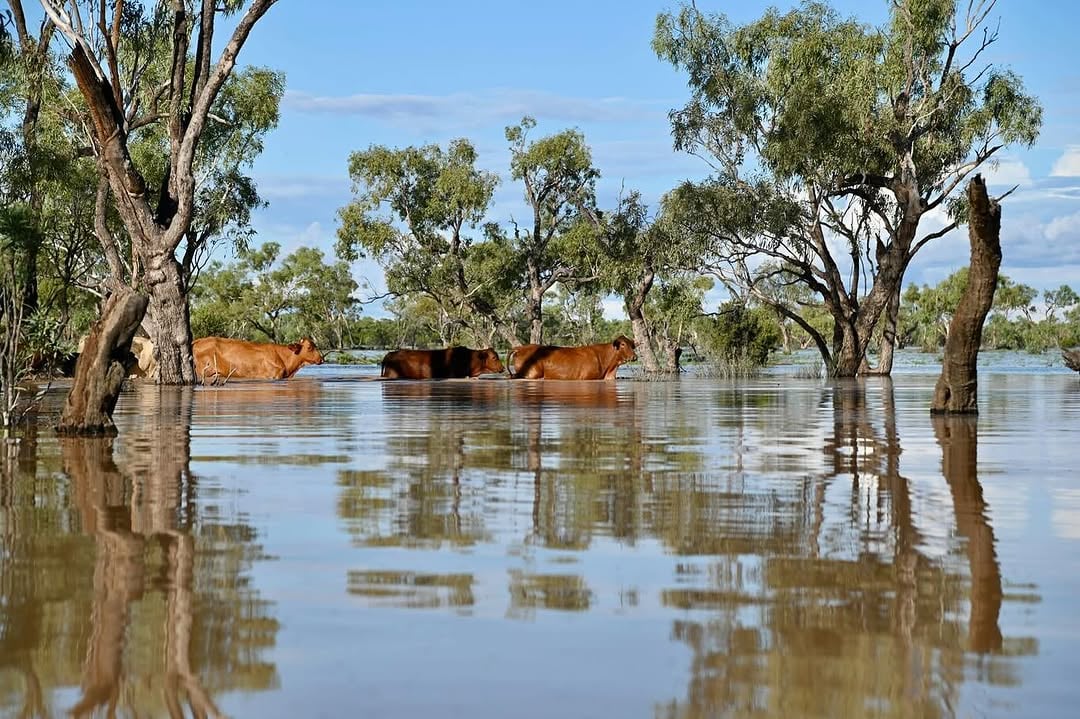
Photo: Floods in Queensland in 2025. Photo by Helen Commens.
Applicants to a $500,000 program offered by Australian petroleum producer Santos to support flood-affected communities across the outback in mid-2025 were told they would only be given financial help if they said good things about the company in the media, campaign groups say.
In April and May 2025, heavy rains falling in the western part of the northern Australian state of Queensland made their way south through New South Wales and into South Australia. A volume of water compared to that in Sydney Harbour was sent coursing through the outback. What was described by some as an “inland tsunami” cut roads in many locations, including the famed Strzelecki Track, in some cases turning remote townships, normally, surrounded by red earth, into little islands particularly in the area around the Cooper Basin.
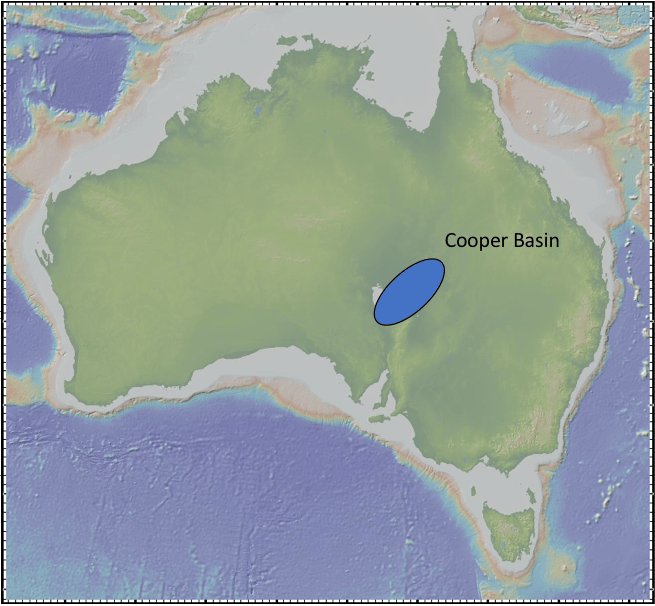
Location of Cooper Basin and associated gas fields (Image by Ashton-Bridges via Wikimedia Commons)
In response to the unfolding natural disaster, Santos pledged $500,000 (USD$359,940) to assist residents in remote South Australia and in Narrabri, New South Wales, where the company has been attempting to develop a gas project despite community opposition for the last 15 years. Gallagher said in a media release at the time that Santos was working closely with state authorities to help respond.
“We know people are hurting – many of them have lost stock and crops, and they are isolated in remote homesteads and outstations – so we are contributing financially and making our people and other resources available to assist where we can,” Gallagher said.
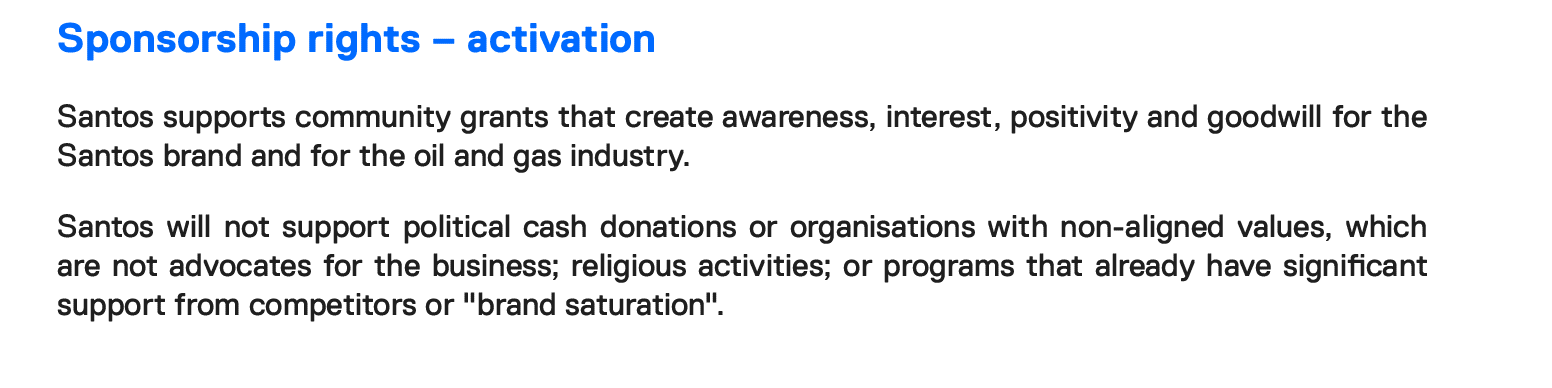
The company did not outline the process to obtain this support, but applications were able to be made through a form accessible through the online portal Sponorium. Applicants seeking financial help from the company were advised on the form that, “from time to time, Santos and our community partners may be the target of activism related to our operations” and that organizations should “have considered and accepted the potential risk associated with activism”. Under a section titled “Sponsor Rights – Activation”, the company outlined the terms on which would provide support:
The form then instructed applicants to “please detail how you will promote the Santos brand through your event or program and what activation you have planned”. This was presented as a mandatory field and listed several options, including “Event/Program/Infrastructure naming rights”, social media promotion, advertising, hospitality and speaking opportunities, “access to VIPs such as ministers, key landholders or celebrity endorsements”, media interviews, and placement of Santos-branded merchandise.
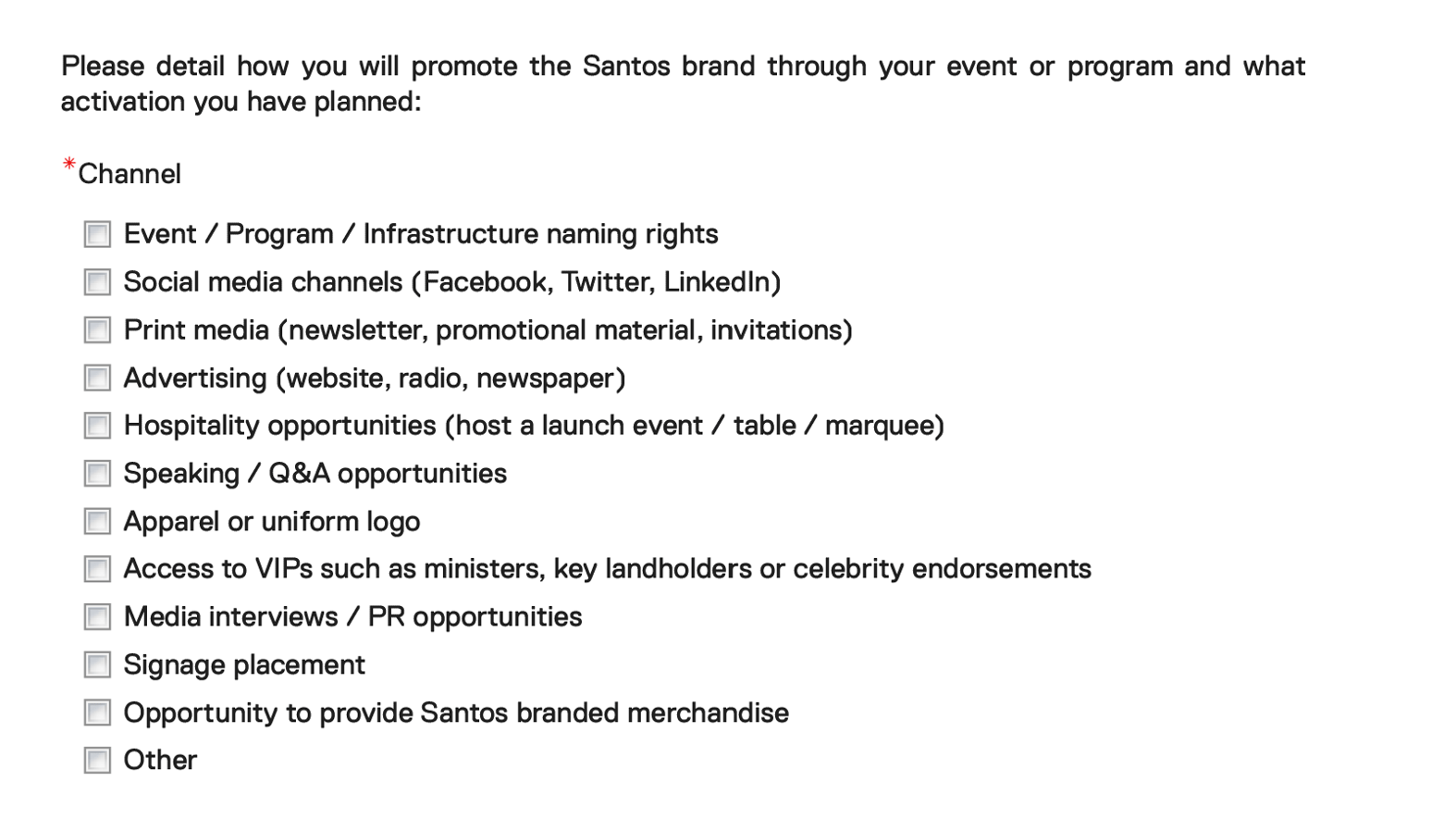
The text outlining these conditions appeared to be standard and applied consistently across all support programs offered by the company. Other categories included Community Sponsorship Opportunities greater than $5000 and Community Grants for $5000 or less for “support of grassroots organizations, local sporting clubs and smaller communities initiatives”.
Belinda Noble, founder of CommsDeclare, an organization campaigning for fossil fuel advertising bans, said it was clear that financial support from fossil fuel producers such as Santos came with strings attached.
"What a perverse world where climate polluters that are causing more extreme weather and damaging our health can extract positive PR from those suffering the impacts,” Noble said. "Donate the money by all means, but don't turn community vulnerability into a marketing opportunity."
Santos did not provide any detail about how many organizations sought to access the fund, or the size of the average payment, but denied the money came with conditions.
“The flood relief funds have now been fully allocated,” they said. “There is no requirement attached to the funding distributed by Santos for recipients to promote the company.”
The apparent conditioning of community support on promotion of the company is significant at a time when these programs have been under pressure. Several South Australian local councils have agreed to ban fossil fuel sponsorship from companies like Santos, including those whose jurisdiction form part of the route taken by the Australian Tour Down Under, a prestigious international cycling race sponsored by Santos and which runs through the Adelaide Hills. The company has similarly been under pressure from a campaign to remove its branding from buildings on the Adelaide University campus and the South Australian Botanic Gardens recently removed its name from the Museum of Economic Botany ahead of its contractual end date.
Santos, for its part, has been keen to highlight the positive contribution it has made in the communities within which it operates, especially during the 2025 floods. Its helicopter team earned the People’s Choice Award at the company’s internal “Directors’ Environment, Health, Safety and Sustainability Awards” in April 2026. The awards “celebrate the innovation and passion Santos’ people bring to delivering safer, more environmentally sustainable and efficient operations and supporting the communities where we operate.” Santos CEO Kevin Gallagher also presented an award at the time for “CEO Values of the Year” to Wayne Kasou, Senior Vice President PNG Stakeholder Management for “the integrity and consistency he delivers when engaging with thousands of stakeholders across government, community and landowner groups to support the business’ ongoing operations in PNG”.
Flooding at the time impacted the company’s operation in and around Moomba, a company-town in the remote northeast of South Australia. The camp has long serviced Santos’s gas operations in the Cooper Basin. First discovered in 1966, the gas fields in the area played a critical role in the creation of the Australian gas industry with the construction of a Moomba-Adelaide Pipeline. Today, as the fields are increasingly depleted, the company has sought to re-use them as part of its carbon, capture and storage operations intended to sequester up to 1.7m tonnes of CO2 a year.
Much of this region has been subject to oil and gas exploration and production, with the floodwaters forcing the temporary suspension of drilling activities as they washed over more than 200 pumpjacks operated by both Santos and Beach Energy.
A Beach company spokesperson said there was “no evidence of environmental impact in relation to our operations”.
"Beach stood up a dedicated response team, which includes utilising daily helicopter and drone surveillance, prior to the arrival of the floodwaters which manages the safety of our people, the environment, and the integrity of our equipment,” a company spokesperson said.
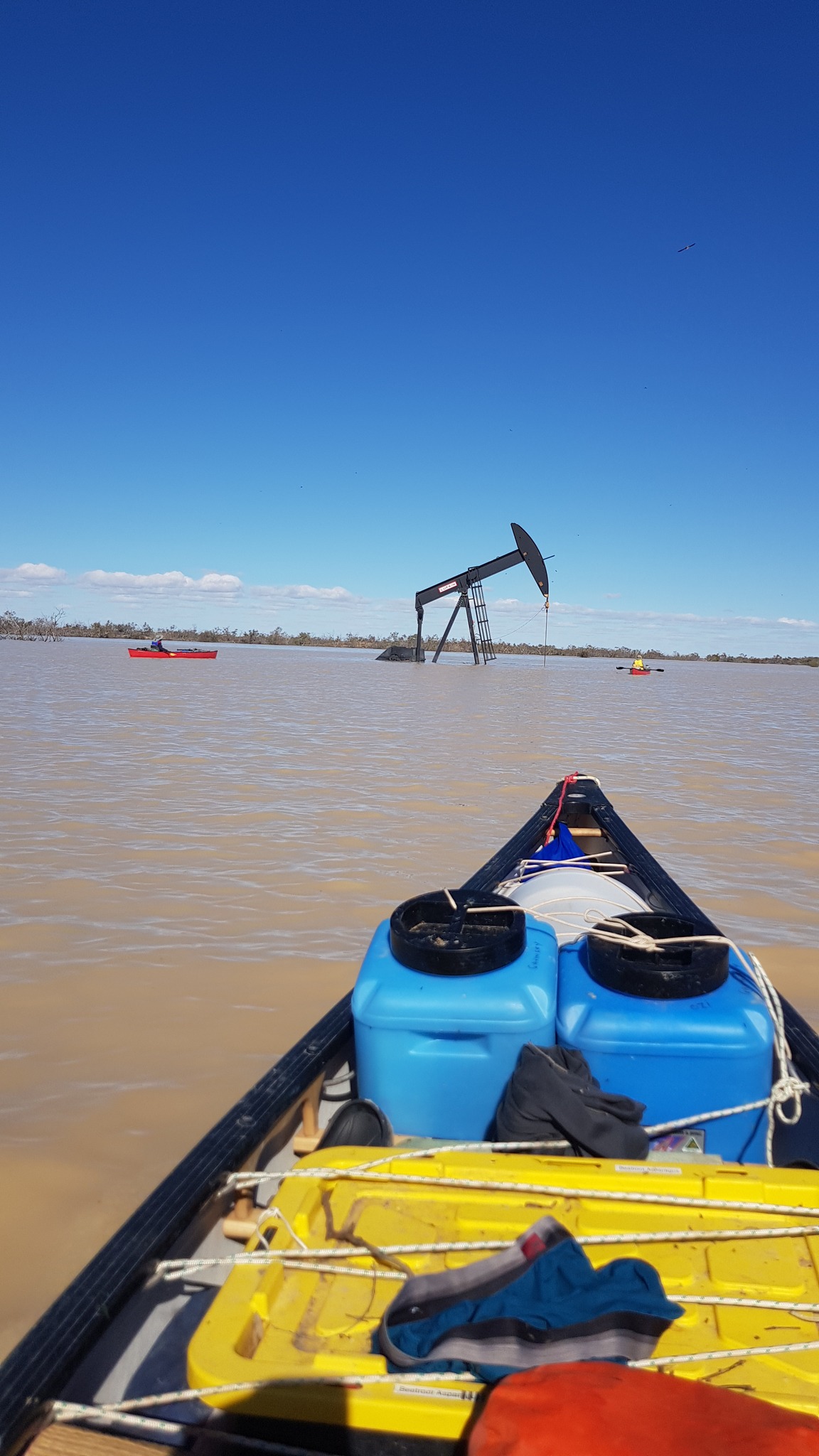
Image of a pumpjack operated by Beach Energy inundated in about a metre of floodwaters, with its boom and frame exposed (Photo by Glen Hughes).
A Santos spokesperson said “no drill rigs were impacted during the floods”, but confirmed it had “shut in” 200 wells which were progressively brought back online “in a staged manner”. The company said it first notified the authorities on 13 April about the risk posed by approaching floodwaters.
A spokesperson for the South Australian Department of Energy and Mining (DEM) said the government had worked closely with “field operators” to monitor the situation, with both Santos and Beach Energy reporting “inundated sites to DEM”. They said with “advanced warning of the flooding events, all drilling rigs that may have been impacted were moved prior to the floods inundating the basin” and that nine-in-ten wells had still been inundated by mid-July 2025.
“Within the Cooper Basin, both in South Australian and Queensland, DEM understands that over 200 well sites were shut in—made safe and stable by isolating the wells—prior to the flood waters arriving,” they said. “This procedure is in line with good practice for flood mitigation.”
Drilled sought access under Freedom of Information to email communications between Santos and DEM during this period, along with copies of any report or investigation relating to the inundation. The Department identified 37 documents and refused access to all of them, citing multiple exemptions relating to law enforcement and public safety, personal affairs, business affairs, internal working documents, secrecy provisions and confidential material in every case.
It was not just the company’s production that was affected by the flood. The floodwaters themselves came perilously close to Santos’ operations at Moomba, swallowing a wastewater treatment pond. Informally known as “Lake Brooks”, the pond is officially referred to as the “Moomba waste water facility” and used as an uncovered or sealed evaporation pool for waste from the town camp and its gas processing facility. Company documents have long acknowledged the risk posed by inundation, which would spread any material concentrated in the base of the pond over a wide area. The company’s December 2024 Environment Impact Report that about 1500m3 a day of sour war was transferred to the evaporation point and that “data from 2013 showed that sour water had a high salinity and elevated levels of aluminium and boron that can affect native fauna and native vegetation”. “Sour water” is any water stream produced as an industrial byproduct that contains Hydrogen sulfide (H2S), carbon dioxide, (CO2), or ammonia (NH3).

Timelapse satellite imagery depicting the advancing flood waters near the Moomba camp as they inundate “Lake Brook” between May and June 2026.
“The Lake Brooks evaporation pond was inundated as a result of the floods,” a Santos spokesperson said. “Surface water sampling has been conducted in and around the evaporation pond since the flooding began, and no hydrocarbons were detected.”
“We leveraged this experience and our resources to support authorities and communities including helping to clear roads and deliver vital food and fuel supplies. “Our helicopters were used to help with the evacuation of local residents and tourists trapped in the flood zone, and we shared our flood modelling with authorities to assist in the planning and preparation as the weather event unfolded.”
Darcy McNamara from the Conservation Council of South Australia similarly described any conditional financial support provided by the company as “deeply cynical”.
“It’s not surprising Santos have tried to lock in community support at a time when communities are trying to move away from being reliant on support from fossil fuel companies left, right and centre,” McNamara said. “Santos is desperate because communities are turning their backs on fossil fuel companies.”