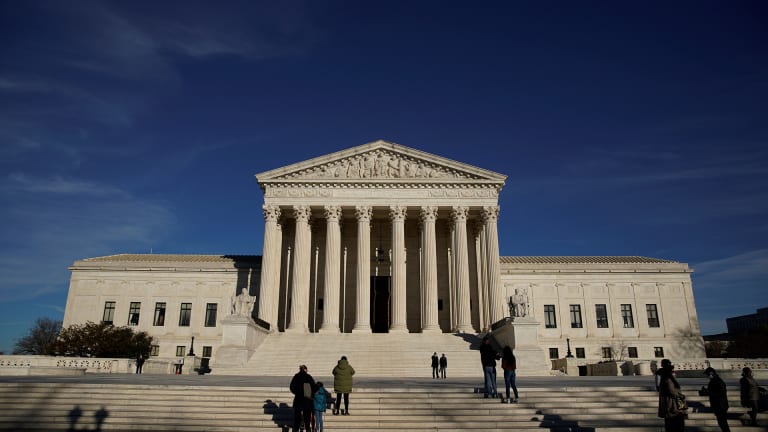
The U.S. Supreme Court announced its plans for the next court term today, a long list of the cases it won’t hear, motions it’s denied, and the select few cases it will take up. Among them was a case that could kneecap local communities' ability to sue fossil fuel companies for climate harms. Oil companies have been arguing for years that state courts shouldn't be allowed to hear climate liability cases. Now, the highest court in the nation has agreed to consider the argument for the first time.
The case stems from a suit filed back in 2018 by the city and county of Boulder, Colorado, against Suncor and ExxonMobil. The Boulder plaintiffs argued that by delaying climate policy for decades, the oil companies had exacerbated climate impacts, contributing to increased costs for the city and county—costs for which the companies are now liable. Suncor and ExxonMobil retorted that state climate liability claims are preempted by federal law and should not be allowed to proceed in state court. This jurisdictional question has held up the case for years. In its May 2025 ruling on the issue, the Colorado Supreme Court found, as more than a dozen state and appeals courts have before them, the companies’ argument flawed.
“Local communities are living with the mounting costs of climate change. The Supreme Court should affirm Colorado’s right to hold these companies accountable for the harm they have caused in Colorado,” City of Boulder Mayor Aaron Brockett said in a statement about the case.
Fossil fuel companies have filed five previous petitions to the Supreme Court to take up this argument, including Exxon and Suncor once before over this very same case, and the justices declined every time. It begs the question: What’s changed now?
Justice Alito has so far declined to recuse himself, as he has in previous instances, for a start. Alito owns stock in both Conoco Phillips and Phillips Petroleum. While those companies are not directly involved in the Suncor case, they are involved in a dozen or so other climate liability cases that will be directly impacted by the outcome of this case. The justice did not reply to a request for comment, but we will update this piece if he does.
Another new development is the American Petroleum Institute’s announcement in January that stopping climate liability cases is a major 2026 goal. In service of that goal, API and other industry lobbyists have been advocating for a liability shield law that would make oil companies legally immune for past deception on climate.
In fact, the fossil fuel industry has been trying to get out of climate liability for years. In May 2019, during Trump’s first term, for example, oil majors backed a legislative proposal from nonprofit think tank the Climate Leadership Council that would have traded a tax on carbon for permanent immunity from climate liability.
The former executive director of the Consumer Product Safety Commission, Pam Gilbert, told me at the time that the only industries that currently have this sort of legal protection at the federal level are gun manufacturers and nuclear energy, though other industries are constantly lobbying for them.
“It’s always the very most dangerous products or industries, which makes you think maybe this isn’t so wise,” Gilbert said. “Is the idea that we wouldn’t be able to have these products without this legal immunity, because of the harm they cause? Then maybe we need to rethink that.”
Neither Suncor nor ExxonMobil responded to requests for comment, but Michelle Harrison, lead counsel for Earthrights International, which is representing the Boulder plaintiffs, told Drilled, “Exxon's ever-evolving arguments as to why they should be immunized from such claims are baseless.”
The Climate Leadership Council’s effort failed, but fossil fuel industry leaders tried again in 2020. Drilled broke the news that the American Petroleum Institute was leading an effort to smuggle a liability waiver into the government’s Covid-19 relief package. That didn’t work either.
Now industry proponents are trying again via both state and national efforts. At the state level, lobbyists are leaning on Republican lawmakers to pass legislation that would block city, county, or state-level climate liability suits. At the federal level, representative Harriet Hagemen (R-WY) has announced that she is crafting legislation that would protect oil and gas companies from climate litigation. Her bill also proposes shielding oil companies from so-called “climate superfund” laws like the one enacted in Vermont, which holds fossil fuel companies liable for a portion of the damages from extreme weather events.
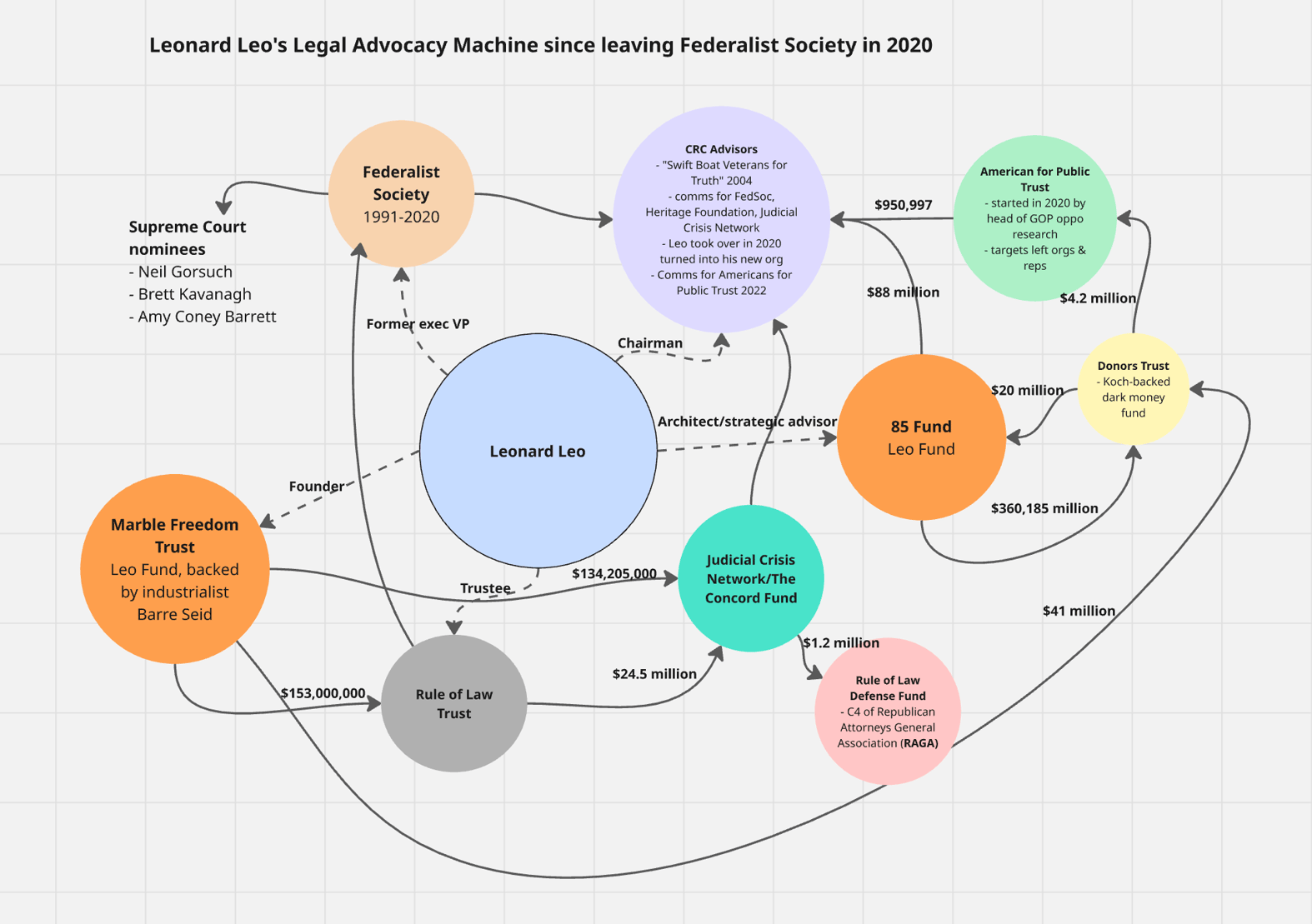
Several of the entities taking aim at climate liability cases at the moment are part of Leo’s advocacy machine.
Meanwhile, Republican attorneys general and Trump’s Department of Justice have begun targeting some of the nonprofits involved in these cases. The Republican Attorneys General Association, or RAGA, coordinated a letter from 19 Republican AGs, led by Montana AG Austin Knudsen, earlier this month, asking the Department of Justice to investigate some150 climate nonprofits, alleging that they may be in violation of federal foreign agent laws. The letter came on the heels of a report from the conservative nonprofit think tank Americans for Public Trust, alleging that foreign NGOs have invested about $2 billion in U.S.-based climate nonprofits over the past decade. Americans for Public Trust has deep ties to former Federalist Society head Leonard Leo, the man credited with handpicking the last three Supreme Court nominees (see infographic above).
The coordinated lobbying, legal intimidation, and PR campaign is all pointing to a single goal: chilling climate litigation.
The Supreme Court could deliver the final blow if it rules that climate liability claims cannot be filed in state court, although several other climate cases, such as those explicitly invoking state consumer fraud laws, would be unaffected by such a ruling. And Harrison, the plaintiffs’ attorney, notes that the justices did add a question to the petition that “reflects barriers to the Court's jurisdiction to hear this case,” so it remains to be seen what the court will rule. Ultimately, if polluting companies don't cover local and state governments' costs for adapting to the climate crisis and dealing with extreme weather events, then citizens will foot the bill.