Around the world, climate and other environmental protestors are being harassed, attacked, and arrested at an increasing rate. Laws are being passed that levy life-altering prison sentences and fines on protestors arrested near anything deemed “critical infrastructure,” which is defined so broadly it’s hard to find a public space that wouldn’t be near it anymore. Corporations are suing protestors and NGOs, comparing protest to organized crime. Governments are growing increasingly comfortable branding environmental protestors as “domestic terrorists” or instruments of “foreign influence,” and going after the nonprofit status of environmental nonprofits. And so far the media is largely participating in the rhetorical “othering” of protestors, opting in most cases to focus on the disruption that protest causes rather than the change it seeks, and to marginalize activists. In this print and audio series we’ll take an in-depth look at how climate protest has evolved in recent years, where this backlash is coming from, how it’s grown so quickly, and what it feels like to be someone who’s concerned enough about the future of humanity to join a protest, only to find themselves facing police violence and several years in jail.
We’ve worked with reporters on almost every continent to cover this trend from as many angles as possible and trace how particular tactics and ideas have spread across borders. The result is more than two dozen print and audio stories that we’ll be releasing over the next several months. The stellar team behind this project includes:
Alleen Brown, Senior Editor: Alleen Brown is an independent investigative journalist. Her reporting on state and corporate repression of Indigenous-led Dakota Access Pipeline opponents at Standing Rock has been cited in civil rights cases, reports submitted to international human rights bodies, and more than a dozen books. Her investigation mapping over 6,500 prisons against heat, wildfire, and flood risk has provided foundational information for organizers and policymakers defining what climate change will mean for mass incarceration. She has reported extensively on the intersections between environmental crises and racism, poverty, immigration, violence against women, and criminalization. She was previously a staff reporter at The Intercept and has written for Grist, The Guardian, Inside Climate News, The Appeal and other publications. Alleen is from St. Paul, Minnesota, and lives in New York.
Anna Pujol-Mazzini, Reporter, France Anna Pujol-Mazzini is an investigative journalist, podcast producer and fact-checker. She is a former international correspondent for Reuters, AFP and The Daily Telegraph and she specialises in gender, LGBTQIA+ rights and the environment. Her work has been published by The Washington Post, Reuters, TIME Magazine, National Geographic, The Guardian and The Daily Telegraph, among others.
Martha Troian, Reporter, Canada Martha Troian is an award-winning independent journalist and writer. Specializing in investigative journalism, she has worked for and contributed to media outlets across North America for close to 15 years, often writing about Indigenous politics, justice, crime, data deficits, and environmental and human rights issues. She was the McLaughlin Centre Science Journalism fellow with the William Southam Journalism Fellowship at Massey College, University of Toronto for 2019-2020. Previously she was a participant of the Investigative Journalism Intensive Program at Banff Centre for the Arts and Creativity. Currently, she is working as a producer with the Institute for Investigative Journalism probing water contamination and Indigenous communities. She is proudly from Lac Seul First Nation and Wabauskang First Nation in northwestern Ontario, and a mother to her young son.
Geoff Dembicki, Reporter, Canada Geoff Dembicki is an award-winning journalist and author from Alberta, Canada, currently based in Brooklyn. He’s a regular contributor to VICE, DeSmog, The Tyee and his work has also appeared in The New York Times, Foreign Policy and The Guardian. He’s the author of Are We Screwed? How a New Generation is Fighting to Survive Climate Change, which was published internationally by Bloomsbury USA in 2017, and The Petroleum Papers, published by Greystone Books in 2022.
Karen Savage, Reporter, US Karen Savage is an investigative journalist who has covered environmental justice communities extensively and has been reporting on resistance to pipeline construction in Louisiana since 2015. Her work has appeared in Undark Magazine, The Appeal, Project Earth, Juvenile Justice Information Exchange, Bridge the Gulf, Youth Today, Truthout and City Limits. Karen is an alum of the Craig Newmark Graduate School of Journalism, where she teaches environmental reporting.
Ugochi Anyaka-Oluigbo, Reporter, Nigeria Ugochi Anyaka-Oluigbo is an award-winning environmental journalist and the recipient of several journalism awards including the UNEP Young Environmental Journalist 2012, 2019 Green Accord Environmental Award, Italy and UNFCCC CDM-African Radio Contest 2011. She created, produced and presented the most popular environmental show on Nigerian TV, Green Angle on TVC News. I have hosted the BBC World Service’s Environmental Radio Programme, Local Warming. Ugochi comes from a community ravaged by erosion – a key factor that inspired her passion to pursue environmental journalism. I am a fellow of the Lancaster University Environment Center – Recirculate Programme. From erosions, flooding and desertification in Nigeria, oil pollution in Ogoniland of the Niger Delta, depleting Africa’s last rain forests to frozen lapland, Finland, she has visited rugged terrains to share underreported environmental stories. She currently works as a freelance journalist covering environmental issues across Africa and Europe, and co-hosts Djoliba – a multi language African radio show on RadioX Basel, Switzerland.
Lyndal Rowlands, Reporter, Australia Lyndal Rowlands is a freelance journalist. Her audio journalism can be found on Drilled, Damages, First Eat with Nakkiah Lui: an Audible Original, Life Matters on ABC Radio National and 7am. Her writing has been published by The Saturday Paper, The Guardian, Al Jazeera, The Diplomat, SBS and Inter Press Service, where she was a UN Correspondent. Lyndal’s work has been recognised with a UN Correspondents Association prize for climate journalism, a UN Foundation Press Fellowship and a UnionDocs Pod-Pod residency. She’s a member of the Media, Entertainment & Arts Alliance, The Science Journalist Association of Australia and the Society of Environmental Journalists. She was born in a valley full of brown coal mines and her favourite sound is a magpie warbling.
Rishika Pradikar, Reporter, India Rishika Pardikar is an Indian environmental journalist tracking science, law and policy. Her areas of expertise are climate change and biodiversity, both nationally within India and internationally with a keen focus on negotiations under UNFCCC and UNCBD. Her work has appeared in The Lever/ Jacobin, Foreign Policy, science magazines like AGU’s Eos, China Dialogue and Indian media like The Hindu and The Wire. She lives in Bangalore.
Wudan Yan, Fact Checker Wudan is an award-winning narrative journalist, podcast producer, fact-checker, and entrepreneur. She writes about contrarian characters, unlikely connections, creative solutions, slow-moving crises — or any combination of the above. Her work appears in The Atlantic, The California Sunday Magazine, The Guardian, High Country News, Longreads, MIT Technology Review, National Geographic, The New Yorker, New York Magazine, The New York Times, and beyond. Wudan is based in Seattle.
Podcast Season


DOCUMENTS FROM THIS INVESTIGATION

S10 Real Free Speech Threat Documents
Documents related to Drilled’s 2023-2024 investigation into the global crackdown on climate protest.

Articles in this investigation

An Indigenous Activist was Accused of Trying to Run Over a Cop. Body Cam Footage Shows What Really Happened
Nick Tilsen, founder of NDN Collective, spent nearly four years fighting felony charges that he says were politically motivated.


A Love Letter to Human Rights Defenders
As she wraps up her six-year stint as UN special rapporteur on human rights defenders, Mary Lawlor gives us an exit interview.


Enbridge paid police to protect one pipeline. Now it wants to do it again in Wisconsin.
The Bad River Band is fighting to stop Line 5 and protect its watershed. Meanwhile, local sheriffs are already tallying the cost of riot gear.
Climate Cases
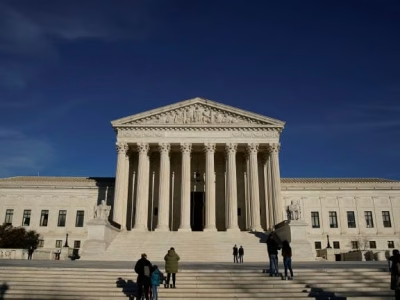
In the U.S., the response to climate litigation is often “who cares when this Supreme Court is ultimately going to knock it back anyway?” And the answer is simple: discovery. Discovery is a term that describes the fact-finding phase of civil litigation. During the discovery phase, lawyers can access primary documents, depose current and former…


EU vs. US Courts Face Off on Free Speech
A landmark anti-SLAPP case underway in the EU could result in a European court verdict declaring Energy Transfer’s suit against Greenpeace legal harassment even as the company seeks to collect a $666 settlement from the environmental nonprofit in the U.S.


Records Show U.S. Steel Giant Nucor Retained Ties to a Honduran Mine as Assassinations of Opponents Mounted
Advocates call for stronger due diligence from corporations, with a sixth opponent of the Inversiones Los Pinares mine killed.


In Canada, Another Call for Criminalizing Climate Protest
In a new report, the Frontier Centre for Public Policy calls on Canada to follow in the U.K.’s footsteps, falsely connecting climate protest to traffic-related deaths.

In Backlash to Campus Pro-Palestine Protests, Echoes of Standing Rock and the Global Crackdown on Climate Protest
The use of militarized police and “antiterrorism” laws against activists is not new in the U.S.


Ugandan Government Targets Youth, Students in Crackdown on EACOP Protests
Police violence and increased prison sentences are becoming more common as the Ugandan government attempts to suppress opposition to the East African Crude Oil Pipeline.

How the Backlash to Climate Protest Laid the Groundwork for What We’re Seeing in U.S. Cities Today
It’s easy to feel like climate “doesn’t matter” as the U.S. descends into fascism. It matters more than ever.

How the U.S. Got the World to View Environmentalists as “Terrorists”
The finale of our Real Free Speech Threat season.

Department of Homeland Security, the Manufactured “EcoTerrorist” Panic, and Cop City
The U.S. government’s ever-expanding definition of what constitutes an “ecoterrorist” continues to drive repression of protest

How Think Tanks Laid the Groundwork to Criminalize Protest
It’s no coincidence that the backlash against climate protest looks the same from country to country. Not only is industry sharing tactics across borders, but also a global network of more than 500 think tanks have been swapping strategies and rhetoric for decades.


Australia’s State-by-State Approach to Criminalizing Climate Protest
How a push to protect coal led to a nationwide crackdown on climate protest.


How Canada Uses ‘Redwashing’ To Crack Down On Indigenous Pipeline Protesters
In an attempt to neutralize pipeline protests from First Nations groups, Canadian industry organizations and think tanks have devised a strategy to court First Nations pipeline allies, a tactic known as “redwashing.”

Judge Grants Restraining Order Against Minnesota County Sheriff in Line 3 Fight
The judge granted a temporary restraining order prohibiting the Hubbard County Sheriff’s Office from blocking vehicular access to Namewag Camp, an Indigenous woman and two-spirit-led camp opposing Enbridge’s Line 3 pipeline.


Indigenous Water Protectors, Allies Protesting Line 3 First Ever To Be Cited under Obscure County Ordinance in Minnesota
Opponents to Enbridge’s Line 3 pipeline expansion project in Minnesota have filed a lawsuit against Hubbard County for blockading access to an Indigenous-led camp and convergence space.