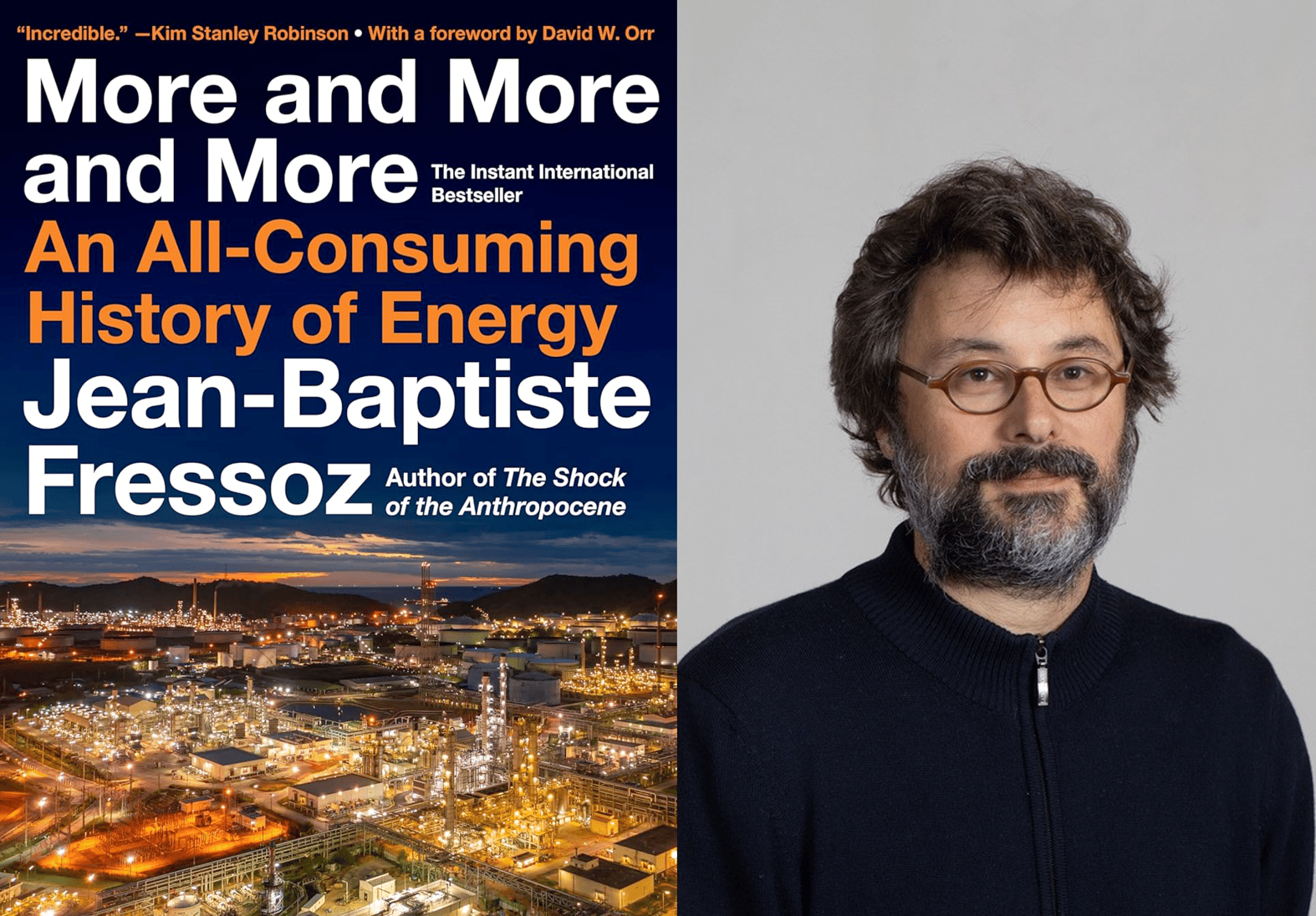
One of the rare pieces of good climate news in recent years has been the rapid expansion of renewable energy, especially solar and wind, around the world. Unfortunately, as Jean-Baptiste Fressoz, a historian of science and technology at Paris’s Centre National de la Recherche Scientifique, argues in More and More and More: An All-Consuming History of Energy, green innovation and decarbonization are not the same thing. It’s perfectly plausible—and, more importantly, accurate—for the consumption of oil, gas, coal, and even wood to continue to increase right alongside clean energy.
This, Fressoz shows, is the real story of humanity’s development and consumption of energy: We keep using more and more and more of all kinds of it. While the popular narrative is one of substitution—oil replacing coal, for instance—the reality is symbiosis. New energy sources do not supplant their predecessors but rather supplement them. If this sounds like a radical argument, it is only because the notion of energy “transition” has become so deeply entrenched.
In a conversation recorded in September, Fressoz and I discussed how the premise of energy transition became widely accepted as true and inevitable, even though it is wildly misleading; why clean-energy innovation is not the same thing as decarbonization; how the fossil fuel industry helped launder pipe dreams of nonexistent technologies like carbon capture and storage (CCS) into mainstream climate “solutions”; and much more (and more and more).
The written version of our conversation below has been condensed and edited significantly for clarity and accuracy.
Prefer to listen to the whole conversation? Check it out in today’s podcast episode. You can listen below, or wherever you get your podcasts:
The question I want to start with is why humanity is still burning so much wood. The story we’ve been told is that there was wood, then there was coal, then there was oil and natural gas, and now we’re in the midst of a transition to green energy. But that’s not the case. We are consuming more wood than ever.
The world consumption of wood right now is 4 billion cubic meters. About half is burned directly to produce heat. For a big part of the population, it is a major fuel. But wood has also increased in the rich world, which is probably more surprising. For instance, wood energy is very important for the paper industry, and the paper industry is a huge industrial consumer of energy—the fourth largest [in the world]. The first is steel, the second is cement, the third is chemical[s]. Right now, the wood energy consumed in the paper industry in Europe is more or less the same as solar electricity in Europe.
But in a more general way, I think it’s important to notice that once you got oil, wood [became] cheaper and cheaper. With oil you’ve got chainsaws, lumber trucks, all sorts of machines which make wood much cheaper, so you can burn more wood because you’ve got access to more wood. Another thing is, thanks to oil and gas and pesticides and fertilizer, you can produce much more wood on a certain area. For all these reasons, wood energy has increased in the 20th century.
One of the things that you show in this book is that different energy systems [and] materials are “symbiotic.” Can you describe what that means?
The history of energy has been obsessed with substitution, transition, competition. How oil “displaced” coal. Of course, when you’ve got diesel engines, you can get rid of old steam engines, which are particularly inefficient. But it is just one part of the story. In general, energies have a symbiotic relationship. They are intertwined.
To give you an example about oil and coal: In the 1930s, Ford would need seven tons of coal to build an automobile. It means that at that time, an automobile is just as much a coal technology as an oil technology. To use an automobile, you need roads, obviously, and to make roads, you need cement and steel. These two materials are also coal dependent. That’s why, despite the advance of oil, you burn more coal [as oil consumption grows]. There is no opposition at all.
And then to extract oil, you need a lot of steel tubes—a tremendous amount. The US, at the beginning of the 21st century, used more steel to extract oil than the whole US economy used in the early 1900s. So there is a symbiotic expansion of both coal and oil. Once you start to think [of] energy like this, the idea of energy transition starts to become stranger and stranger.
The first part of the book is an explanation of why coal, oil, wood, and all energies are completely intertwined and growing symbiotically. And the second part of the book is how this idea of energy “transition” became so natural, whereas it shouldn’t be. It’s a really weird notion.
Can you talk about the genesis of this narrative, which has become so entrenched that a lot of us [see] it as “the way things are”?
For a long period of time, nobody talked about energy transition, because what I just explained [about the symbiosis of different energy sources] was completely self-evident. They knew coal would be necessary to produce steel, for instance. In the 1950s, American conservationists were asking questions such as, Will there be coal in the 23rd or 24th century? We should economize coal because we will need coal for a very long period of time. They did not imagine [an] energy system shifting suddenly to another base. It was not something they had in mind.
And then there is a small group of scientists [and] experts who started to talk about energy transition. Most of them were US atomic scientists who had participated [in] the Manhattan Project. After Hiroshima and Nagasaki, they start to imagine what you could do with this tremendous invention. I think some of them felt guilty about the bombing of Japanese cities, and they wanted to explain that what they had done during the war was not just this terrible instrument of destruction but also key for the long-term survival of humanity. It was the only energy that you could project in a far, far away future.
There is an atomic scientist called Alvin Weinberg who was a participant [in] the Manhattan Project. He was the head of Oak Ridge National Laboratory after the war. In his biography, he said that “I became obsessed with the idea that the entire future of humanity depended on the breeder reactor.” It is [a concept of] a certain kind of nuclear reactor, which [theoretically] opens up unlimited energies for not decades or centuries, but for millennia. It [became] a kind of providential technology.
The person who coined “energy transition” is Harrison Brown, who is also an atomic scientist. When he invents this word he is recycling a technical term of nuclear physics to talk about the future of energy. This is the beginning of energy transition as a kind of expert knowledge. It comes from this small group of people.
What is problematic is that we recycle this idea of energy transition to reflect upon climate change. Because now we have to do the energy transition not in three or four centuries, but in three or four decades. It’s a completely different situation. But we recycle the same kind of energy futurology—I think a very wrong energy futurology—which has played a detrimental role in our understanding of the enormity of the challenge of solving climate change.
Can you describe what a futurology is, and how it applies to this discussion?
Perhaps forecast would be a better word. Futurology is a vision of the future, a theory about the future, what we can do in the future, what will happen. It’s this discussion geared at imagining what will be the shape of things to come. It’s the word they used at that time, and it was very fashionable in the 1950s, with the atomic age. Futurology becomes a scientific discipline in the 1960s.
One of the problems is that most of the forecasting was on the evolution of technologies, and it is from this discipline that our understanding of what we should do for climate change emerged. The problem is that [the] dynamics of technologies are not the same as [the] dynamics of materials and energies. Technologies do become obsolete sometimes. Landlines, for instance, are obsolete now. But materials are never obsolete. Despite all the innovations, all the new technologies that we got in the 20th and 21st century, all raw materials have increased. That’s why we burn so much wood.
You can ask the question for every material. It’s not just that oil, gas, and coal are expanding; it’s that every raw material is expanding. There are very few exceptions to this rule. One of them is asbestos, which was prohibited. It’s interesting to see that prohibition does work. If you want to do something about climate change, you have to prohibit extraction or consumption. You have to [make] a decision. You cannot rely on technological obsolescence of fossil fuels. It’s a losing strategy.
You cannot overestimate the enormity of what we have to do now. We have no historical analogy. We have never done an energy transition in the past. We don’t know how long it takes since we have never done [it]. I think it’s important for people to realize that this is extraordinarily ambitious. It’s not just the matter of putting [up] some solar panels and windmills. It’s much deeper than that.
How [did] the narrative of the energy transition [become] so persistent and so entrenched?
In the 1960s, there are just a small group of people talking about energy transition. They were promoters of nuclear energy, of [the] breeder reactor—a very specific kind of technology. But then there was the oil shock and the energy crisis. After 1973, the phrase “energy crisis” became omnipresent. It was on talk shows, [in] the New York Times. It was an obsession. Energy transition became natural as a solution for the energy crisis.
If there is one person to normalize this idea, it is President Jimmy Carter. [In] 1977, he gave a very important talk on television where he says, In the past the US has done two energy transitions—one from wood to coal, the second from coal to oil. And now we have to do a third energy transition. It was a very astute way to sell to the US public the increase of the coal industry. Carter is now remembered for having put some solar panels on the roof of the White House, but the main basis of his energy policy was coal: Oil is going to become more expensive. We have to dig more coal in the US.
[After] a low point about discourse around energy transition, it reemerged with climate change. The same experts who had worked on the energy crisis became the experts of the climate issue. That’s why we have recycled this wrong vision of energy dynamics from the 1970s: because they are the same economists. A few years later they would be fighting climate change, and they would just recycle the same kind of theories.
William Nordhaus is probably the most famous one. [He won the] Nobel Prize in economics for 2018. Energy transition, for him, was a delaying tactic. In 1973, he writes a paper on energy prices, explaining that oil is becoming more expensive. Should we conserve oil? Not at all. On the contrary, we have to extract oil right now, while it is expensive, because with the breeder reactor, oil might become obsolete at the end of the 20th century. Two years later he wrote the very first paper of climate economics and has the same reasoning. There is an issue about [the] greenhouse effect. Does it mean that we have to tighten our energy belt? Not at all. It would be so much easier to do the energy transition later when we’ll have the breeder reactor.
The concept of the breeder reactor becomes a placeholder for “future innovation that we haven’t come up with yet, but we will, and therefore we don’t need to change what we’re doing right now.”
Exactly. William Nordhaus is also the introducer of a famous phrase called “backstop technology.” Backstop technology [is] a non-defined technology. For a long time, it was [the] breeder reactor and hydrogen. Now it’s carbon capture and storage. When you read articles of climate economics, they still have this hypothesis: We assume there is a backstop technology that at $100 per ton of CO2 can capture CO2... or whatever. It’s a very abstract vision of technology, a deeply wrong vision of technological development. But it is still with us today.
Can you talk about how the notion of economic growth intersects with the transition narrative? You point out that the transition narrative in some ways enables the idea of perpetual future growth to go unchallenged, to be taken as conventional wisdom.
Most of the expertise on climate mitigation, it’s not so much about saving the climate, it’s about saving economic growth. It’s about imagining all the transformations—most of them are completely unrealistic—that would allow economic growth [and] business to continue just as before, without damaging the climate.
When you look at the history of the IPCC, and especially the third [working] group of the IPCC, which is really the one in charge of studying mitigation, you can see that for the US government that was really its role. They explicitly state, Our aim is not to save the climate; it is to save the economy from the consequences of climate—which is a different question.
[It is similar to] the emergence of corporate social responsibility [and] industry working to “solve” the climate crisis. They can say, We’re working on developing future technologies to save us—in the future. You distinguish it from climate denial because in a lot of ways climate denial was an old ideology that stopped serving them well decades ago. A much more effective and insidious one is accepting that there is a problem and saying, We’re working on it. That becomes a delay tactic that they can deploy pretty much indefinitely.
Look at the story of CCS. How come there is so much about carbon capture and storage in the IPCC Group III report? How come carbon neutrality depends so much [on] negative emissions?
With technologies that don’t even exist yet, right?
They exist in a very marginal way. They exist to extract more oil. The only place where you really capture CO2 is when you want to make what is called “enhanced oil recovery.” You inject CO2 in old oil wells to get more [out] of it. [That is] the only place where you do CCS on a significant scale—like 50 million tons per year. But the IPCC Group III net zero scenario expect[s] 10 gigatons of carbon capture and storage, not 50 million tons. Ten gigatons—10 billion tons. It’s a crazy number. It is completely meaningless, in a way.
For a long time, CCS was considered not very serious. If you want to do electricity from coal with CCS, for every two power plants, you need to build a third power plant just to produce the electricity to power the CCS unit. It’s a complete waste of energy, of money, of resources, so it was considered completely ridiculous even by the IPCC in the early 2000s. Then the oil industry pushed CCS from 1992 onward. In 2005 the IPCC published a special report on CCS that truly changed the status of the technology. From a very dubious technology, it became a central element for carbon neutrality. When you look at the report, most of the references come from the oil industry or fossil fuels in general.
Then it’s laundered through the IPCC or other institutions that we treat as objective research bodies. And then CCS comes out as The Plan for humanity to save the planet.
The modelers making these ridiculous scenarios, we can pity them because they are asked an impossible task. Find a scenario where we reach carbon neutrality without touching [the] economy. We’ll have the same kind of world, with the same kind of travels, agriculture, and so on, but without CO2. It’s an impossible task. Of course they introduce these ridiculous technologies.
They explained that they did that to push governments to be ambitious, to show that carbon neutrality was possible. In a way, the Paris Agreement of 2015 was made possible thanks to these scenarios, even if they are absurd. That’s one positive reading. The more negative reading would be that they introduce false hopes and a false sense of safety. It gives the impression that you [have] competent engineers that in the end will solve the problem. This is depoliticizing the issue. It’s infantilizing the population because we have been sold false promises.
I think a more adult conversation would be that there will be CO2 in the economy in 2050 because there are many sectors that we don’t know how to decarbonize, or not at scale. So the key democratic discussion that we need to have is, where do we put this CO2? Where do we “invest” it? What is the CO2 that is vital [and] necessary, and the CO2 that is about luxury consumption?
It is something we should be able to discuss without being treated as [a] dangerous “degrowther,” or whatever. It’s the only reasonable way to frame the issue.
There’s something you point out toward the end of the book. It was a real mental shift for me. You note that the rise of wind and solar power is treated as “equivalent to the disappearance of fossil fuels.” And I had always thought of it just like that—that salvation would come in the spread of solar panels and turbines around the world. But as you point out, green innovation and decarbonization are not the same thing at all. We misunderstand that at our peril.
The book is certainly not against renewable energy. The only good news, in a way, is the fact that solar panels are cheap and extensively used in the poor world to diminish the consumption of coal. We have to recognize that it is a necessary step, but it’s insufficient.
Renewables are interesting technologies to produce electricity, but electricity production is just 40 percent of emissions. To produce cement, steel, plastic, fertilizer, food—you don’t do that with solar panels. We can talk about a transition in the electricity sector but probably not in the rest of the economy. The whole economy is much bigger than the electricity sector. One possibility, and the most probable, is that in the next decades there will be more and more so-called green electricity that will power a world that will remain deeply entrenched in fossil fuels. Nobody has the solution. We need to discuss that in a very clear-minded way and a more political way.
At the end of the book, I say this [the idea of transition] is the ideology of capital in the 21st century. Thanks to [the idea of] energy transition, all big companies are on the “right” side because they can invest, innovate, and so on. It’s a powerful tool to depoliticize the issue. A big part of the climate discussion should be about redistribution of emissions—to whom, to do what? That should be a key aspect of the discussion, and it isn’t, even in the climate movement. It used to be framed as an equity issue. More and more the discourse has shifted toward technology, about “renewables are good, fossil fuels are bad,” something like that.
One of the points you make toward the end of the book is that we can’t look to history for what we have to do in the future. The [idea of] transition is soothing because from this false history, we have a false path forward toward solving this problem without any disruption to industry or anyone else.
Remember Jimmy Carter saying that we have done two transitions in the past, [and] we need to do a third transition? It’s absurd, of course, because at that time coal was very important. More recently, you’ve got John Kerry, [formerly] the US envoy for climate change, explaining that the energy transition is like a new industrial revolution, as if there was something from the industrial revolution analogous to what we have to do.
This is not the case at all. It’s what I want to emphasize: We have never done an energy transition.
The material history of humanity is the history of the symbiotic expansion of everything. That’s what we have done. Technologies improve and are becoming more efficient, obviously. For instance, the carbon intensity of the economy from the 1980s [to today] has been divided by two. There is technological progress. It’s not the issue. CO2 emissions keep rising. Believing that with solar panels and windmills we’re on the threshold of a complete material revolution, is an illusion.
I say that history is useless to understand what we have to do, but it is useful to understand the misunderstanding of what we have to do. Solar panels and windmills are just part of the history of technological progress. They’re not a massive shift in the material history of humanity. It’s even worse for electric cars. Of course they are better than petroleum cars, but they’re certainly not zero emissions. This is a lie.
Even at a national scale it’s very difficult to see countries really getting out of coal or gas or oil. Countries that don’t burn coal anymore [still] depend on coal because we import so many goods—we use steel and so on—that depend on coal. Energy transition is based on a false history. It projects a false history onto a very shadowy future.