At this point, everybody knows that it’s naive to think that fossil fuels won’t be around for decades to come. Even in the best-case scenario, it’s just too expensive and too politically fraught to move more quickly. Plus, we’ll still need oil and gas—and maybe even coal—to keep the lights on while countries around the world gradually decarbonize their economies. Everybody knows this, right?
Well, not everybody agrees with the Very Serious People in Western boardrooms and capitals whose smug, self-interested takes set the parameters of what is and is not possible. More than a decade ago—when wind and solar power were far more expensive than they are today—the nation of Uruguay, long plagued by droughts and energy shortages, transitioned its entire economy such that some 98 percent of its electricity now comes from renewable sources. And they did it in just two years. And they used the savings to slash the country’s poverty rate from 40 percent into the single digits.
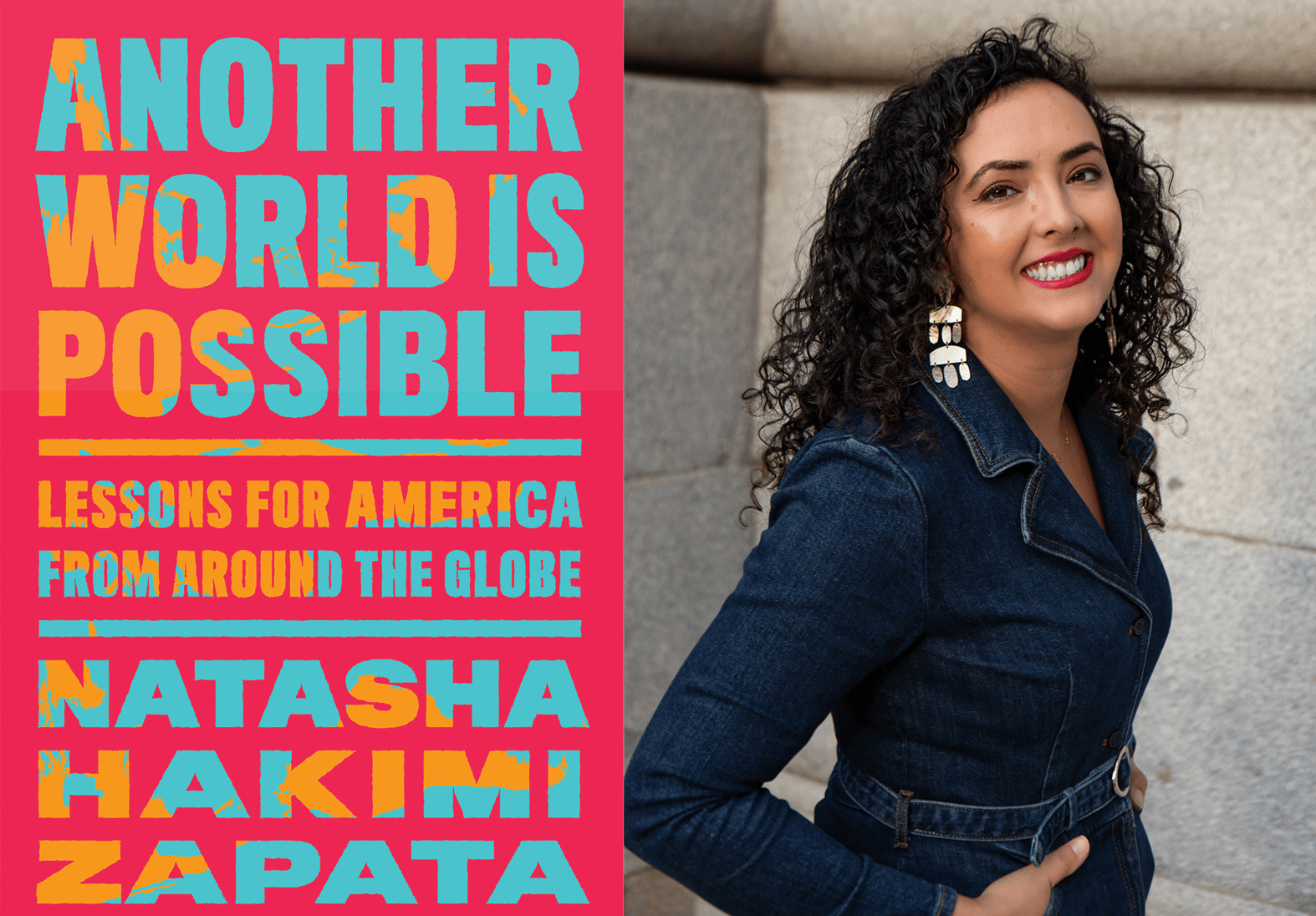
Uruguay’s conventional-wisdom-busting transformation is one of nine inspiring case studies in the journalist Natasha Hakimi Zapata’s Another World Is Possible: Lessons for America from Around the Globe. In August, Drilled spoke with Hakimi Zapata about what lessons climate advocates and policymakers around the world can learn from Uruguay’s remarkable transition, why the left should not shy away from articulating the economic case for clean energy, and how many of the progressive policies profiled in the book seem to emerge from moments of crisis.
The conversation below has been condensed and edited significantly for clarity and accuracy.
Want to listen to the whole conversation? Check out this week’s podcast episode:
In a lot of ways, your family’s story embodies the American dream. Yet you write, “There are plenty of other countries that offer their citizens not just a better future, but a better present.”
I’m the daughter of undocumented immigrants. My mom’s from Mexico. My father’s from Iran. I grew up in a household where this idea of the “American dream” was talked about quite a lot. I often refer to my brothers and me as these little American dreams that my parents had. I was the first in my family to get a college degree, so in some ways, that American dream did come true.
But in other ways, it started to feel like that American dream that my parents had was actually more possible in [other] countries. A lot of that understanding came from a health incident with my mom. When I was in grad school, my mom, who hadn’t had access to healthcare, hadn’t had health insurance for many years, had undiagnosed, untreated diabetes that was diagnosed when she was being rushed to the emergency room, nearly in a diabetic coma, and had to have her right foot amputated.
At the time, I was flooded with this concern that, unfortunately, many of us have felt. How was she going to survive? What was her life going to be like moving forward? But at the same time, I had this added dread of, how were we going to afford the insulin she was going to need to stay alive? How were we going to afford all of the treatments she needed?
I knew, because I had lived in countries like the UK, that it didn’t have to be like this, that we could have universal health care, and that we’re one of very few wealthy countries in the world to not have a system like that.
Can you tell the story of Uruguay and their remarkable energy transition?
This book has what I would call “crib to crypt” policies: everything from universal health care to paid parental leave to universal pensions. But I couldn’t really conceive of a book that talked about progressive policies like paid parental leave that didn’t also talk about climate change or biodiversity loss. If there is no planet to have children on, what is the use of paid parental leave?
Uruguay was a fascinating example of how a lower-income country could do the unthinkable and actually green their grid in less than two years. And that story, like a lot of the stories in the book, starts with a crisis. Uruguay doesn’t have any naturally occurring fossil fuels—still hasn’t found any, despite searching for them. Because they have a publicly owned utility that’s been around since the early 1900s called UTE, the government was essentially in charge of keeping the lights on. It depended on hydroelectric dams for more than half of its electricity needs, and the rest came from imported fossil fuels, usually from neighboring Argentina and Brazil.
Whenever there were severe droughts—and they became more frequent and more severe over the years because of the climate crisis—they really struggled to keep the lights on. They had rolling blackouts and power cuts. It was incredibly disruptive to everyday life. I went to a textile factory where the owner told me, “Whenever there was a blackout, we would just have to stop working. There was nothing we could do.”
There was a real recognition in the early 2000s that this was a crisis that was affecting everyone and everything, and something had to be done to address it. In 2005 you have the first Frente Amplio left-wing coalition party winning an election. The Frente Amplio negotiates a cross-party agreement with all political parties in Uruguay: yes, continuing to look for fossil fuels, because they think this is important, but actually exploring renewable energy on a mass scale. This starts a record-breaking transition.
The public utility, UTE, was until then in charge of everything from generation to distribution to transmission of electricity. They opened up generation to private companies because they didn’t have the funds to do it all themselves. They put out calls for private companies to come and set up wind farms and solar farms and also biomass throughout the country.
It’s been so successful that you now have a country that runs almost entirely on renewable energy—something between 97 to 98 percent, [even as] energy consumption actually increased. Because the country went from being low-income to middle-income, people were doing things like buying air conditioning units for the first time and a lot of other [products] that increased the demand for electricity.
Despite this, rather than spending hundreds of millions of dollars every time they had a dry year or a drought lasted longer than they expected, they [are] saving those millions and also selling their excess green energy to Argentina and Brazil.
One of the patterns that seems to play out across the stories throughout this book [is that] things had to get really bad before these changes could build the coalition or the public support to move forward. I found it encouraging that so many of these good policies emerged from a moment of crisis.
That was one of the most hopeful things that came out of the book for me. I started to realize there was this pattern of dark periods yielding long lasting solutions.
The National Health Service, the first universal healthcare system in the world, came out of the literal ashes of World War II as Britain was trying to chart a different path forward after the devastation. You look at Uruguay—rolling blackouts, this inability to keep the lights on in the most literal sense—and that crisis leading to a consensus across the political spectrum that something quite different needed to be done. I looked at Portugal, dealing with a dual epidemic of overdose deaths and opioid use and rising HIV/AIDS rates, creating this consensus that something that hadn’t been tried before needed to be tried because whatever they were doing just wasn’t working.
I think about that a lot in the U.S. It’s not like all of our problems started with this second Trump administration or even the first. There have been a lot of people who have been suffering for a very long time under our current systems. I would argue that Trump is very much a symptom of this broad discontent that we’re seeing. A lot of people feel that they can’t survive in the country as it is.
Do you think Uruguay’s transition could have happened the way it did if they did have more of an entrenched fossil fuel industry?
I think it would have been a lot harder. You have the example of Argentina right next door, [which] has a lot of oil reserves and has not been as interested in a full green transition. That’s the case in a lot of countries. You’re right that it was sort of luck [that Uruguay did not have fossil fuels], but in many ways it had been a curse throughout the past century. Not having fossil fuels really held Uruguay back.
Something Ramón Méndez, a physicist who helped lead the transition from the department of energy within the Frente Amplio government, said to me is really important. We’re going to get to a point in which, he thinks, there are economies that have transitioned and there are economies that haven’t. Those that have not transitioned are going to suffer economic consequences. There was a 2022 Oxford University study that said the world could save $12 trillion by 2050 if we ditched fossil fuels. There are very clear financial incentives to transition to clean energy.
The other side of things is that we can’t afford not to. We’re facing an existential question here when it comes to the climate crisis. What kind of planet is going to be left in the coming years to fight over these profits for?
One of the things I thought was interesting about Uruguay’s [transition] was that climate change was not the focus of this effort. It was economic. On the left, we talk about climate in the way that you and I have been—for good reason, because it is an existential threat to all of humanity and the planet.
But in some ways we don’t want to make the economic argument because it feels like conceding the terms of the debate to a more neoliberal perspective. Can you talk about the way that this was framed to the people of Uruguay as an economic issue rather than a climate change issue?
I went through so many interviews with everyone from policymakers to electrical engineers to people running the wind farms to people on the streets. Very few times, if any, would they mention climate change unless I brought it up. It wasn’t the driving force behind this green energy transition, which feels counterintuitive to those of us on the left in the U.S., who see this primarily as a question of fighting this existential threat.
But Uruguay did something really fascinating. First of all, in a very real, material way, everyone could feel this crisis. Then it was framed as something that would bring a ton of investment into a relatively small, low-income country. [Uruguay’s] calls for renewable energy projects for wind and solar farms before 2008 essentially went unanswered. The main wind turbine manufacturers were too busy with larger economies to really care what Uruguay wanted to do.
The 2008 financial crisis created an opportunity for Uruguay. [Renewable projects in] a lot of larger, wealthier countries like Germany and Spain, and I’m sure in the U.S. as well, were put on hold because of this banking crisis. Those same manufacturers called the government: “Hey, do you still need these?” So it was this question of the financial conditions for something like this to happen.
Then there was the question of electricity prices, which are still relatively high for the region, despite the fact that there have been these massive savings by transitioning to renewable energy. The government made a decision that was very controversial, which was to take those savings and fund anti-poverty measures. In many ways, this really paid off because even though people weren’t necessarily feeling the economic benefits of a green transition in their electricity bills, they did feel it in a lot of other ways. Under Frente Amplio, from 2005 to 2019 poverty was reduced from 40 percent to under 9 percent. This wasn’t just clean energy, but being able to stabilize your energy supply had a huge impact on how the country was run.
I understand the reluctance on the left to talk about green policies as purely economic policies. And yet, if we do not make this argument and we cede that space, we are missing a huge opportunity to point out that people will benefit economically from a green transition.
A couple of the folks you interviewed described the energy transition as a tool for social justice [and] wealth redistribution. It reminded me of some of the foundational principles of the Green New Deal: This is not just a climate thing, not just an energy thing. This is reshaping society.
And it’s something that on the left we could talk a lot more about. Obviously, sacrifices are going to have to be made on some level for some of these policies to be implemented. But this is actually a place where we can highlight how much better lives are going to be, down to the air we’re going to breathe. Rather than having a fossil-fuel generator in your neighborhood, you’re going to have a solar farm, which doesn’t have that impact on air pollution and air quality, which has all of these knock-on effects in society. I don’t see the downside in talking about this.
One of the lessons that you outline at the end of the book is the importance of public ownership. In the context of the energy transition, there’s two different aspects to nationalization. There is, what do you do with these legacy industries—how do you get them to change if they will not do so willingly? And then, what do you replace them with?
I’m a big believer in public ownership. I have seen how it allows critical infrastructure to be built for everyone, and not just for those who can pay for it. Public ownership is the only way that we can ensure that that’s the case. I looked at universal public schools in Finland; universal healthcare in the UK; Uruguay’s grid, which is publicly owned; and a number of other places.
All of these stories highlight how important it is for these things to belong to us, for people to feel like they have ownership. The reality is that corporations, private companies, answer to their shareholders, if that. Whereas in a democracy—which we still live in—the government and these publicly owned utilities, for example, have to answer to citizens.
In Uruguay, what I found really interesting was [what] someone said to me: that energy distribution can be redistributive. It can be a matter of social justice. I don’t see how you would do that if you hand over everything to the private sector because they’re interested in profit. You had people like Ramón Méndez ensuring that all of the contracts that were set up with private wind farms and solar farms made it so that, as he describes it, electricity remained a de facto public good. Those private generators could only sell that electricity back to the public utility and use some of it themselves.
Gonzalo Casaravilla, who was the head of the public utility, told me that you—as a country, as a community—need to come together to decide what’s best for your local needs. He talked about how different that energy transition might have been if you had a bunch of multinational companies coming in and saying, “Well, we’ll profit more from putting a wind farm here.” [In Uruguay,] they were able to decide all of these things with the public interests at heart, rather than with profit.
Let’s talk about Costa Rica. The chapter about Costa Rica’s biodiversity law reminded me a lot of the U.S. policymaking process. Whereas Uruguay’s came out of a moment of crisis and was a radical transformation in just a couple of years, the way you described Costa Rica’s process was much more convoluted—much longer; more entrenched interests saying, “We like things the way they are”; prior supporters getting cold feet and changing their minds.
Many people within Costa Rica started to recognize this devastating crisis that was taking shape in the 1980s, 1990s, in which there was severe deforestation of their rainforest for things like banana plantations or other for-profit endeavors, often run by multinational or American-owned companies.
Costa Rica is this incredible place, one of the most biodiverse places on earth. Because it’s in Central America, it’s this corridor between different flora and fauna that come together. There was a sense that these natural resources were the riches that Costa Rica had. It wasn’t a wealthy country, but this was their wealth—the natural environment that they lived in—and it was being decimated right before their eyes.
The story goes back to the Rio Convention on Biodiversity [in 1992]. There is a biologist, an environmental lawyer, and a local policymaker that start to pay attention to what the CBD [Convention on Biological Diversity] is saying about the equitable distribution of the benefits of biodiversity and how key this is to sustainability—to not just maintaining the biodiversity that’s left around the world but also reversing some of that damage that they’ve been seeing in their own backyard.
The three of them came together to write a version of the CBD that took into consideration Costa Rica’s own political and cultural and environmental context and came up with a biodiversity law. They were essentially trying to codify those guarantees that the benefits of the biodiversity in Costa Rica belonged to Costa Ricans and needed to be safeguarded for future generations, which is actually quite a radical thing. To say that the natural resources of a nation belong to the people of that nation is something that can upset a lot of entrenched interests.
And to do so in a way that’s not describing them in an extractive [sense] of, “These are our resources to be used and burned and consumed.”
Right. So these three people—Vivienne Solís, Patricia Madrigal, and Luis Martínez—coming together and writing this great biodiversity law and then trying to pass it starts a more than 10-year battle within the Costa Rican government. There was initially support within Luis Martínez’s political party. Then it was retracted. Once the biodiversity law did pass in 1998, an environmental vice minister that felt that it entrenched on her rights as a vice minister kind of put it on pause. It became this very long battle in which the biodiversity law slowly gained more and more support amongst different groups within Costa Rican society.
Importantly, those three people and many others—environmentalists, activists, academics—saw the importance of the biodiversity law and went around spreading the lessons. They had these great picture books that explained what the law was. They held workshops with local communities across the country to talk about the law and get more input into it. I think this is one of the keys to the law: It tries to create mechanisms that ensure that locals in every community and in the broader Costa Rican community have a say in how their biodiversity is managed.
This translates into a couple of things. One is the Sinac [Sistema Nacional de Áreas de Conservación], which is the national park service. Within Sinac, thanks to the biodiversity law, you have regional, local, and national councils that are made up by different communities and groups that all get a say in how national parks and public lands are being managed. Those groups include tribal leaders. And then you have the Conagebio, which is an agency that’s dedicated solely to ensuring that the benefits of biodiversity are equitably distributed.
In many ways, the Costa Rican biodiversity law is sort of an unfinished success story. The key parts are essential for us to learn from, especially this idea that you can’t just cordon off large swaths of the natural environment and then tell people, “This is for the tourists to enjoy, and you who were doing subsistence farming now have to figure something else out.” It at least created legal mechanisms in which communities could protest and find ways to be more involved in the decisions that were being made about their natural environment.
Have these participatory measures worked? Do people feel bought in?
There has been, over the past few decades, a real sense of ownership over these natural riches that has spread throughout Costa Rica. A lot of it has been down to the biodiversity law and efforts that were made to inform [and] bring communities into decision-making processes around the country.
On the Caribbean coast in Cahuita, a local community decided to come together and occupy the local national park in order to retain rights over the decision-making in that park. To this day—and it’s one of the first national parks in the world to do this—they have set up a co-stewardship model. That means that you have people who live and breathe Cahuita making decisions, taking care of the national park, protecting biodiversity not just within the national park but within the community itself and ensuring that the benefits are felt by the whole community.
I wanted to ask you about something that Amy Westervelt has written about recently. It could be interpreted in a pessimistic way; I found it somewhat hopeful or encouraging, a silver lining of some kind. She wrote [that] one potential consequence of the second Trump regime is that on a lot of policy areas, including climate change, the rest of the world might just move on without the United States.
That is obviously a huge, missed opportunity. We can’t fully tackle the climate crisis without the United States. But there are some areas, including climate, where maybe it’s just better if everyone else gets on without us. Not everyone is addicted to market worship the same way that the United States is. [Other countries] are moving on in ways that are different from what we’re doing.
Maybe one consequence of the moment we’re living in right now is that the world becomes a little bit less America-centric, and that might not be a bad thing.
The subtitle of the book is “Lessons for America from Around the Globe.” It could be lessons for anywhere. I’ve done some talks in the UK and in Portugal, and I’ve been asked, “What’s applicable here?” I think almost everything is.
To this idea that it’s maybe not such a bad thing for other countries not to look to the U.S. for leadership, or for the U.S. not to be imposing American interests on other countries, I do agree that that’s a positive thing. Maybe we’ll see that all along there have been really important lessons in other places that, because of American exceptionalism, we have not been paying attention to.
I have friends who work in politics in the States, and they often tell me that if they bring up something that’s happening in Portugal or in Norway, there’s always this immediately dismissive, “Well, that’s there, and this is here.” This is obviously something I hear a lot, too. I try to reframe that and say, “How is it that scrappy Uruguay can learn the importance of a just green transition, and we, the wealthiest country in the history of the planet, seemingly can’t, with all of these immense resources?”
Like you, I find that hopeful. I’m the daughter of immigrants, and I grew up with multiple histories. The American narrative of the world wasn’t the only one that I had under my belt when I was thinking about the world.
Obviously, it feels terrible right now with how much devastation the Trump administration is wreaking on immigrant communities with these ICE raids, and how his administration is slashing funding that had already been allocated for things like solar panels for low- and middle-income families, [and] how they’re trying to open up public lands, including near national parks, to more drilling and oil exploration.
This is all terrifying. And as you said, there really isn’t a significant way out of the climate crisis without the U.S. completely changing its energy makeup. But I’m also hopeful that at the end of this administration, we will get another chance to rebuild, and that this time, more and more people will become aware of what was already broken, what needs to be fixed, and what kinds of solutions work for more people.