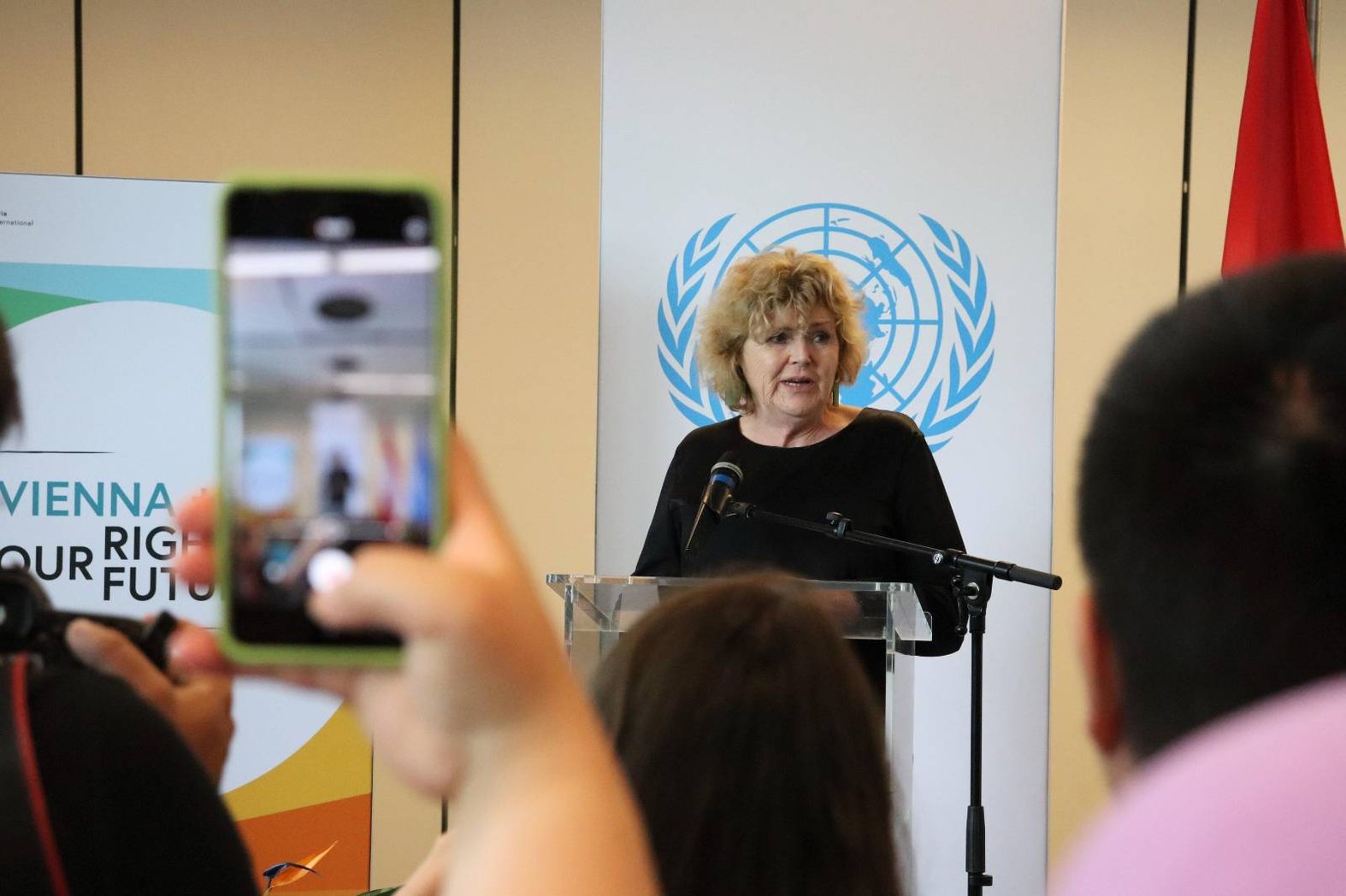
The grassroots struggle for human rights and climate justice will continue despite the crackdown against activists by governments and corporations across much of the world, according to Mary Lawlor, the outgoing UN special rapporteur on human rights defenders.
Lawlor, an Irish human rights advocate, leaves the mandate after six years having witnessed a slew of European governments target Palestinian rights supporters, climate activists and those defending the rights of migrants, refugees and asylum seekers by criminalizing the right to peaceful protest and basic humanitarian work. Europe’s backslide also includes far-right elected leaders in at least 10 countries including Slovakia, Hungary, Italy, Turkey and Bulgaria targeting LGBTQ rights and defenders in an effort to sow division.
“All over Europe we see a pivot to securitization and putting money into weapons and armaments and divestment from human rights work, which they're entitled to do given the volatile geopolitical situation with Putin on one hand, Trump and Israel on the other hand. But what I didn't expect to find is a crackdown on freedom of association in country after country… in France, the UK, Germany, Greece, Turkey, Hungary, a bit in Ireland, and even Sweden, which really shocked me because it used to be a bastion of human rights and disarmament,” Lawlor told Drilled.
UN special rapporteurs are independent experts who carry out country visits, advocate on individual cases, and report on human rights situations across a range of themes including the climate crisis, food systems, housing, water, torture, and freedom of expression. But the scope and capacity of their work is likely to be limited going forward after the Trump administration slashed funding to the UN.
Lawlor, the former director of Amnesty International's Irish branch and founder of Frontline Defenders, was appointed as special rapporteur after more than four decades working with human rights defenders.
Lawlor’s first major report to the UN General Assembly was in 2020 on Greece, where lawyers, journalists, and search and rescue workers helping refugees and asylum seekers were being charged with crimes such as aiding and abetting people smuggling. “I was really shocked by the criminalization that was occurring. One journalist had charges brought against him for giving a cup of water to somebody at a landing site.”
Lawlor describes the treatment of refugees, migrants and asylum seekers globally as “one of the horrors of our time,” and the dire situation in Greece prompted a global focus on the plight of those defending their rights leading to the Refusing to turn away report.
Grassroots activists and campaigners have historically led the charge in advancing basic human rights in every sphere of life and injustice, but advances have always been slow and non linear, according to Lawlor, 74.
“Obviously, there's not a lot of space currently for civil society activism in some countries, but it's always been the way. When I started in the 70s, you had the military dictatorships in Latin America, the Soviet Union drugging dissidents with psychiatric medication, and then Idi Amin in Uganda; Bosnia, the Rwanda genocide, Congo. There was a brief period when the wall came down and the Soviet Union dismantled where it looked like the trajectory of human rights was on the right incline, but it's never linear… and somehow the world always muddles through.”
The current global crackdown on human rights defenders is happening amid a surge in extreme-right governments and conflicts not seen since the post-World War II era. Even before the current US-Israel illegal wars across the Middle East, 2024/25 marked a grim new record with the highest number of state-based wars in over seven decades including major conflicts in Ukraine, Palestine, Myanmar, Congo, Yemen and Sudan.
This backslide is taking place under democratic and autocratic governments across the global north and south, with states clearly learning from each other, according to Lawlor.
El Salvador, a tiny country in Central America with a democratically elected autocrat, is the latest to pass a nefarious foreign agent law, a repressive legal tool deployed by authoritarian regimes in Russia, India, Georgia, the United States, Nicaragua, and Hungary to silence critical voices and force human rights defenders including journalists to self censor, go into exile or face prison.
Israel meanwhile, has demonstrated utter disregard for all international law and norms, leading Lawlor to advocate for Palestinian paramedics, doctors and journalists systematically targeted for assassination, as well as Palestinian rights defenders in Israel, the US, and across Europe who have been criminalized.
“In Gaza, medics, ambulance drivers and journalists were targeted while working in accordance with the Universal Declaration of Human Rights, the right to life, the right to health, all of that kind of stuff,” said Lawlor. Deliberately targeting health workers is a war crime under international humanitarian law, specifically the Geneva Conventions.
Globally, human rights defenders often face the brunt of repression during democratic backslides, and while the climate crisis, artificial intelligence and social media present new and unique challenges, this will not stop them, according to Lawlor.
“You will always have human rights defenders, people who see injustice and want to do something about it. There are many more good people in the world than bad people, and more people working in some capacity for human rights now than there have ever been before and that'll continue.”
Lawlor’s final mission takes her to the Pacific islands which are facing an existential threat from the climate crisis as well as high levels of intrafamilial gender violence. She will be replaced in May by Andrea Bolaños Vargas of Colombia, the first Latin American expert appointed to this role by the UN Human Rights Council
Reflecting on her tenure, Lawlor said: “As special rapporteurs, we can’t solve the global geopolitical situation but we can support the struggles of human rights defenders by using the mandate to bring their voices and concerns to the international community, giving them visibility, credibility, legitimacy, and solidarity.”
“Human rights defenders are in my blood. They are the people I admire most, and to this day, I still think that they are the ones who will build civil and just societies in their countries. You can't impose this from outside. There has to be people on the ground who are continuously advocating for human rights, social justice and the rule of law, and exposing injustices. But it is hard work, and I would love to see human rights education in primary schools because everybody has a part to play.”