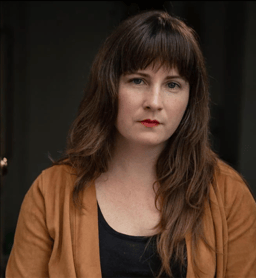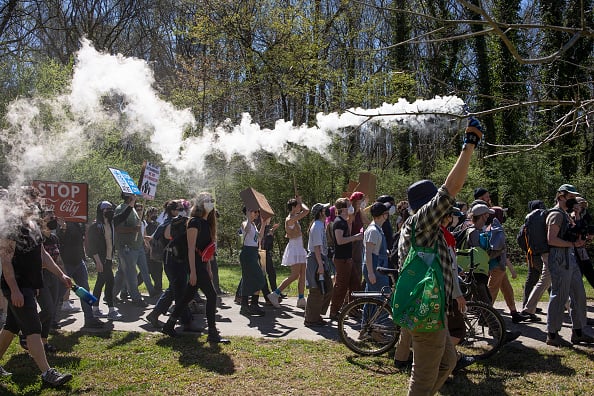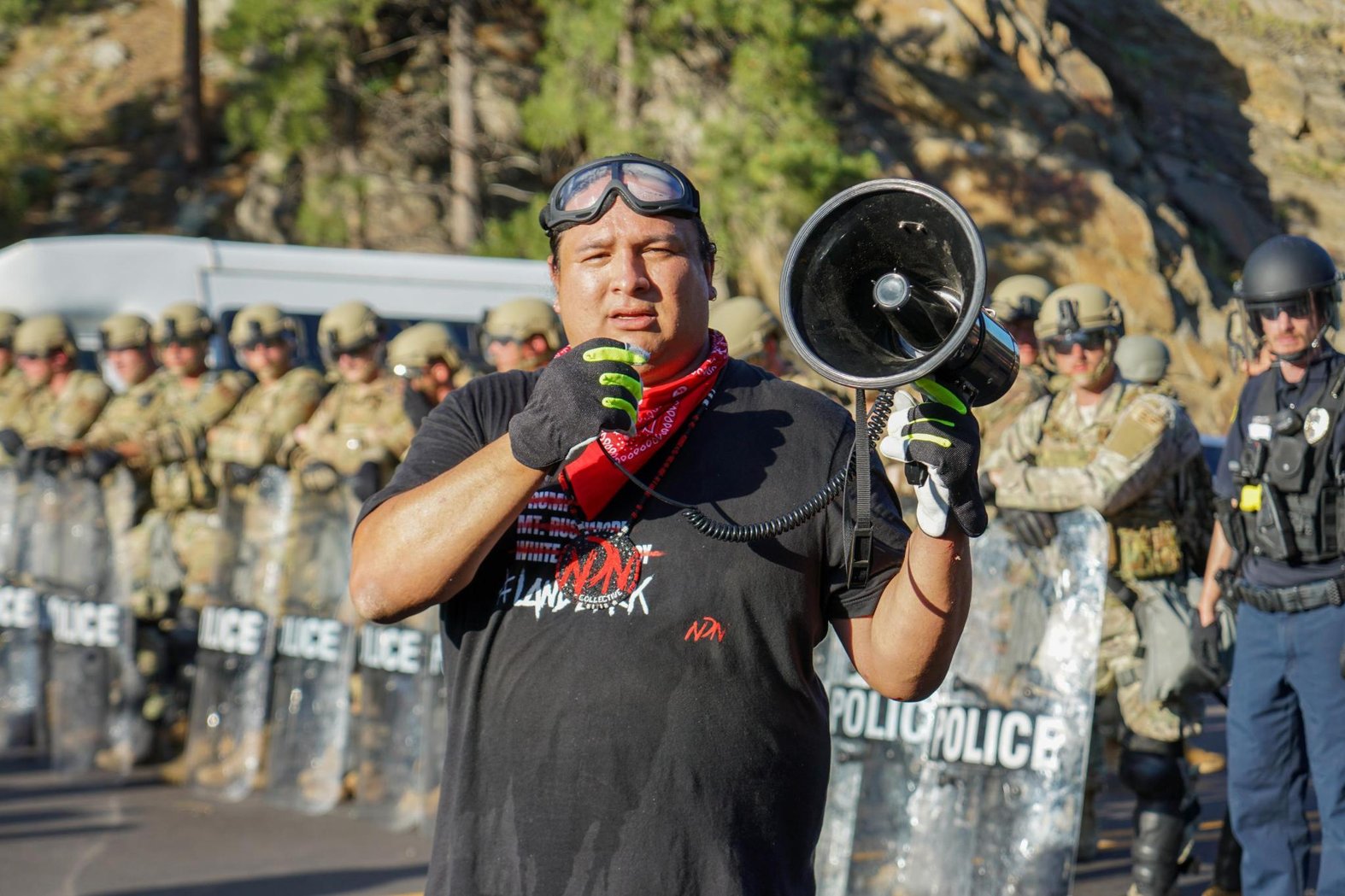
Photo: Nick Tilsen stands before a police line during a protest against Donald Trump’s visit to Mount Rushmore in July 2020. Credit: Arlo Iron Cloud.
The surveillance footage begins with a police car stopped behind other vehicles at a traffic light. A man begins to cross, then the cars move through the intersection, toward him. As the man reaches the other corner, blue and red lights spiral. The police car turns right, then Officer Nicholas Glass exits his vehicle, and walks to the end of a parking spot, to question the pedestrian.
It was June 11, 2022, in Rapid City, South Dakota, and what happened next would alter the life of one of the best-known Indigenous activists in the United States over the next three-and-a-half years.
Glass’s body camera footage, which captures a different angle, shows that the man is Indigenous and wearing an American flag t-shirt. His first name is Mario (Drilled is leaving out his last name to protect his privacy), and he appears to be inebriated.
“The reason I’m stopping you is you were jaywalking, and it forced some cars to slow down,” the officer says. “You gotta wait till there’s walk signal.”
“Everybody does it,” Mario replies. “Why you fucking jacking me up?”
“I just don’t want to see you get hit by a car,” the officer answers.
As they talk, the security camera captures a red truck easing into the parking spot, before pausing.
“Look out — you’re gonna get hit by a truck,” Mario says.
The officer glances back. “I’m not moving,” he says. The car accelerates a few more inches into the spot, toward Glass, before stopping again.
Glass approaches the driver and recognizes him immediately. “I’ve got Nick Tilsen here,” he says into his radio. He soon adds, “Nick Tilsen just tried to hit me with his car.”
The video footage, obtained via a public records request, captures the beginning of a yearslong legal saga for Tilsen, a citizen of the Oglala Lakota Nation and founder and CEO of the nonprofit NDN Collective. The organization provides grants and loans to Indigenous groups, nations, and individuals from North America and organizes campaigns to protect Indigenous rights and the environment. One of their main campaigns targets systemic racism in Rapid City, including a demand for a U.S. Department of Justice investigation into the Rapid City Police Department. Tilsen was deeply involved in the Standing Rock protests against the Dakota Access Pipeline in 2016 and 2017; he was called as a witness last year in the pipeline company’s lawsuit against the environmental nonprofit Greenpeace.
Tilsen denied he attempted to hit the officer. Rather, he said he was there to observe Glass's interaction with Mario. “I’m just pulling into a parking spot,” Tilsen says in the body camera footage. “I’m just making sure you ain’t fuckin harassing people, man.”
Ultimately, Tilsen was released that evening. A warrant for his arrest wasn’t issued until over a year later, on a conspicuous date. Tilsen was charged with two felonies, including aggravated assault on a police officer, four days before a protest his organization had planned against racism within the Rapid City Police Department.
“It was a political prosecution,” Tilsen told Drilled. “If it wasn't me, if it wasn't NDN, if I wasn't an activist, the reality is those charges would have never have been brought.”
In an email, Rapid City Police Department spokesperson Brendyn Medina said the charges were justified. “Any suggestion that the investigation or charging decision was based on protected speech or planned demonstrations is inaccurate,” he wrote.
He continued, “The Rapid City Police Department recognizes that our community faces significant challenges, including disparities related to poverty, victimization, addiction, and historical trauma. We also recognize concerns regarding disproportionate contact with the criminal justice system,” Medina added that Glass had been trying to keep Mario safe. “The department does not tolerate discrimination, and allegations of misconduct or bias are taken seriously and reviewed appropriately.”
Around the world, the criminalization of Indigenous and environmental defenders isn’t always as straightforward as an activist being handcuffed at a protest. Sandra Patargo, who works for the organization Front Line Defenders as protection coordinator for the Americas, said the case reminded her of another in El Salvador. Just as the government moved to lift the country’s historic mining ban, several of the anti-mining activists who had helped bring it about were charged for a decades-old unsolved crime related to the civil war. (Listen to Drilled’s podcast episode on the case.)
In January, Tilsen’s case went to trial. It was the same month that Renee Good was shot and killed behind the wheel of her car by an Immigration and Customs Enforcement agent in Minneapolis, as she attempted to monitor agents’ activities during President Donald Trump’s immigration crackdown. The Department of Homeland Security secretary at the time, former South Dakota governor Kristi Noem, claimed Good attempted to run over the agent, which, she added, appeared to be an act of domestic terrorism.
Tilsen’s trial ended with a hung jury. Rather than attempt a retrial, prosecutors dropped the charges in mid-March.
Asked for comment, a spokesperson for the prosecutor’s office provided a press release, quoting Pennington County State’s Attorney Lara Roetzel. “Our office prosecuted this case based on the evidence and the law, and we remain confident that the charges were appropriate to bring,” she said. The statement added that the state determined a retrial would not be the most effective use of resources.
South Dakota law is notoriously effective at protecting law enforcement from having to turn over body- or dash-camera footage. The video footage was only made available after trial, because it had been entered as evidence in court.
“The videos don't show a damn thing,” Tilsen said. “And if those videos were released to the media in the period of time in which they were trying to make their decision, then they would look like the fools that they are.”
A Familiar Face to Police
To understand what happened to Tilsen, you have to look back several decades. His story began back in the 1970s, when the American Indian Movement was fighting for Indigenous people’s treaty rights. Tilsen’s parents met during AIM’s occupation of Wounded Knee, South Dakota, in 1973. His grandfather was one of AIM’s defense attorneys, his Lakota mother a participant in the occupation. One of his most formative memories is getting tear-gassed as a kid at a protest with his parents.
In 2007, Tilsen co-founded the Thunder Valley Community Development Corporation, which now operates a housing development, a 39,000 acre buffalo range, Lakota language classrooms, youth camps, and a workforce development program. He also helped found the Indigenous Peoples Power Project, which provided trainings on how to protest nonviolently during the movement to stop the Dakota Access Pipeline at Standing Rock. A year after those protests ended, Tilsen launched NDN Collective.
In short, officials in Rapid City have known Nick Tilsen’s name and face for a long time.
On the weekend of July 4th, 2020, Tilsen and others blocked a road leading to Mount Rushmore, in an attempt to disrupt a visit by Trump to the monument. Mount Rushmore is located in the Black Hills, a region sacred to a number of Indigenous nations. Tilsen was left with four felony charges amounting to a potential sentence of nearly 17 years in prison. The charges hadn’t yet been dismissed two years later, when he pulled into the parking spot.
NDN Collective sometimes conducts formal community patrols, where they intentionally look for police actions to monitor. It’s a practice that goes back to the American Indian Movement’s early days, when they were patrolling the streets of Minneapolis for police violence. However, in this case, “I had dropped off my son after his birthday, and I was going home,” Tilsen recalled. “I just happened to look over and notice a cop that was coming up on an unhoused relative.”
Body camera footage from another officer on the scene shows several officers arriving. One demands Tilsen step out of his truck, but he refuses. “I’m not stepping out of the vehicle,” he says.
Tilsen told Drilled he was afraid for his safety. He texted people in the community, asking for support, and a couple showed up and started filming.
The officer told Tilsen, “Right now I’m talking to my lieutenant to see if he wants to do an arrest for simple assault for almost hitting him with your car, and that’s why you’re being detained.” Shortly afterward, he allowed Tilsen to leave. The whole exchange lasted less than 20 minutes.
A spokesperson for the Rapid City Police Department told Drilled the office filed a warrant request several days later, after reviewing additional video footage from a business in the area. “The Rapid City Police Department does not control court scheduling, prosecutorial timelines, or when formal charges are filed with the court system,” said spokesperson Medina, over email.
It was up to the state prosecutor to take action, or not. For months, nothing happened.
Felony Charges on the Eve of a Protest
A year later, NDN Collective was preparing for another 4th of July protest. They planned to march to the police station to draw attention to police killings of Indigenous community members. One of their demands was for a release of all body camera footage within seven days of any instance of police violence.
Local officials responded aggressively. The holiday fell on a Tuesday, and the Thursday before, Rapid City’s mayor at the time, Steve Allender, held a press conference asserting that the protest was a public safety threat.
“This is something that can’t be played off as trivial,” he said. “July 4 comes on a time that is extremely busy for public safety, so public safety resources will be depleted.”
“We’re expecting this is going to be a very expensive demonstration for the taxpayers,” he added.
The next day, Pennington County Deputy State’s Attorney Olivia Siglin signed a warrant for Tilsen’s arrest. He was charged with obstructing a public officer, as well as aggravated assault on a law enforcement officer for using a deadly weapon — his truck — to menace the officer and make him scared for his life.
Legal filings provided complicated reasons for the timing of his charges. The case was briefly transferred to another county, because of a conflict of interest, then was transferred back. Then, during a coffee meeting in May or June of 2023, Rapid City Police Chief Don Hedrick asked Pennington County State’s Attorney Lara Roetzel what happened to the charges. Roetzel then reached out to Officer Glass to see if he wanted to proceed with the case. The filing says he graduated from Air Force Basic Training and became available to testify after June 30, 2023, the same date as the warrant.
“It is not uncommon for police leadership and prosecutors to discuss significant or high-profile cases,” said Medina, of the Rapid City Police Department.
The Pennington County Sheriff later acknowledged that the protest on Independence Day proceeded peacefully.
For the next two-and-a-half years, Tilsen had to check in with a judge every time he left the county. It was particularly complicated, since his ranch is located on Pine Ridge reservation, across county lines.
On the eve of Tilsen’s trial last January, Siglin added a simple assault charge, which alleged Tilsen had attempted to make the officer fear for his life “with or without the actual ability to harm” him.
To Tilsen, the mistrial was a win. However, the charges didn’t come without a cost. “We're [NDN Collective] in our eighth year of existence, and I was under indictment for six of those eight years,” he said. In addition to the Mount Rushmore and Rapid City cases, one of the other organizations Tilsen co-founded, Indigenous People’s Power Project, was at the center of the pipeline company Energy Transfer’s lawsuit against the environmental nonprofit Greenpeace. Fighting against criminalization became a significant part of NDN Collective’s effort to build Indigenous power.
“They're trying to drain the resources of the movement so that the resources are spent battling them instead of moving those resources into community to solve problems or protect Mother Earth,” Tilsen said.
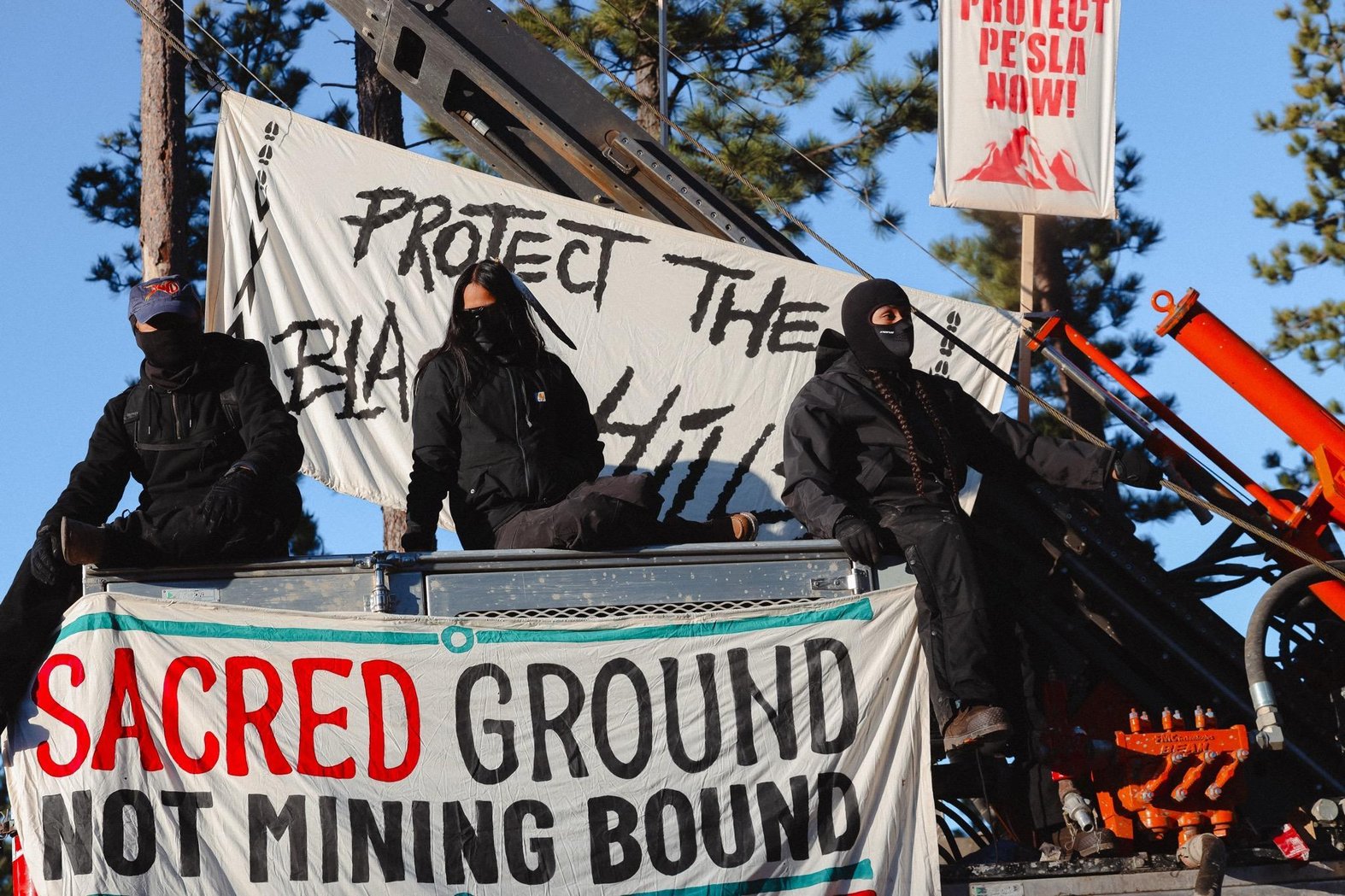
Demonstrators lock themselves to construction equipment in April 2026 at a planned mining site near Pe’Sla, a culturally important part of the Black Hills that NDN Collective has fought to protect. Credit: Angel White Eyes.
Winning the Narrative Battle
After the mistrial, the prosecutor had 45 days to decide whether to retry to the case. It was at that point that Drilled requested video footage of the incident. The court came back with an unusual response. The judge was concerned that copying the videos could damage them, complicating a potential retrial. “The Judge does not want to risk copying the exhibits or potentially altering or damaging the original materials,” a Pennington County court clerk wrote to Drilled in an email.
Then, about a week before the deadline, the prosecutor requested that the judge block the videos from being released until after the retrial decision. She argued that the footage could bias a jury pool.
In the end, there would be no new jury. On March 16, Siglin announced that the charges against Tilsen had been dropped. A week later, a clerk invited Drilled to pick up a flash drive with the videos.
The court declined a request for comment.
Tilsen viewed the whole series of events as a battle to win the story. “They didn't want the video released because they didn't want the public to see what everybody's seen in that courtroom,” Tilsen said. “I think that what people don't realize is when prosecutors and police bring politically motivated charges like this, it's often a narrative war.”
For now, NDN Collective has focused its attention back on its core work, including a successful effort to stop a graphite mine in a culturally important part of the Black Hills called Pe’Sla. They’ve also launched a new member-based Land Back Action Network, centered around a public storytelling platform for people involved in fights for Indigenous land. Call it the latest volley in a narrative war.