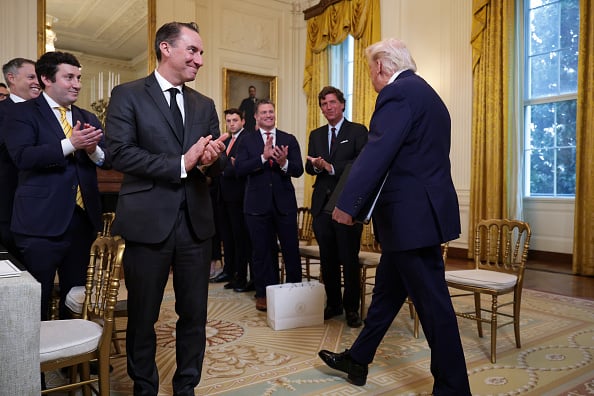
Image: Oil executives meet with President Trump at the White House January 9, 2025. Photographer: Alex Wong, Getty Images.
The Trump administration’s efforts to ramp up Venezuela’s oil industry after illegally claiming ownership of the country’s fossil fuels would violate international law and leave the US government—and American corporations—open to litigation for environmental harms, experts warn.
On January 3rd, the Trump administration carried out a large-scale military assault against the oil-rich Bolivarian Republic of Venezuela, bombing several cities including the capital Caracas and illegally abducting President Nicolás Maduro and his wife, Cilia Flores. At least a hundred people were killed in the invasion, in what UN experts have condemned as a “grave, manifest and deliberate violation of the most fundamental principles of international law.”
Trump immediately claimed dominion over Venezuela’s vast crude oil reserves. “We’re going to be taking out a tremendous amount of wealth out of the ground,” said Trump, later suggesting that US taxpayers could reimburse or subsidize energy companies for repairing Venezuela’s aging infrastructure for extracting and shipping oil. Since then, Trump has authorized the seizure of Venezuelan oil tankers and met with fossil fuel executives at the White House to discuss plans to illegally appropriate the country’s oil industry, despite pushback from even the oil companies themselves, none of which seem particularly interested in investing in Venezuela’s oil industry.
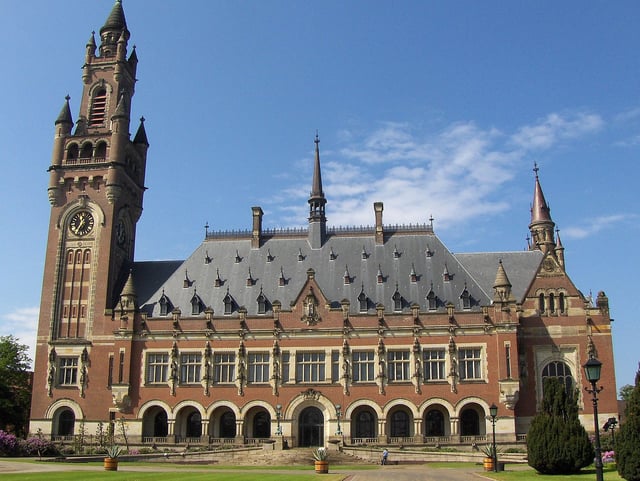
The Trump administration’s oil grab comes just months after the International Court of Justice (ICJ), the world’s highest court, delivered a landmark ruling clarifying that all states, whether they are signatories to international climate agreements or not, are bound under customary international law to prevent, mitigate, and remedy harms to the climate system.
The ICJ provided the boldest-ever language on fossil fuels, specifically spelling out the legal obligation by states to exercise “due diligence” in ending extraction, consumption, licenses and subsidies due to the mountain of unequivocal evidence on the harms caused by the extraction and consumption of fossil fuels to all life-supporting systems including climate, food, water and biodiversity.
The duty extends to an obligation to regulate private businesses responsible for emissions and other significant harms to the climate system operating within their borders, and indicates that a state’s failure to regulate these greenhouse gas emissions and emitters constitutes an internationally wrongful act susceptible to legal consequences.
Importantly, the legal obligation to prevent climate harm is not contingent on a country’s ratification or membership of formal treaties such as the Paris agreement, from which Donald Trump withdrew on his first day back in the White House, or the UN Framework Convention on Climate Change (UNFCCC), which was among 65 entities that Trump last week announced the US will exit — though the legality of that exit has been questioned.
“It bears repeating that the highest court in the world laid out in plain language, in a unanimous decision that underscored how overwhelming the evidence and the legal principles are, that the ongoing addiction to fossil fuels and a commitment to their production and use is a blatant violation of existing and longstanding international law,” said Nikki Reisch, climate and energy program director at the Centre for International Environmental Law (Ciel).
“The law is no less the law because certain powerful actors flout it, and the more the US continues to do so, the deeper the hole they dig in terms of their own legal responsibility and the greater their obligations to provide reparations,” Reisch told Drilled.
Venezuela has the largest proven crude oil reserve in the world, with an estimated 303bn barrels, according to research group the Energy Institute, almost as much oil as the US, Canada and Russia combined.
Aging infrastructure, corruption, poor governance, international sanctions and falling global demand, particularly for the sort of heavy crude produced in Venezuela, has seen the country’s oil extraction fall from a peak of more than 3m barrels per day (bpd) in the late 1990s, to around 1m bpd (including refined products and petrochemicals) currently, accounting for 0.9% of the global supply.
Ramping up oil extraction to the country’s previous peak of one billion barrels per year would generate around 418 million tonnes of planet-warming CO2. In other words, Trump’s illegal oil grab in Venezuela could eventually unleash more greenhouse gases than the entire annual emissions of South Africa in 2022.
On Friday, Donald Trump promised more than a dozen oil executives including the leaders of Chevron, ExxonMobil and ConocoPhillips “total safety, total security” in Venezuela in a bid to persuade them to invest $100bn in the country’s infrastructure. While oil majors remain hesitant, leaders of several independent companies expressed support for the Trump administration’s unlawful military actions in Venezuela, hinting that they were ready to invest, though none have committed investment to date.
The imperialist-corporate expansion comes as communities across the world including in the US are increasingly hit by deadly and devastating fires, floods, drought, and extreme temperatures driven by greenhouse gas emissions from burning oil, gas and coal. Rising levels of hunger, water scarcity, biodiversity loss, conflicts and forced migration will continue to spread if governments continue to violate international law and continue producing, financing, expanding and using fossil fuels.
In addition, communities in the US and around the world, particularly in Latin America, have been made more exposed to climate impacts due to Trump’s assault on science and data including early warning systems.
“The escalation here is that a historically high-emitting state is violating international law in order to undertake yet another internationally wrongful activity—harming the climate system, through the extraction, consumption and subsidies of fossil fuels,” said Elisa Morgera, the UN special rapporteur on climate change.
“There will clearly be so much economic and social harm domestically, regionally and internationally, while the economic benefits are going to reach only elites and the fossil fuel industry. This is not just a disregard for international law, but a disregard for everything that makes life livable for everyone in Venezuela, in Latin America, and globally, including for communities in the US, who are already facing devastating and in some cases lethal impacts of climate change.”
Later this week, a group of UN experts including Astrid Puentes, the special rapporteur on the right to a healthy environment, is expected to release a statement citing the ICJ, warning the US and corporations that further contributing to the climate emergency risks violating international law and complicity in human rights violations.
Puentes told Drilled: “The situation in Venezuela highlights the importance and urgency of moving towards a just transition that respects international law and the human rights of all peoples, instead of deepening dependence on fossil fuels which have too often led to violations in human rights, democracy and the rule of law, including the increase in conflicts and militarization.”
The July 2025 ICJ advisory opinion made clear that the established legal duty to prevent climate catastrophe and remedy harms caused flows from the entirety of international law, including the UN charter and universal obligations under customary law that obliges all states to prevent serious transboundary harm to the environment and human rights from activities within its borders, including harm from greenhouse gases.
Every person, the ICJ affirmed, has the fundamental human right to a “clean, healthy and sustainable” environment—a prerequisite for enjoying all other foundational rights such as life, health, food, water and housing. The obligation to protect the environment and the climate system supersedes all international agreements and applies to all states by virtue of their membership in the international community.
And while states have legal duties to act with due diligence to prevent, mitigate and remedy harms to the climate system, the onus is on the industrialized wealthy countries that have contributed most to the crisis to act first. The US is the biggest historical greenhouse gas emitter by some margin, and remains one of the top three emitters today, both per capita and in terms of total emissions.
The US pulling out of UN climate cooperation is important because it weakens transparency and makes it easier for misinformation and disinformation to spread, but it does not erase legal responsibility or shield the US from future litigation for violating customary international law, according to Delta Merner, associate director for the Climate Accountability Campaign at the Union of Concerned Scientists.
“The Trump administration is pursuing really large flows of heavy Venezuelan oil which includes more drilling, more refining, more burning of fossil fuels, leading to climate and pollution impacts that are completely foreseeable, and which the ICJ has said cannot be ignored,” Merner told Drilled.
The environmental, human and economic costs of tripling oil extraction in Venezuela to 3m barrels a day would be immense, and the equivalent of unleashing an additional carbon bomb into the atmosphere each year.
Every single carbon bomb—the term for a mega fossil fuel project that will emit at least 1Gt (one billion tonnes) of CO2 over its lifetime—will result in more than 200,000 preventable heat deaths by the end of the century. The mortality cost of carbon, published in Nature, does not include deaths caused by drought, food and water insecurity, floods, desertification, sea level rise and other human-made climate related catastrophes.
“The status quo, just keeping the oil flowing as it is, is already damaging, destructive and suicidal. Ramping that up as Trump says he plans to will cause a lot of additional harm. It is wrong, crazy, and probably illegal,” said Kjell Kühne, director of the Leave it in the Ground Initiative and lead author of the carbon bombs research.
According to Rystad, it will cost $183bn over the next 15-years, or $12 billion per year, to bring Venezuela’s crude oil production back to 3 million bpd by 2040. International finance would need to cover around two thirds of the investment, Rystad said.
The climate cost of Trump’s illegal plan will be on top of other foreseeable and inevitable harms to human health across the entire production chain from extraction to combustion.
In the US, 91,000 people already die prematurely every year from cancers, respiratory and other medical conditions due to pollution from the oil and gas industry, according to a landmark longitudinal study. Trump’s desire to send at least some of the stolen Venezuelan oil, which is among the dirtiest and most polluting to process, to US refineries in Texas and Louisiana would lead to further harm in these already overburdened communities of color.
“We're not in a grey zone here. Seeking to seize and extract oil from reportedly the biggest oil reserves in the world spells a grave danger for the people on the planet, for our collective future,” said Reisch, the Ciel attorney.
“The harms are foreseeable and indeed inevitable, and because of that, there is a long standing legal duty to prevent them—and it is incumbent upon all states to take action to uphold and enforce this obligation.”