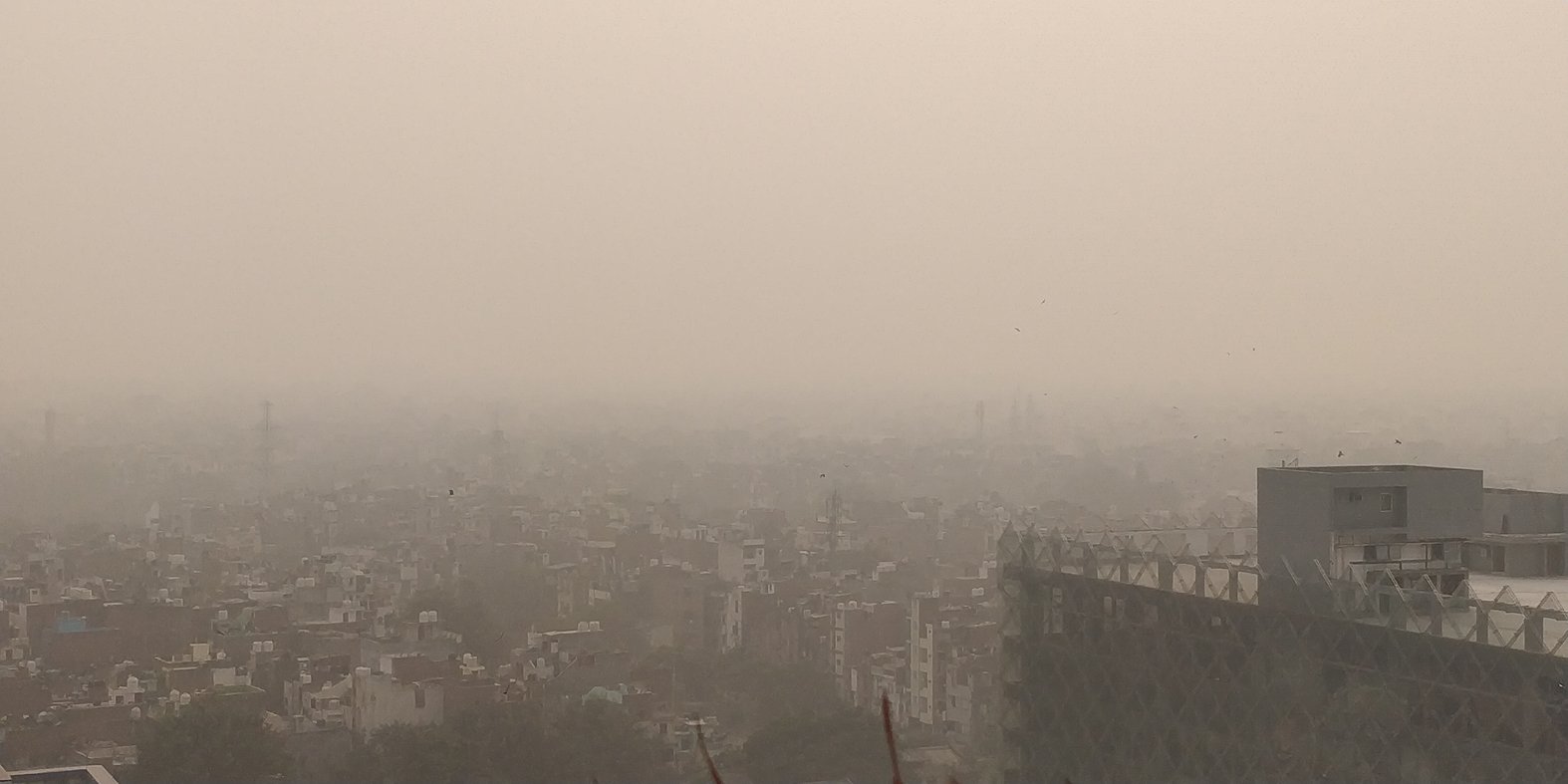
Image: Air pollution in Delhi. Photo credit Prami.ap90 via Wikimedia Commons.
As people living in Indian cities and villages grapple with the health impacts of some of the world’s worst air quality, many politicians and policymakers appear to be evading and denying the problem, public records obtained under India’s Right to Information (RTI) Act show. The matter has implications for hundreds of millions of people.
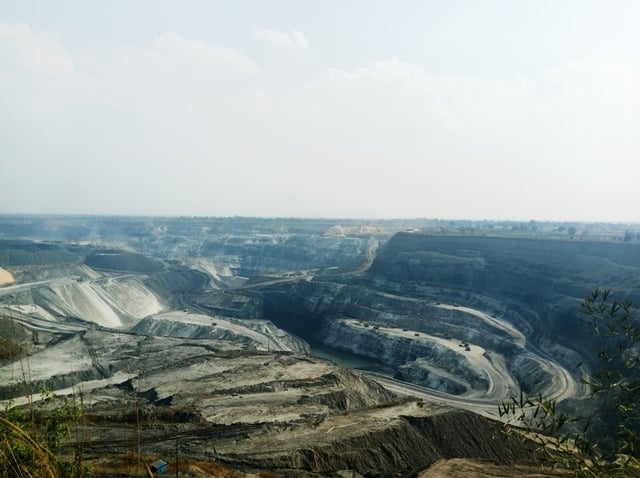
Industries, including coal, are major sources of air pollution in the country, as are the transport and construction sectors and activities like the burning of waste and crop residue and the usage of solid fuels in households. Efforts to deal with the problem, however, are met with a big obstacle: political denial that is deeply entrenched and longstanding.
Across administrations—regardless of party—governments have consistently maintained that there is no “conclusive evidence” establishing a causal link between air pollution and mortality. This stance flies in the face of peer-reviewed literature on the subject but has appeared in parliamentary discourse from as early as 2006 to as recently as January 2026.
At times, the denial has also taken subtler forms, such as alleging that global air quality indices that rank Indian cities among the most polluted are biased or not based on representative data, and seeking an ever-larger base of “indigenous/local studies” to establish health impacts. This sustained posture shapes—and constrains—policymaking, and dissuades scientists and researchers from advancing proposals they believe are unlikely to secure legislative backing. The story of the National Ambient Air Quality Standards (NAAQS) is a prime example.
The standards were first framed in 1982. They are revised every few years with an aim to update knowledge related to the adverse impacts of exposure to air pollution on human health. Meetings related to the current revision process began in 2020. The work is led by IIT-Kanpur, a public research and technology institution located in the north Indian state of Uttar Pradesh.
The committee tasked with the revision includes members from the Central Pollution Control Board (CPCB), the Union environment ministry and the India Meteorological Department. CPCB is a statutory body under the Union environment ministry. The committee has held meetings since 2022.
In multiple meetings, members of the committee appear to lack ambition in setting revised standards using the same talking points politicians use to dismiss the severity of the air pollution problem, minutes of meetings obtained via RTI requests found.
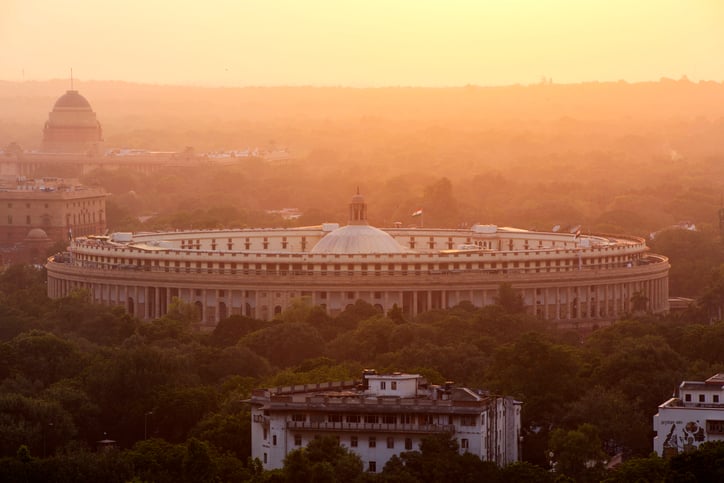
Parliament building in New Delhi, shrouded in polluted air. Credit: Westend61 via Getty Images.
“Air quality standards are typically formulated based on two key considerations: their impact on public health and their practical achievability,” said Mohan George, a scientist who previously served in the Delhi Pollution Control Committee.
The concept of “achievability” implicitly recognizes the wide variations in geographical and meteorological conditions across regions, both globally and within India. For instance, cities such as Delhi, in particular, and across the Indo Gangetic Plain in general experience elevated levels of naturally occurring dust, which influences baseline pollution levels and must be accounted for while setting context-specific standards.
However, George noted, prevailing political attitudes also constrain policymakers, who often frame standards to ensure they are more readily accepted rather than strictly aligned with scientific or health-based benchmarks. George previously assisted the drafting of the 2009 update of NAAQS.
Subterfuge of “indigenous studies”
For the longest time, politicians and the policymakers who work with them have called for “indigenous/local studies”, arguing that studies done elsewhere in the world do not capture Indian conditions. The same argument is made in meetings held by the NAAQS revision committee as well.
In one of the minutes of the meeting, a member of the committee says "health impact studies done elsewhere are often questioned for relevance in Indian context and, therefore, indigenous studies may be given greater consideration while framing the standard.”
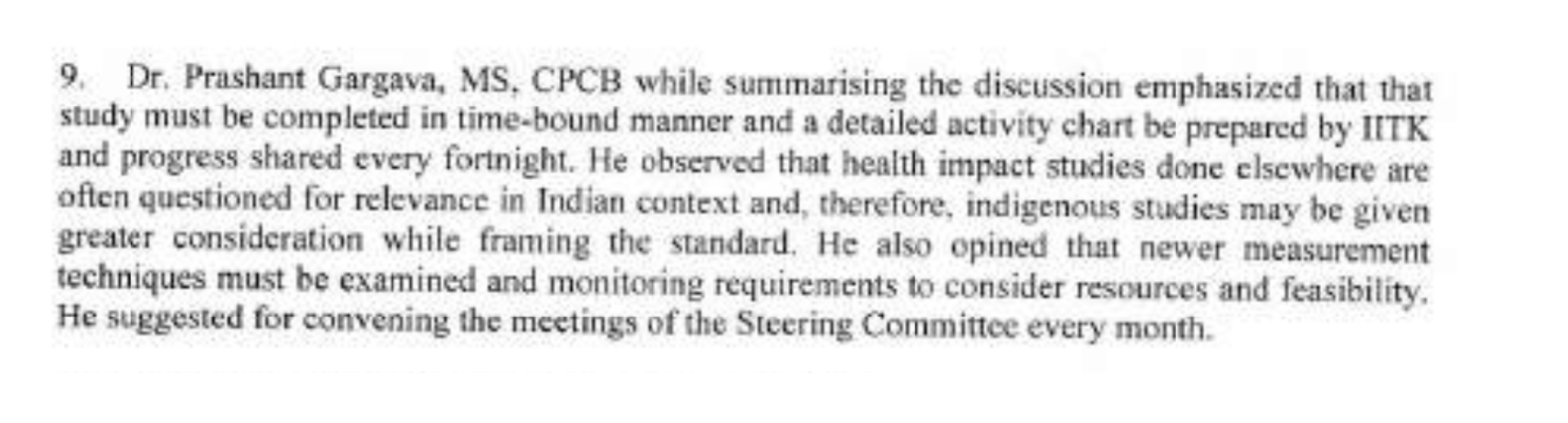
Screen grab from minutes of meetings held for NAAQS revision obtained under Right to Information Act
This stance is based on an implicit belief that Indians are somehow more ‘adapted’ to air pollution. Such arguments are pervasive and have gained legitimacy from the political denial of the air pollution problem. In 2017, for example, the Union environment ministry and the Indian Council of Medical Research (ICMR) held meetings to assess environment-related health issues. Drilled obtained copies of reports and summaries of these meetings. They make multiple references to unscientific statements like taking “different Indian culture” and practices like “pranayam [breathing exercises]”, “environment purifying ritual of yagnas [fire rituals]” and “jalneti [the cleansing of nasal passages with water]” into account.
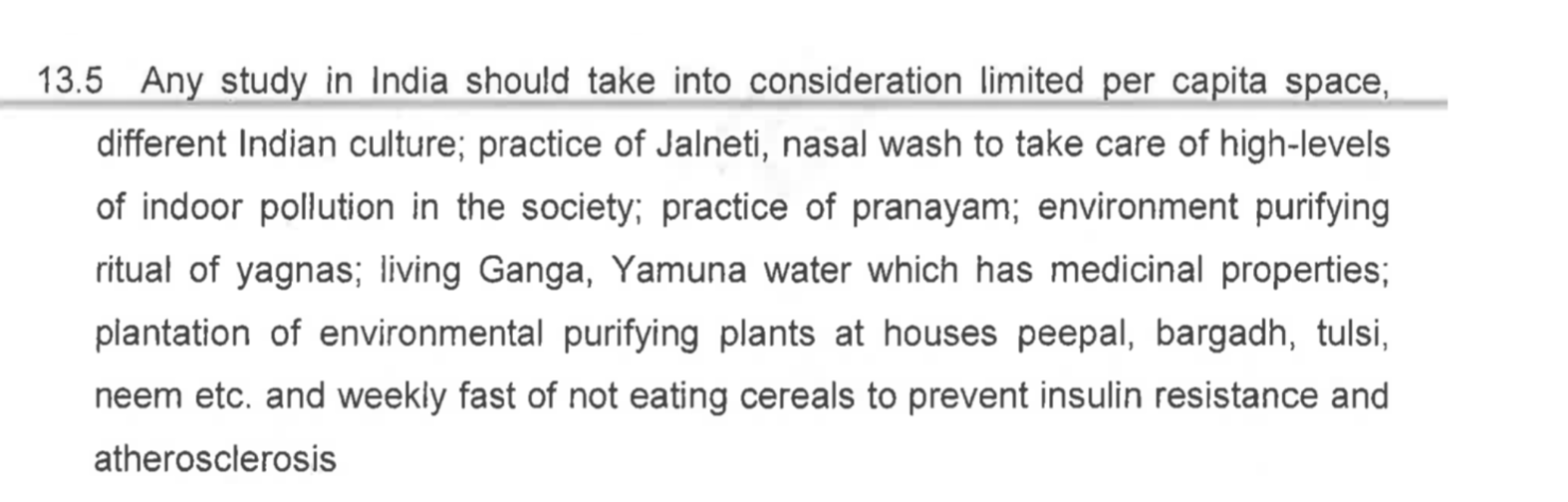
Screen grab from meetings of the Union environment ministry and the Indian Council of Medical Research on environmental health.
Bhargav Krishna, convenor of Sustainable Futures Collaborative, a research organisation based in New Delhi, said the idea that Indians are not as susceptible as others to air pollution has been “systematically disproven with decades of research conducted in India.”
One of the earliest studies by a cardiologist published in 1959 showed high exposure to air pollution as a causal factor for high incidence of pulmonary heart disease among low-income households in New Delhi. In the last few decades, multiple studies from various Indian cities link poor air quality to various adverse health outcomes like premature mortality among children and the elderly, asthma and high blood pressure.
The meetings between the Union environment ministry and ICMR also dismiss causal links to respiratory ailments, noting that air pollution could only be “one of the triggering factors.”
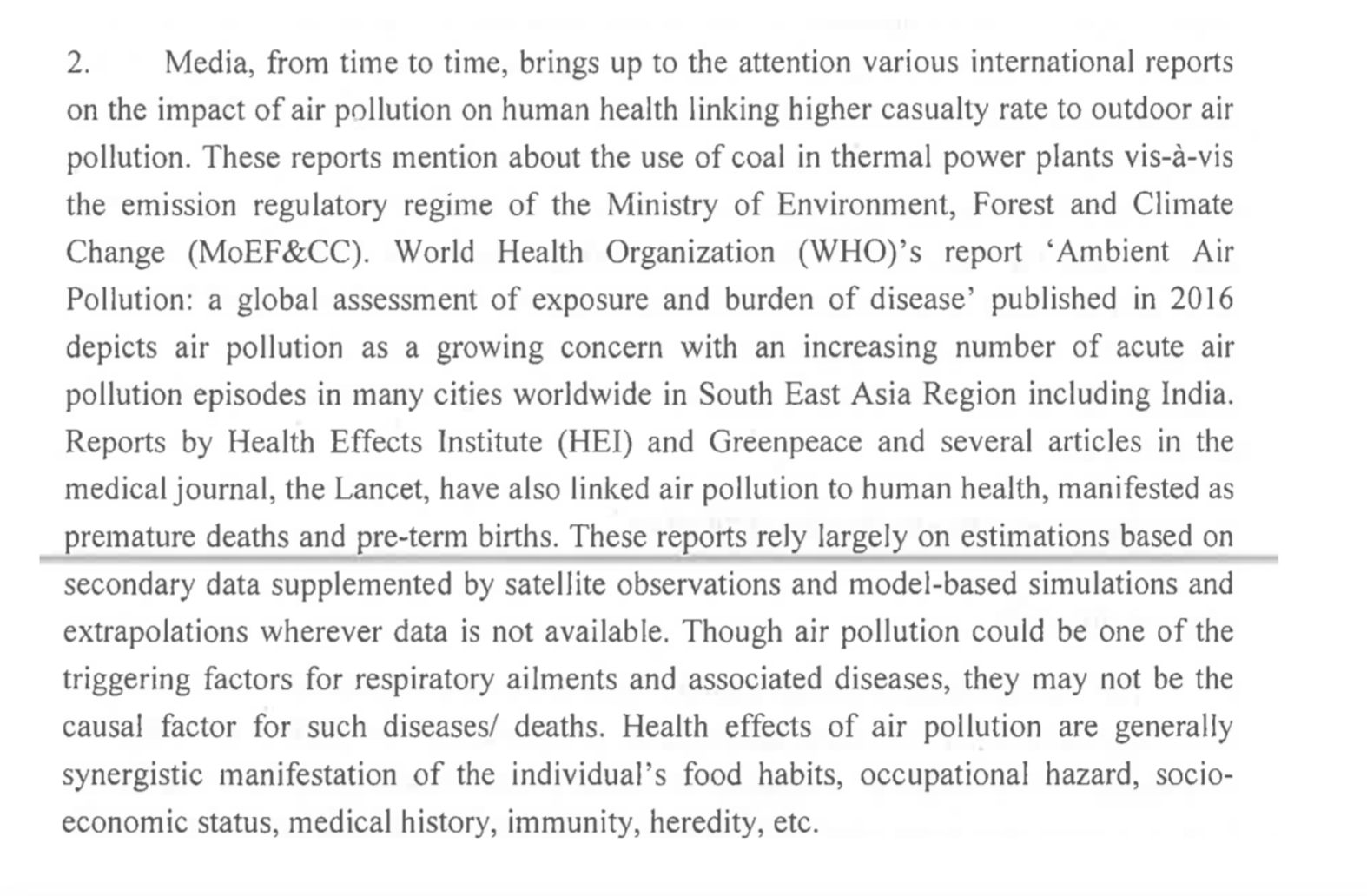
Screen grab from meetings of the Union environment ministry and the Indian Council of Medical Research on environmental health.
Pointing to all the other causes of lung and heart disease is a common tactic that multinational private industries–most notably the tobacco, coal, oil and gas industries–used for years to obscure the link between their products and health impacts. In the case at hand the profit motive might be removed, and some government officials genuinely believe that the link is unclear, but the result is still the same: obscuring the connection between air pollution and health in a manner that puts the public at risk. Such arguments have been disputed earlier noting that diseases are often multifactorial and a product of behavioral, environmental, genetic, and other forms of risk factors, which doesn’t discount the impact of any one of those risk factors. And yet, they continue to dominate policy-making decisions not least because they echo political statements made within the Indian parliament that there is no “conclusive evidence” to establish a causal link between air pollution and mortality.
There are other forms of denial of the air pollution problem in India, too. One prominent form is tampering with air quality monitors by spraying water on them to reduce the pollution load that would otherwise settle around the monitor or placing monitors behind trees or walls that obstruct airflow, thereby obstructing the path of pollution. It’s unclear who is doing the tampering, only that it is happening.
An occasional silver lining
Sometimes suggestions that run counter to evidence-based policymaking are shot down in the NAAQS revision meetings. For example, the suggestions made to phase out the monitoring of particulate matter with a diameter of 10 micrometers or less (PM10) like dust stating “controlling PM2.5 through implementation of various policies will eventually help to reduce PM2.5 as well as PM10.” PM2.5, being smaller in size, can be inhaled more easily and therefore, is more toxic than PM10. Its sources are also industrial in nature with combustion of fuels being a leading source, while those of PM10 are more natural like dust. While it is true that PM2.5 includes particles like soot and is a subset of PM10 and therefore, controlling PM2.5 would result in reducing PM10 as well, the suggestion reflects a lax attitude about PM10.
“PM2.5 is the pollutant of concern in India. But we cannot discontinue monitoring PM10 because the same infrastructure [Continuous Ambient Air Quality Monitoring Stations] does not exist to monitor PM2.5 at the moment as it does for PM10 and doing away with the monitoring of PM10 will eventually create blind spots about pollution levels,” said Sunil Dahiya, founder and lead analyst at Envirocatalysts, an organization that works on clean air and decarbonization. PM10 broadly acts as an indicator of PM2.5 levels across geographies, especially in certain cases in India where PM2.5 is not monitored as well as PM10.
The suggestion to discontinue PM10 monitoring was eventually shot down in the meetings.
In another instance during the NAAQS meetings, there are discussions on discontinuing the monitoring of sulfur dioxide, the concentration of which remains high in India. Peer-reviewed studies have conclusively linked acute and persistent exposure to SO2 to a range of cardiovascular and respiratory impacts. It remains unclear whether the suggestion to discontinue monitoring was accepted.
Process transparency under question
The committee tasked with NAAQS revision has submitted a draft report to CPCB for finalization. The report has not been released publicly.
Drilled was denied a copy of the report under RTI. The reasoning provided was “the project titled ‘Review of National Ambient Air Quality Standards (NAAQS)’ is presently under progress. As per Section 11(1) of the Right to Information Act, 2005, disclosure of such third-party information cannot be made at this stage.” This is despite the fact that the study was commissioned by CPCB and IIT-Kanpur, the organization leading the study, is a public institution, and not a private entity. The issue at hand is also one that concerns public health and not private affairs.
Drilled sought interviews with five government officials at CPCB, including the chairman and the member secretary, and also others like past CPCB members who worked on NAAQS revision and relevant persons from IIT-Kanpur. None of them agreed to be interviewed or provide comment as of the date of publication.
“The NAAQS revision was promised back in 2020, yet years later, the process remains shrouded in mystery. This isn't just a missed deadline; it’s a public health failure,” said Dahiya, adding that the lack of transparency and reluctance to engage with the public and provide basic updates is exactly why we see the stagnation. "If we want to breathe cleaner air, the government must stop the delays and get these standards finalized with the urgency and openness the public deserves,” he noted.
This story was produced as part of the ‘Following the Fumes’ project with support from Earth Journalism Network.