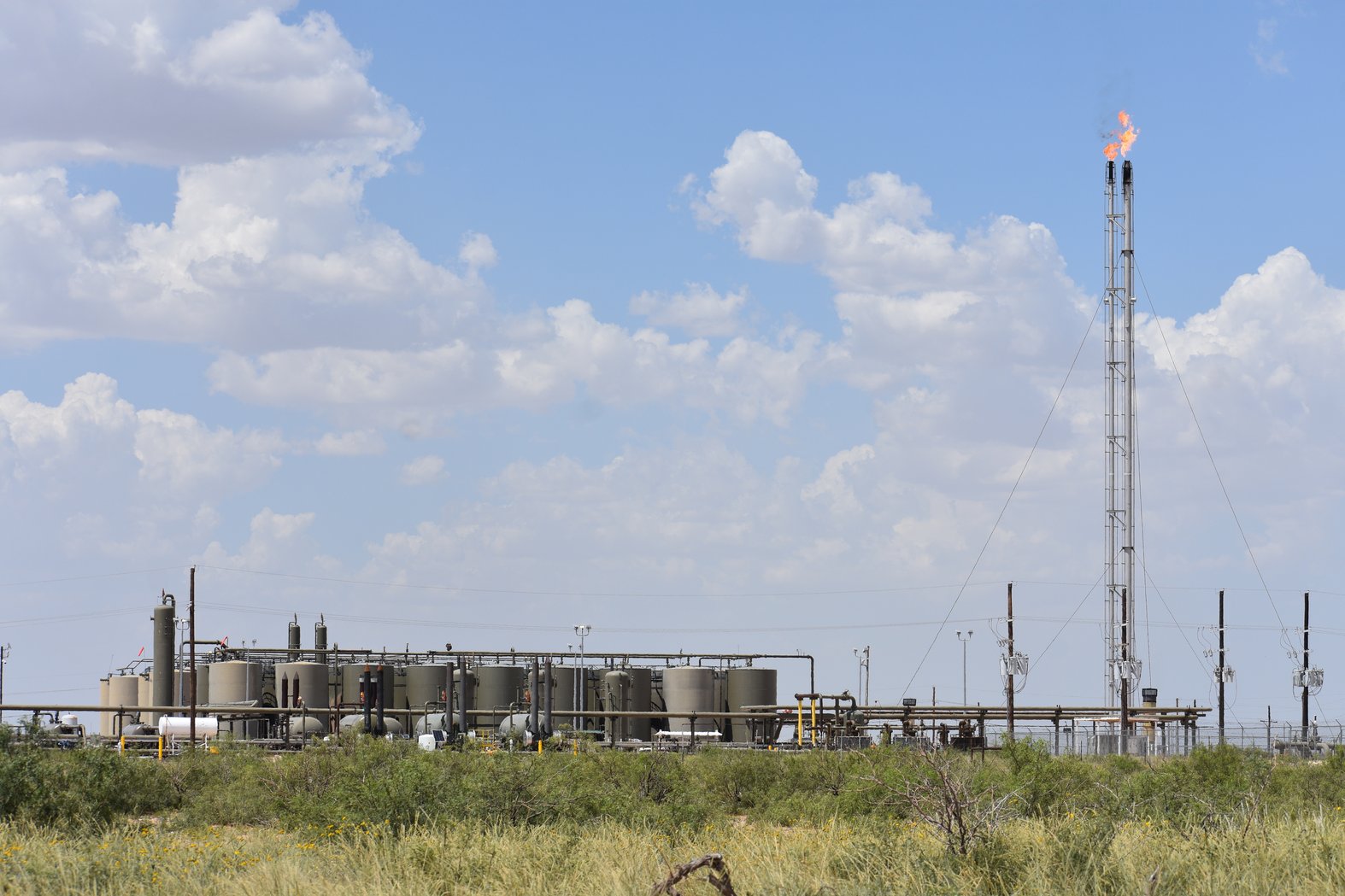
Top photo: A gas site in Orla, West Texas. Photo by Nicholas Cunningham.
A condensed version of this story was published by The Guardian.
On a hot July day outside the town of Orla, in West Texas, Sharon Wilson pulled over along a dusty roadside and set up her camera. The tripod held an optical gas imaging device pointed toward a steel flare stack on a gas wellpad just beyond a barbed wire fence. The site looked unassuming, almost idle.
But only to the naked eye. Seen through the camera's lens, the view was different: clouds of hydrocarbon pollution, including methane, were spewing into the air like plumes from a volcanic vent.
The wellpad, operated by the oil and gas behemoth BP, carries an increasingly coveted distinction, having been certified as “low-methane” under a rapidly expanding certification scheme run by a little-known U.K. organization.
Over the past few years, major companies including ExxonMobil, Repsol and EQT have turned to London-based MiQ to prepare for the implementation of the European Union’s new methane regulations, or EUMR, a first-of-its-kind framework designed to reduce emissions of the potent greenhouse gas from the energy sector.
MiQ runs the largest voluntary methane certification program in the world, covering roughly a fifth of US natural gas production and 7% globally. It maintains that its framework is specifically designed to comply with the EU methane regulation.
The EUMR, in force since August 2024, requires energy firms to monitor, report and verify methane emissions at their drilling sites and conduct regular leak detection surveys. It will also require importers to obtain methane-intensity data from their suppliers starting next year. Penalties for non-compliance include fines up to 20% of the annual revenue.
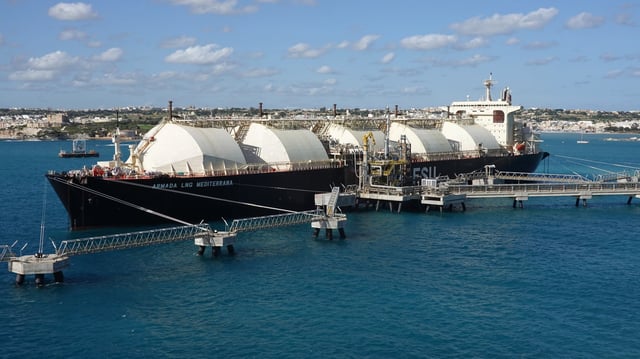
For US companies, the stakes are high. American producers now supply 60% of Europe’s LNG, up from almost none in 2016, when US LNG exports first began. The trade expanded steadily in the following years, surged after the EU in 2022 introduced a phased ban on Russian gas imports, and is expected to grow further thanks both to industry lobbying and to diminished exports from Qatar amidst the US-Israel war with Iran.
EU officials pledged to deepen energy cooperation with Washington following last year’s negotiations amid tariff threats from the Trump administration, and several European utilities have since signed long-term supply contracts with US exporters. A recent analysis by the energy think tank IEEFA estimates that the EU could source as much as 80% of its LNG from the United States by 2030.
But an investigation by Drilled, Gas Outlook and The Guardian, combining on-the-ground reporting with analysis of the certification methodology and satellite data, suggests that the program may be significantly underestimating the methane footprint of the facilities it certifies.
The findings raise questions about whether third-party certification schemes can credibly demonstrate exporters’ compliance with the bloc’s new methane rules, an approach championed by the gas industry and now under consideration by the European Commission.
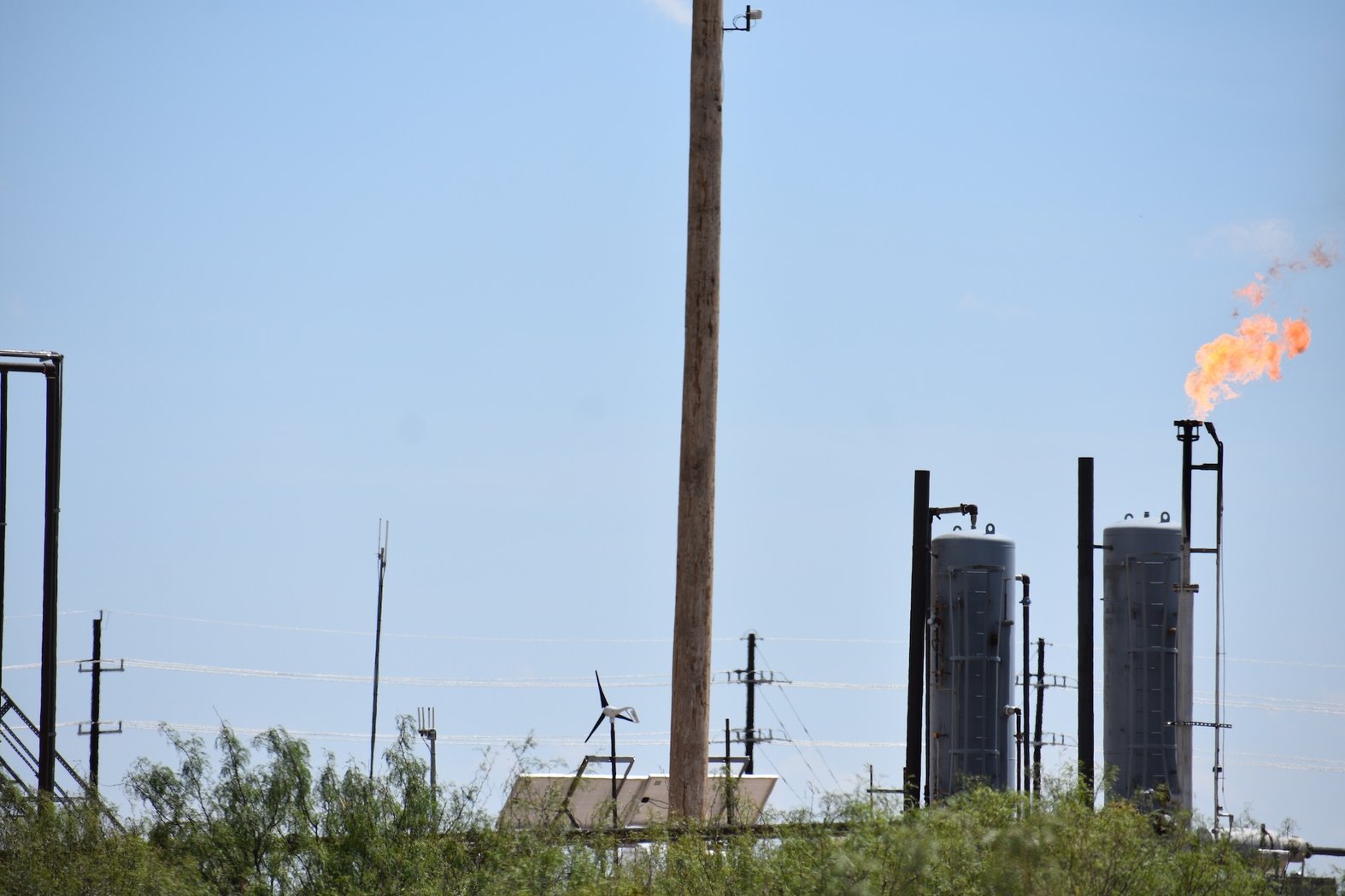
Flaring at an MIQ-certified BP site in the Permian Basin. Photo by Nicholas Cunningham.
“Terrible pollution”
MiQ grades gas production facilities based on methane intensity—the ratio of methane emissions to total gas produced—and assigns ratings from A to F. Certification lasts a year and must be renewed annually. MiQ has certified 33 facilities worldwide to date, covering a vast array of oil and gas wells, most of which are in the US.
In July 2025 Gas Outlook traveled with Oilfield Witness, an environmental monitoring group, to 10 MiQ-certified sites across the Permian Basin, the country’s largest oil and gas field, which straddles the Texas-New Mexico border.
Using optical gas imaging cameras that detect methane invisible to the naked eye, they documented what Tim Doty, a former air quality inspector at the Texas Commission on Environmental Quality who reviewed the footage, described as “huge emissions” at multiple sites.
Images from the BP-operated Ella Mae Hall gas well showed that the site’s flare appeared to be malfunctioning and “was acting as a vent pipe instead of a combustion device”, said Doty.
Further south, the camera picked up “significant emissions” that Doty said were generated by flaring and maintenance issues at the BP-operated Gretchen Northrup well.
BP says all its onshore upstream operations in the US are certified under MiQ. The company does not disclose individual ratings, but available information suggests these sites received grades from A to C, implying leakage rates below 0.2% of production.
BP did not reply to requests for comment.
For Gunnar Schade, an atmospheric chemist at Texas A&M University, the process of flaring gas alone makes it exceedingly difficult to limit methane emissions. “All ‘candlestick’ flares release some methane,” he said.
While lower intensity gas is possible in some basins, in the oil-rich Permian, flaring is rampant.
Researchers estimate that average methane emissions across the basin range from 2.4 to 4% of production, among the highest worldwide. Methane emissions are also frequently higher in areas that produce oil alongside natural gas, such as the Permian.
While the Trump administration characterizes U.S. oil and gas as cleaner than that of other countries, it has rolled back regulations governing methane emissions. The Environmental Protection Agency has, under Trump, postponed the implementation of previously finalized rules that would have mandated that the industry monitor for methane leaks and address them. The administration also repealed the country’s first-ever tax on methane. And in June, Trump withdrew a Biden-era guidance document that provided companies with a roadmap for complying with a law targeting methane leaks from pipelines.
The industry disputes the idea that emissions are high in the Permian, citing a 2025 report from S&P Global Commodity Insights indicating that methane emissions in the basin declined 29% between 2023 and 2024. However, S&P’s report acknowledged that satellite data showed a much more modest reduction of 4%, contradicting the company’s own data.

Certified thermographer Sharon Wilson with Oilfield Witness shoots a certified gas site in New Mexico. Photo by Nicholas Cunningham
Back on the ground, similar patterns emerged across the border in New Mexico, where methane was observed leaking from tanks, inefficient flares, and faulty equipment at ExxonMobil’s Poker Lake complex, which has held an A rating from MiQ since 2022. At one location, a pressure relief valve was emitting un-combusted gas.
Georges Tijbosch, CEO of MiQ, said that “it is scientifically impossible to conclude that these plumes are unreported methane emissions” with OGI footage alone.
DataDesk, an investigative consultancy, cross-referenced satellite and aerial data from third-party datasets with the coordinates of the visited sites, uncovering additional methane plumes.
Aerial surveys conducted by the Global Airborne Observatory in 2024 also detected three “super-emitter” events, rare but extremely large methane releases often caused by equipment failures and responsible for a hefty share of total emissions, at the Poker Lake complex.
The gas production site produced over 100 million cubic feet of gas between 2024 and 2025. ExxonMobil reported no venting or flaring in regulatory filings with the state of New Mexico over the same period.
Exxon did not reply to requests for comment.
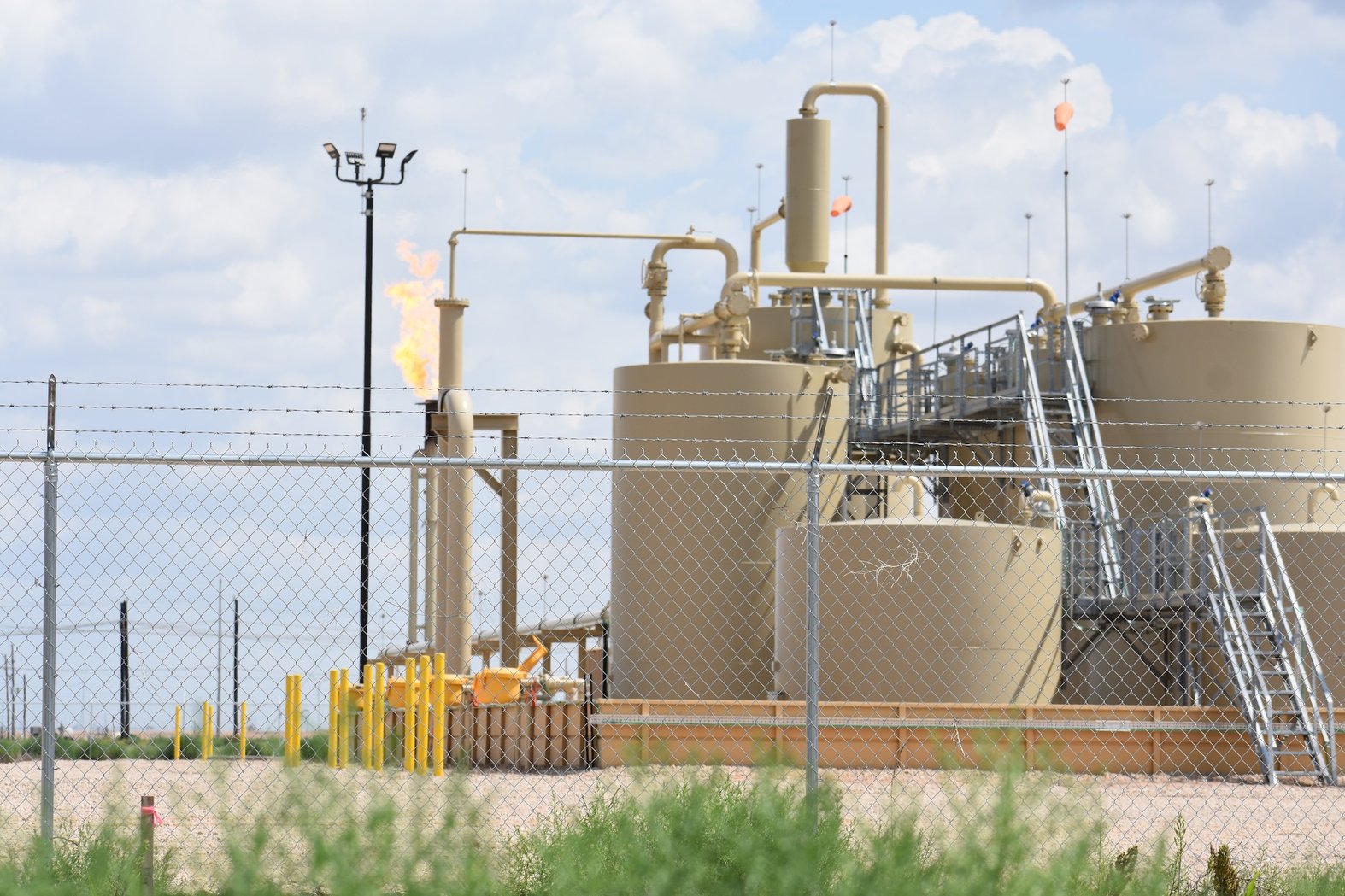
Gas compressor station in Midland, Texas. Photo by Nicholas Cunningham.
After leaving the well pad, gas often travels just a short distance, sometimes less than 50 metres, to a nearby processing facility. That is the case with ExxonMobil’s Tiger compressor station, which gathers gas from Poker Lake. There, the camera detected “egregious emissions from three malfunctioning flares,” according to Doty.
A series of “super-emitters” was also detected at the site in May 2024 by aerial flyovers.
In West Texas, footage from the BPX’s Bingo facility, which gathers gas from nearby BP production wells, showed a similarly malfunctioning flare releasing a large plume of partially combusted methane, as well as emissions from vent pipes and ground-level sources, which Doty described as “terrible pollution in no way typical for the source type.”
Gathering and processing facilities like these belong to the midstream segment of the oil and gas industry, which handles the transport and treatment of gas between production and final use. Despite generating emissions that can rival those from well sites, they currently sit outside the scope of the EU methane regulation.
MiQ has published additional standards intended to cover midstream infrastructure such as compressor stations, gathering systems and storage facilities, but adoption has been limited. Only three of the 33 facilities listed in MiQ’s public registry cover midstream or downstream infrastructure, and none are in the US.
Self-reporting
Even where certification does apply, the way emissions are calculated has raised concerns amongst some EU regulators over the ability of certified gas to comply with the EUMR.
To earn MiQ certification, operators are evaluated on three main criteria: a site’s methane intensity, the procedures in place to prevent leaks, and the monitoring technologies deployed. Third-party auditors visit facilities to review these factors before recommending a grade, after which MiQ issues certificates that can be attached to gas sold on the market.
Audits are conducted annually, with advance notice, though MiQ says auditors do not always disclose which specific sites they will visit. The process does not involve auditors carrying out independent emissions measurements on site.
“As part of the certification process, auditors do not calculate emissions,” said Elizabeth McGurk, methane sector leader at Montrose Environmental, one of MiQ’s audit firms.
Instead, she said, auditors “review and verify the operator’s emissions inventory” — an estimate of the total methane emissions from a facility over a year — assessing whether “intermittent emissions are properly accounted for through personnel interviews, documentation, and evaluation of supporting calculations.”
Auditors, added McGurk, “specifically ask how operators are tracking and responding to intermittent events — both to mitigate emissions and to ensure they are accurately represented in the annual inventory.”
MiQ maintains that it requires operators to report on a broader set of emission sources than many regulatory frameworks. However, an analysis of its standard shows it does not mandate direct measurement or the use of specific third-party datasets nor does it require measurements to be independently collected, although some operators choose to incorporate these tools into their emissions inventories.
MiQ noted that while direct measurement of methane emissions is not required for certification, auditors will ask to review raw operator data on an as-needed basis.
Dan Zimmerle, director of Colorado State University’s methane emissions programme, said that because emissions occur around the clock and continuous monitoring is costly and technically challenging, measurements capture only a “snapshot”, with the rest inferred through “statistical extrapolation.”
However, verifying the data remains a challenge. “The big issue with certification schemes like this is: how does the verifier actually know what was done?” Zimmerle said.
Most energy companies don’t measure their actual methane emissions. Instead, they produce estimates based on how much methane they say typically escapes from their equipment using a combination of short-duration measurements, engineering calculations, and statistical methods.
Scientists have found that those estimates are often inaccurate. Using data from satellites and aerial surveys, they have consistently concluded in peer-reviewed studies that nations and companies are emitting significantly more methane than they’re reporting.
In a recent study, Kevin Kircher, an energy researcher at Purdue University in Indiana, compared US government estimates of LNG-related methane emissions, largely based on self-reported facility data, with more measurements from satellite observations.
His analysis found that methane emissions from the rapid expansion of shale oil and gas production in the Permian have risen far beyond official estimates over the past two decades.
“There’s a pretty stark difference between what companies self-report and what’s there when you actually show up and look at it,” he said.
Observations by the MethaneSAT mission from May 2024 to June 2025 found methane emissions in the basin to be nearly four times higher than those reported in official US inventories.
A March report by the Rocky Mountain Institute, one of MiQ’s founders, found that operator self-reported data to the Railroad Commission of Texas understates emissions, with actual gas waste in 2024 estimated at three to four-and-a-half times reported levels.
Another March report found that methane loss rates in the Appalachian Basin, home of longtime certification booster EQT and often touted as having the lowest methane emissions intensity of any US oil and gas region, are several times higher than reported.
A no less critical element concerns the inherent nature of US production, which unlike state-controlled systems in Qatar or Algeria is fragmented across thousands of operators, with gas from multiple wells and companies commingled in pipelines before it reaches export terminals.
Gas from BP and ExxonMobil's Permian operations, for example, mingles with dozens of other producers' output at the Waha hub before making the long journey to LNG terminals on the Gulf Coast, according to an analysis by Data Desk.
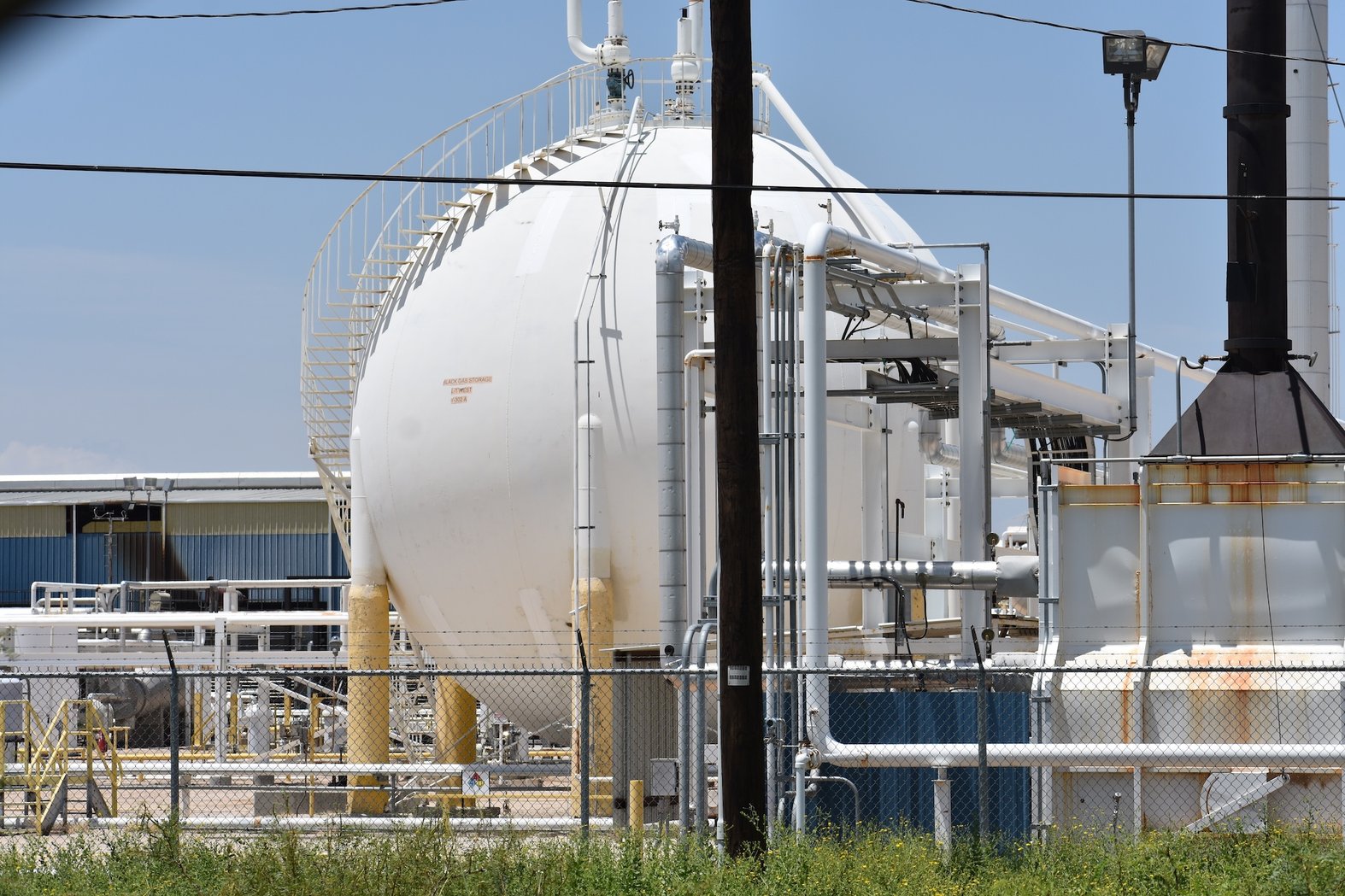
At the WaHa hub, gas from oil fields throughout the region is co-mingled in large tanks. Photo by Nicholas Cunningham.
Copying homework
MiQ certificates can also be “decoupled” from the facilities that generated them and traded to other producers as a way to offset emissions. Certificates are sold through platforms such as the CG Hub marketplace, where companies can purchase them and attach them to gas with significantly higher emissions.
Trading in such certificates is already picking up. In February, British energy trader Centrica Energy signed a 10-year agreement to purchase certificates linked to natural gas produced by Eastern Appalachian Seneca Resources, whose natural gas production has held an A rating from MiQ since 2022. The deal does not include the delivery of physical gas.
A month later, a European energy supplier and a U.S. integrated energy company completed what was described as the first trade of certified methane emissions reductions on the Xpansiv CBL spot exchange, with emissions verified under the MiQ standard.
Niklas Höhne, co-founder of the Germany-based New Climate Institute, warned that delinking credits from physical entities "can create problems." He pointed to renewable energy credits as a cautionary example: "You can create a credit from a hydropower dam that's been there forever and claim renewable energy without having done anything."
EU officials have voiced similar concerns over whether schemes allowing decoupling credits from physical entities can credibly reflect real emissions reductions.
Jutta Paulus, an MEP on the EU’s committee on environment and climate who helped design the EUMR, said MiQ’s trading rules may not be “totally compliant with the regulation” because certificates should only be sold with the gas it has certified.
MiQ strategic adviser Axel Scheuer told EU commissioners last April that “transfers from one region to another are controlled and limited to volumes actually exported and imported between those regions,” he said. “This means an importer bringing in gas from, for example, Nigeria cannot use certificates linked to US production.”
However, certificates can be traded between operators within the same country. In the US, where gas from multiple producers is routinely mixed in pipelines, it is often impossible to determine whether “certified” gas actually comes from lower-emission facilities.
Brandon Locke, a methane expert at the Boston-based nonprofit Clean Air Task Force, said decoupling could discourage gas producers from pursuing the operational changes needed to curb methane emissions. “Companies can effectively ‘copy someone else’s homework’ rather than clean up their act,” he said.
Unlike many other offsetting certifiers, MiQ does not maintain an open database, meaning information on buyers of its certificates is not publicly available.
When reporters requested access to trading data, they were offered a demonstration but not direct access.
Pragmatic compliance tool
As the EU finalises its new methane requirements, the lobbying battle around certification is intensifying, with gas producers hoping voluntary certification will help them avoid more stringent laws.
The American Petroleum Institute, an industry lobby coalition, announced earlier this year that one of its 2026 goals is to “ensure” EU methane laws do not “disadvantage US producers”. In January, another lobby group, FuelsEurope, pressed the EU to accept “certificates transferred independently from the underlying commodity”.
The Partnership to Address Global Emissions, a trade group founded by EQT and representing US gas exporters to Europe, has also lobbied for certification as a way to increase US LNG exports to Europe without running afoul of European climate policies. MiQ’s director of policy, Ben Webster, sits on the trade group’s advisory board.
Documents obtained through freedom-of-information requests also show MiQ hired the lobbying firm Energy & Climate Policy Advisory Europe to promote its certification framework in Brussels. The firm is led by Axel Scheuer, a former ExxonMobil and International Association of Oil and Gas Producers lobbyist, who is now Strategic Advisor to MiQ.
According to the records, Scheuer has pitched the MiQ system to EU lawmakers as a “pragmatic compliance tool” and held meetings with officials responsible for developing rules for imported fuels.
In January, he presented the certification scheme at a workshop organized by the United Nations Economic Commission for Europe, describing MiQ’s standards as “largely equivalent to the EU methane regulation requirements.”
These efforts appear to be gaining traction, particularly as the escalating tensions between the US and Iran are once again putting energy security at the heart of the EU’s policy decisions. In December, the European Council endorsed third-party certification as a compliance tool, a position the European Commission echoed earlier this year.
MiQ CEO Tijbosch views certification as progress. “Reducing methane emissions from oil and gas is one of the fastest, most cost-effective ways to slow climate change,” he said. And the technology exists today to achieve reductions, he added. “This means the challenge is not about capability, but accountability.”
For Kircher and many other climate experts, low-emissions gas certification only has credibility if measurement and reporting is “done by someone independent and neutral, not by the companies themselves.”
“I’m not sure who that might be, but it has to be someone with no skin in the game and nothing to gain from lowball estimates,” he said.
Back in Texas, Sharon Wilson, a former oil and gas worker and now director of Oilfield Witness, watched the methane gas stream pouring endlessly into the sky on her rainbow high-contrast palette camera screen.
After decades spent surveying oil and gas fields, she said scenes like this are all too familiar.
“I’ve been hearing that the industry can solve the methane problem since the early 2000s,” she said. “But it hasn’t happened, and methane keeps climbing higher and higher. The only way methane levels will come down is to stop permitting new wells.”
Additional reporting by Jess Staufenberg
This investigation was supported by Journalismfund Europe and Gas Outlook.