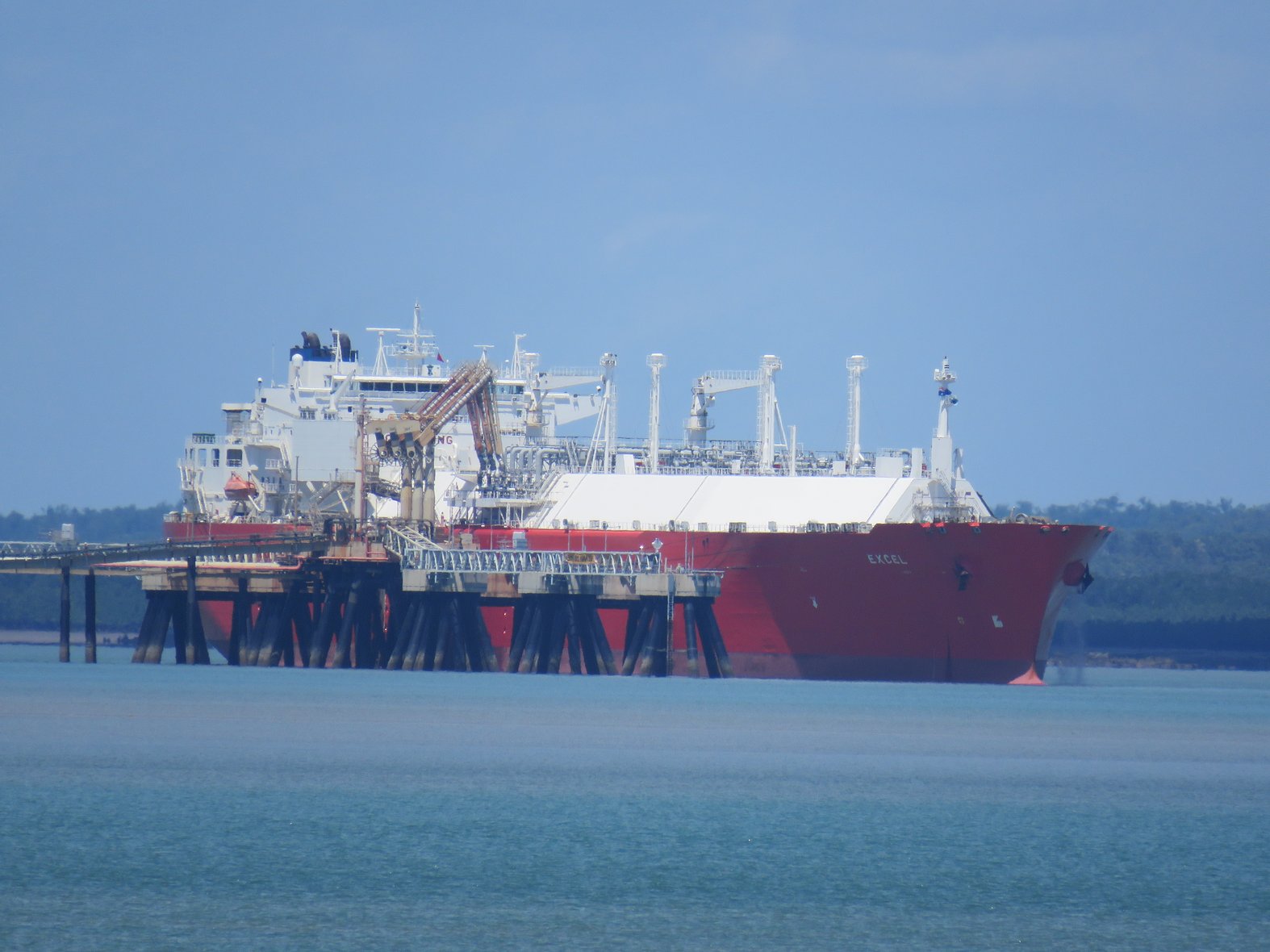
Cover photo: An LNG tanker departing from a port near Darwin, in Australia. Photo by Ken Hodge.
It is no secret that the trade in methane gas across South East Asia is as lucrative as it is influential. Naturally, this has made it a target for geopolitical ambition. As Drilled has previously reported, it is possible to trace a line from the U.S. and Australia, two of the world’s biggest suppliers, through Japan, the cornerstone market soaking up two fifths of the global gas supply, to countries across South East Asia such as Bangladesh, where debt and fossil fuel dependency has entrenched Japanese government influence. This is by design. China’s dominance of the critical minerals and renewable energy supply chain and massive manufacturing capacity has rendered solar power the cheapest form of energy the world has known, and in response Japan and the U.S. have sought to expand the fossil fuel trade as an independent alternative.
In March 2024, however, a core plank of this U.S.-Australia-Japan nexus began to come under pressure. The Institute for Energy Economics and Analysis (IEEFA) exposed what was then an open-secret among industry: Japanese trading houses were re-selling Australian gas while the cargoes were still on the water. The news sparked smouldering frustration among the Australian public as there was a growing perception the country was giving away its resources for a song while prices spiked back home. Domestic price hikes were increasingly blamed on gas exports, and the public’s appetite for efforts to address climate change grew. As left-wing think tank The Australia Institute pointed out, the Australian tax system collects more from student debt than it recovers from its system for taxing the country’s massive gas projects.
In response, the Japanese government has lobbied Australian government and industry in an apparent effort to blunt calls for a managed phaseout of oil, gas and coal—or any constraint that might hold up Australian gas production, particularly over climate concerns. Representatives of Japanese government and industry have not been shy about making public statements in service to this goal, but Drilled can reveal that at least two prominent and influential Australian foreign policy and security think tanks have joined the defense. These organizations, the Australian Strategic Policy Institute and the Perth USAsia Centre, both of which are grappling with shrinking budgets, appear to have done so without proactively disclosing the financial support they receive from the U.S. and Japanese governments, and major fossil fuel companies, even where they have been directly advocating for projects that benefit the interests of their backers, often at the expense of Australian climate policy.
The Australian Strategic Policy Institute (ASPI) is an influential defense and security think tank founded by former conservative prime minister John Howard in 2001. In 2021, ASPI set up the Climate and Security Policy Centre, headed by Dr Robert Glasser, partly as a way to talk to the former conservative Morrison government about climate change. This was part of a wider push within Australian society in the wake of the Black Summer Bushfires and the catastrophic floods in the Northern Rivers to get governments to take climate seriously, at a time when former Prime Minister Scott Morrison promised a “gas-fired recovery” from the pandemic and warned that electric vehicles would “end the weekend”. For the most part, however, the bulk of ASPI’s work has focused heavily on China’s status as an emerging regional and global power. China may be Australia’s largest trading partner, but the Australia-U.S. alliance has been considered the cornerstone of Australian national security. ASPI’s output has been consistently critical of China, with the organization seeking to foreground Chinese human rights abuses in its reports, such as the treatment of Uyghurs in Xinjiang. The institution was among several think tanks subject to a recent government review in July 2024 that recommended structural changes to how the ASPI was funded and governed, including the end of a consistent government grant for its work.
Since then the organization has been forced to make up the funding gap by seeking private donations. Alongside the independent review and growing criticism of the Japanese government, ASPI’s output appears to have undergone a shift in tone. The organization began to step up its attacks criticizing renewable energy as unreliable, promoting gas, and attacking critics of Australian fossil fuel production as “naive” and “ideological”. In one example from July 2025, Dr John Coyne, ASPI’s National Security Program director, defended the Japanese re-sale of Australian gas as “sovereignty-enhanicng economic diplomacy” in an editorial published by The Australian, a Murdoch-owned national newspaper. In the article, Coyne attacked critics from competing think tanks, The Australia Institute and Jubilee Australia, both organizations that have generally argued for taxes on Australian gas exports, the creation of a gas reservation policy, and the managed phaseout of oil, gas and coal in response to climate change.
Coyne, who has previously written seriously about climate security issues, argued in another article published in August 2025 that “gas remains an essential part of the decarbonization pathway” by offering “dispatchable energy sources that can stabilize the grid”—a common fossil fuel industry talking point that neglects the marginal role gas is expected to play in renewable-powered grids, one that is diminishing further thanks to the rapid advancement of battery technology driven largely by Chinese research and development.
China’s role in rendering renewables cheap and affordable features prominently in ASPI’s output. In June 2025, an article co-authored by Tilla Hoja, James Corera and John Coyne and published in ASPI’s magazine The Strategist focused on the “existence of undocumented control devices in some China-made inverters” alleging that foreign interference may result in “costly blackouts”. As evidence, it pointed to the power outages in Spain and Portugal. Those particular blackouts were the result of multiple factors stemming from a failure by coal, gas and nuclear generators to properly regulate voltage. Nevertheless, ASPI has continued this anti-renewables theme through January 2026 when it published an editorial by Alex O’Brien, an anti-wind activist from Wollongong, who suggested the construction of offshore wind turbines was a “security risk”. Another article flattered coal and iron ore billionaire Gina Rinehart for her investments in critical minerals “without waiting on government help or direction”.
Even before the U.S. and Israel attacked Iran, which has responded by closing the Strait of Hormuz through which a fifth of the world’s fossil fuel is shipped, ASPI pushed for the expansion of Australian gas production. This included calls for construction of enabling infrastructure to open the Beetaloo Basin in the Northern Territory to fracking, in part justified by the need to meet energy demand from AI data centre construction. One article published in ASPI’s magazine, The Strategist, by New York University academics Richard Hass and Carolyn Kissane went so far as to advise those concerned about climate change to abandon commitment to international diplomacy through the COP process, suggesting those concerned about climate change “would be better off trying a different approach, one that reflects political realities in the U.S. and around the world but could still make a meaningful difference”, especially as “fossil fuels will be here for decades to come” largely because the developing world needed oil, gas and coal for their development—a common industry talking point. In a separate January 2025 interview with the Murdoch-owned newspaper, The Advertiser, John Coyne defended Japanese re-selling of Australian gas by casting it in geopolitical terms as a “strategic lifeline that supports the prosperity and industrial strength of these nations” necessary for “fueling diplomatic clout in Asia.”
The same article quoted former Australian foreign affairs minister Alexander Downer describing the Australian gas trade to South Korea and Japan as “literally vital”.
“South Korea and Japan are both allies of the United States. They’re an important part of the power balance in the Indo-Pacific region,” Downer said.
Downer previously served as minister during the AWB Scandal, where Australia sought to circumvent international sanctions on Iraqi oil. He was also minister when the Australian Secret Intelligence Service (ASIS) bugged Timor-Leste’s embassy in Dili to help gas giant Woodside in negotiations over access to oil and gas fields in the Timor-Gap. Downer later became an advisor to Woodside. None of these affiliations were mentioned in the story. Downer is currently chair of right wing UK-based think tank Policy Exchange that has helped drive the crackdown on climate and anti-war protesters.
These arguments repeat inaccuracies about gas as a fossil fuel. Gas is a form of pure methane, a potent greenhouse gas. Over a 20-year period, methane is 80 times more potent as a greenhouse gas than carbon dioxide. The infrastructure needed to process and transport gas is notoriously leaky and considered to have climate impacts similar to coal. Gasfields typically contain CO2 that needs to be stripped from the gas. It is then either vented into the atmosphere, or captured for use in enhanced oil production. The production of LNG is also notoriously energy-intensive and inefficient, with more gas burned just to operate gas terminals than is used by Australia’s entire manufacturing sector. Worse, though industry often argues that LNG is replacing coal and is thus a climate solution, that is not the case. Today, when exported overseas, gas displaces more renewable energy than coal, at a rate of about two-to-one.
When Drilled examined ASPI’s financial disclosures published on its website, it found a total of $14 million in financial support from the U.S., UK and Japanese governments dating back to 2019, roughly equivalent to a fifth of its funding. The U.S. government was by far the biggest contributor, providing a total $12,263,064.97 in this period. The UK, meanwhile, provided $1,226,568.69, followed by Japan with $644,824.94. Combined, Japan and Korea—both countries with significant investments in fossil fuel developments across Australia—gave $767,889.62 to the organization. Domestically, the Northern Territory government, home to a rapidly developing gas export hub for the country, represented the most generous Australian state or territory jurisdiction to support ASPI, with $1,962,121.01 flowing to the organization since 2019 for work on the development of Northern Australia. Similarly, big tech companies associated with Silicon Valley—Facebook, Microsoft, Amazon, Twitter, Google and CISCO Systems—were the source of $3,440,123.42 in funding.
Whether for geopolitical, national security or financial reasons, these governments and corporate entities all have direct material interests in fossil fuel production, distribution and consumption. Asked about these relationships, an ASPI spokesperson said the organization operated with “a unique level of unmatched transparency” in that it ensured its financial information remained public and “readily accessible at all times” on its website. Because of its longstanding relationship with the Australian government, ASPI has long been required to disclose such financial details. Where a report or article published in its magazine, The Strategist, is tied to specific funding, it was disclosed in the document, they said. They added that the organization is listed with the Foreign Influence Transparency Scheme—which records 18 activities—and externally audited by the Australian National Audit Office.
“This openness means that, even where stakeholders disagree with ASPI’s judgments, there’s complete transparency on who funds what at the institute,” they said.
In reviewing several contributions by figures associated with ASPI on the U.S.-Australia-Japan relationship, fossil fuel extraction and climate change over the last several years, Drilled did not find any instance where these relationships were proactively acknowledged when commenting on an issue. The think tank does disclose its financial relationships on its website, but this relies on readers, particularly those from external news media, to seek out this information. Drilled does not suggest that ASPI and its employees have been explicitly paid to promote gas. There does, however, appear to be alignment in public statements on issues including gas and climate change, particularly in the context of activities by the Japanese government and industry, between ASPI and those of its financial sponsors.
Ian Dunlop, a former Shell petroleum engineer and chair of the Australian Coal Association who works on climate security issues with the Australian Security Leaders Climate Group said ASPI should “absolutely” proactively disclose its funding sources when making public comment on climate and energy issues. He added that he believed climate change represents “the biggest [security] risk we face”. For a brief time, he credited ASPI’s climate security team with doing serious work, but said the broader organization had been antagonistic to taking climate change seriously, a failure now exposed with rising fuel prices in the wake of the US attack on Iran.
“My view is that ASPI has been blind from the real risk of climate change, have paid lip service to the importance of climate change, and continue to do so in line with the rest of the defense establishment,” Dunlop said. “Energy security in the oil sense is part of that. We’ve made ourselves so reliant on imported supplies [of fossil fuel] and not been prepared to look at the bigger picture, and we’re now starting to see the implications.”
Drilled also examined financial disclosures by the Perth USAsia Centre (USAC) which has similarly advocated in favor of ongoing gas production and export in Australia. The think tank, which is housed at the University of Western Australia, maintains considerable ties to both the U.S. and Japanese governments, and the Australian resources sector. The precise nature of this support, however, is difficult to know. In 2021, the organization changed how it reports its external funding. Rather than breaking this funding down according to the specific entity, it instead groups donations together by type. Prior to this change, the organization reported $206,277 in funding originating with the U.S. government, and $141,000 from the Japanese government since 2019. Of its corporate donors, mining giant Rio Tinto was the most supportive, giving $200,000, followed by part Japanese-owned energy giant Inpex ($150,000), Chevron ($100,000), Woodside ($50,000) and shipbuilder Austal ($50,000) for a total of $776,780. After this change, from 2022 onward, it recorded a cumulative total of $1,125,350 in corporate donations and $115,772 from unspecified foreign governments. The think tank has yet to submit its latest financial disclosures.
USAC’s chief executive, Professor Gordon Flake, who has been in the role for over a decade, has been similarly active in promoting gas extraction and promoting Japanese government interests, particularly as it has come under fire for re-selling Australian gas. In February this year, the think tank hosted its annual Japan Symposium in Perth through a partnership with the Consul-General of Japan. The event would celebrate the signing of the Basic Treaty of Friendship and Cooperation between the two countries, sometimes referred to as the “NARA Treaty”. Flake published a video to social media, praising Japan for its investment in the Australian resources sector.
“It was the early Japanese investment that built our iron ore industry,” he said. “The Japanese investment and offtake agreements that built our LNG industry. It is Japanese investment in markets that are building our hydrogen industry, our lithium industry, our critical minerals sector, that keep it alive today, that provide tremendous tourism opportunities both to Australia and to Japan. Ultimately this relationship is one that is historic and runs squarely through Perth and Western Australia.”
The conference was marked by the publication of a report stating that “Japan’s continued focus on LNG imports has created some tension with Australia’s domestic decarbonization agenda”. It argued that “ultimately, LNG—and to a lesser extent, coal—will remain part of the Japanese energy mix in the coming years, regardless of Australia’s decarbonization agenda,” and that Australia should maintain “a constructive LNG relationship with Japan” as “a key economic policy.”
It was a continuation of a theme. That began back in October 2025 when Flake contributed an editorial in The West Australian emphasizing that “Japan relies on us for resources and for energy security.” These talking points appear to have been recycled from an earlier interview Flake gave The Australian in September 2024, where Flake said “the local is a mirage” and that the business community failed to appreciate the strategic importance of Australian gas.
Flake went on to suggest that gas was the “flexible backstop” to support any energy transition.
Drilled did not find any proactive disclosure of the think tank’s relationship to U.S. and Japanese governments when it reviewed several public communications on the issue of gas by the Perth USAsia Centre. Neither did the organization note its relationships to major resource companies, including Japanese energy giant Inpex, a part-state-owned enterprise. The organization does, however, acknowledge these partnerships on its website, relying on readers to seek out this information. Drilled contacted USAC for comment but did not receive a response by publication. Drilled does not suggest that USAC, or any of its employees, are paid directly to promote gas on behalf of any foreign government or corporation, but only notes alignment between its statements and the interests of its financial supporters.
James Bowen, a former USAC policy fellow who currently works as a climate and energy policy analyst, described the organization as existing largely to amplify Japanese government messaging on gas exports, particularly in response to any action from the Australian government to address climate change, and to connect prominent industry and government figures, usually through “a lot of private, closed-door dialogues.”
“They don’t do issues, they do relationships,” Bowen said. “I think they provide a really quite powerful platform for amplifying the arguments of the Japanese government and industry, and western Australian government and industry, and some interests at a national level as it relates to a continued use of gas in Australia, Japan and the broader region.”
“And I think they played a key role in putting a security focus on gas exports.”
Bowen, who shares a surname with the current Australian climate minister but is of no relation and who left the organization amidst concerns about its direction, said Russia’s invasion of Ukraine marked a turning point. At that time the Japanese government sought to make access to Australian gas a national security issue largely to protect its own industrial interests, and he believed this has defined USAC’s approach since.
USAC is notably well-connected to the senior ranks of the Australian government and foreign policy establishment. Australian industry minister, Madeleine King, who has fiercely defended Australia gas exports to Japan, served as USAC’s inaugural chief operating officer. The think tank’s website includes photos of King at its events, one under a section titled “our partners”, and in its annual reports. In a speech given in July 2024, King described Flake as her “good friend.”
Notably, Flake also serves as a director on another well-connected think tank, the Sydney-based United States Studies Centre (USSC), a sister organization to USAC which lists its east-coast counterpart as a “major collaborative partner” on its website. USSC’s board is made up of other significant political figures. These include former Coalition senator Arthur Sinodinos, who serves as chair, and fellow directors Kim Beazley, former Labor leader, and Stephen Conroy, for Labor communications minister. Both Sindinos and Beazley previously served as U.S. ambassadors, and both sit on USAC’s board, alongside former Western Australian Liberal premier and Australian ambassador to Japan, Richard Court, and USSC CEO Michael J Green.
USSC’s financial disclosures reveal it received $615,210 from the United States government since 2019, $231,092 in donations from unspecified foreign governments and $1.5m in corporate donations. By far its biggest contributor was the American-Australian Association, founded in 1948 by Rupert Murdoch’s father and other industrialists, providing USSC some $18m in funding since 2019, a portion of which is split with USAC. Its website lists the Asia Natural Gas and Energy Association, ConocoPhillips, Minerals Council of Australia and The Japan Foundation as contributing entities. Drilled did not find any published material where the USSC or its employees were publicly promoting gas production or the Australia-U.S.-Japan relationship.
“It doesn’t look good that Australia has been quite defensive about Chinese influence on the political process, but there’s no scrutiny here, no disclosure of these relationships from the governments and organizations involved,” Bowen said. “If we imagine this was a story about China, I believe we’d think more critically of that.”

.jpg)