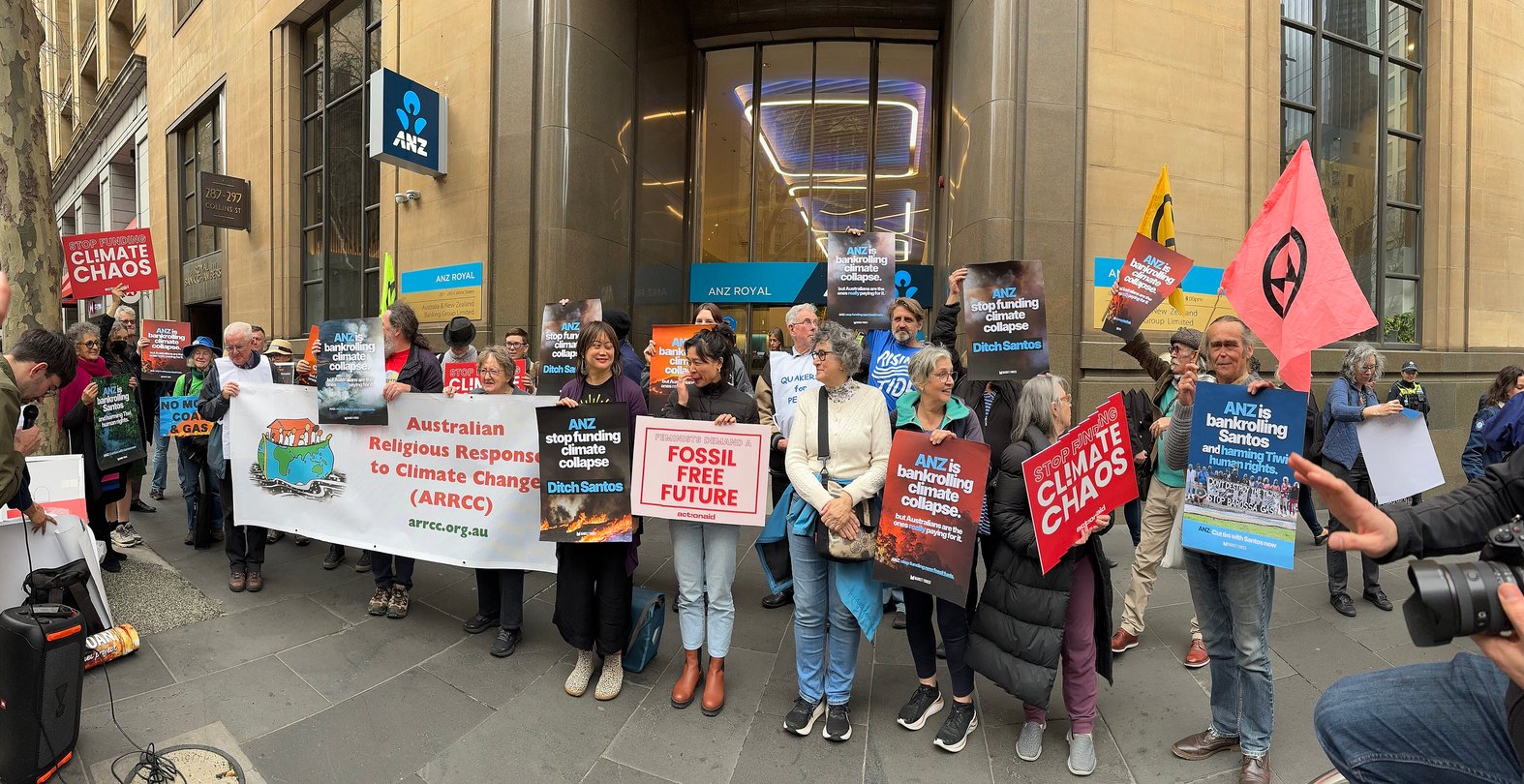
Photo: Rally to put pressure on ANZ, NAB and Westpac not to approve a loan to Santos. By John Englart
Within hours of the Federal Court publishing its decision in what was billed as a landmark greenwashing case, Australia’s oldest oil and gas industry association wasted no time in calling for “activist groups” to be stripped of their democratic right to sue in court. Days later, Australian federal Resources Minister Madeleine King expressed her “deep concerns” about the conduct of lawyers involved in the case, saying she expected “a higher standard of conduct” despite no adverse findings against the case.
The cynical opportunism outside the courtroom offered a curious twist on what had been a messy process. The week before, on February 17, Federal Court Justice Markovic handed down her decision in the case, brought by the Australasian Centre for Corporate Responsibility (ACCR) against Australian oil company Santos five years earlier. It was a significant case, both in Australia and worldwide. ACCR was a shareholder advocacy group that held shares in Santos, which, at the time the case had been brought, had been making a significant play into hydrogen production and carbon, capture and storage (CCS). The complaint charged Santos with misleading and deceptive conduct under Australian consumer law, and was the first among what would become a clutch of successful greenwashing cases brought by advocacy groups and corporate regulators.
At heart were two claims made by the company that the ACCR found to be fraudulent: the first that it had a “clear and credible” transition plan to achieve Scope 1 and 2 emission reduction targets by 2030 and net zero emissions by 2040 despite working to expand its broader oil and gas production. The second Santos’s claim of being a “clean energy” producer. Specifically, claims by the company that “natural gas” is a “clean fuel” and that “blue hydrogen”—produced using methane gas and CCS—is “clean” and “zero emissions”. When the decision was handed down in mid-February 2026, after five long years, the announcement was short and sweet. In an appearance lasting no more than ten minutes, Justice Markovic dismissed the matter outright and ordered ACCR to pay Santos’ full legal costs. The parties could make submissions on the costs order, she said, suggesting there was room to negotiate, but the decision delivered what appeared to be a total victory to Santos.
For days, no one other than the parties knew why. In making the order, and in deference to the company’s consistent claims throughout the process that the materials sought and obtained under discovery contained sensitive commercial litigation, the court deferred publication of the decision a week to allow the parties to suggest redactions. From the outside, this marked a dramatic turn: ACCR was not seeking damages from Santos but had brought the action as public interest litigation. Requiring them to pay the oil companies full costs, after a five-year-long legal battle, suggested they had either committed a serious error or behaved very badly. In the context of the federal court’s previous decisions, the ruling appeared to be heavy handed.
Afterwards, the reaction of the parties was muted. In a statement published to its website, Santos said it was “committed to transparent, accurate and compliant reporting” and that its climate transition plan—supported by 85 percent of voted shares at the company's 2025 Annual General Meeting—have undergone further development. A quote attributed to an unnamed spokesperson pointed to its ongoing CCS projects that it said were capable of injecting “up to 1.7m tonnes per year of CO2e for safe and permanent storage in the same geological reservations that held oil and gas in place for tens of millions of years.”
“Every four days, Moomba CCS can store more CO2 than 10,000 electric vehicles avoid in one year. That’s real emissions reduction,” it said.
In ACCR’s release, Brynn O’Brien, co-CEO, described the ruling as “disappointing”, saying it was “not about punishing climate ambition”—a concern in corporate circles referred to as “green hushing”—but “standing up for market integrity and ensuring that investors are given all the information necessary to confidently assess emissions targets and net zero plans.”
“It has been a David versus Goliath battle and Goliath won this round,” O’Brien said. “Evidence given by Santos’ own witnesses exposed reverse-engineering of emissions numbers and materials to meet top-down CEO demands. This is troubling behavior and should reinforce investor concern about leadership and cultural issues within the company.
“The ruling puts the burden on investors to scrutinize every statement, every number and every assumption provided by companies in relation to climate commitments.”
When the decision was finally published the following Monday morning without redactions, the full digital document ran to 337 pages and would take time for legal experts to digest. Across the complex judgment, Justice Markovic spent considerable time quoting extensively internal company documents and communications to reconstruct a timeline of events. Though ACCR had direct evidence that Santos CEO Kevin Gallagher directly intervened to tell staff to alter emissions data in a way that did not follow the company’s internal process and which made the company’s future emissions look kinder, the decision demurred. Context, Justice Markovic held, was king. Company claims about emissions plans had to be based on “reasonable grounds” at the time they were made, she found.
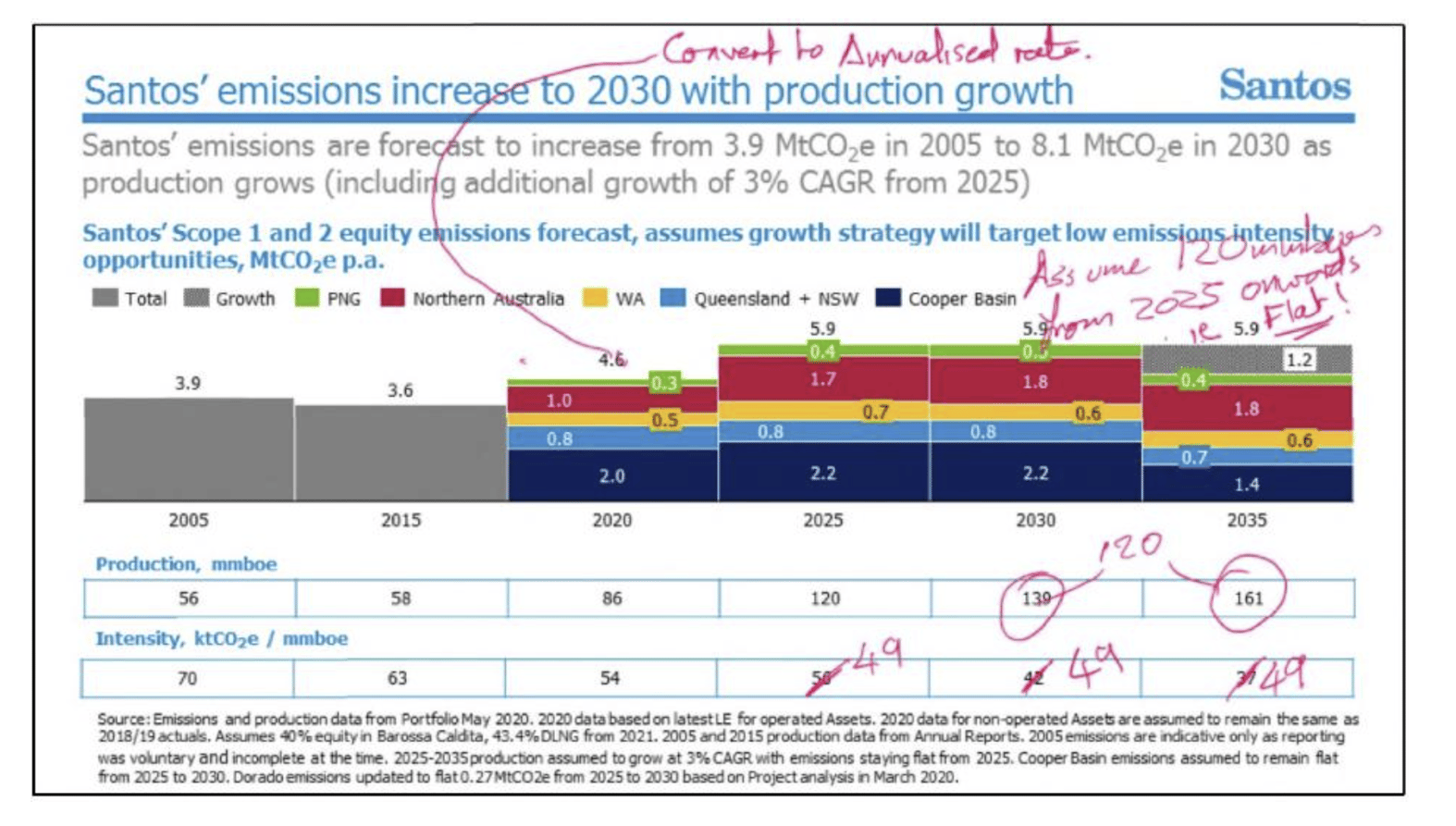
A copy of the slide published in the judgment that included notations by Santos CEO Kevin Gallagher directing staff to keep emissions flat.
When Santos announced its plans in its 2020 Annual Report, 2021 Climate Report and 2021 Investor Day presentation, she reasoned, industry jargon was in flux at the time, technology was evolving and the audience for these statements would have understood what the company was trying to communicate in context.
“[...]The 2020 Annual Report used “clean” to convey that “natural gas” was cleaner than coal and diesel, not to convey that natural gas had no GHG emissions on consumption,” the ruling said. “As is apparent from the extract from the Chairman and CEO Message set out above, Santos stated that it ‘has committed to working with [its] customers to reduce their emissions. In the near term, this means switching from heavier emitting fuels, such as coal and diesel, to cleaner fuels such as natural gas.’ That statement does not convey that natural gas is “clean” but that it is in relative terms cleaner than coal and diesel.”
These statements, it was held, were being made in the context of Santos’ discussions about its “transition from natural gas to hydrogen’ and a “transition to a lower carbon future”. When the company said it had a “clear and credible” pathway to achieve its emissions, the court held the company was not actually making a promise that it would get there using that method, meaning it could not be held to account. Finally, the court gave CEOs and senior executives the benefit of the doubt in setting the strategic direction of the company, even where more junior members of staff might raise objections, particularly in the context of a rapidly changing regulatory and technological landscape. In one example, the court held that Santos’ could include hydrogen as a potential future technology in its Net Zero Road Map, even if it was accepted that the cost of transporting the gas alone would cost “potentially trillions of dollars”.
“To the contrary, Santos was aware of the potentially high costs but continued to investigate and consider how it could meet the technical and commercial challenges of transportation,” the ruling held.
However, what first appeared like an unreserved win for Santos met a mixed response among legal experts. A case summary published by MinterEllison, one of Australia’s biggest law firms, presented the decision not as a stunning triumph for the company, but a stern reminder for its clients that “organizations making claims about emissions reduction and net zero ambitions must be able to substantiate their claims with contemporaneous reasonable grounds because, if challenged, the evidentiary burden falls squarely on them.”
Dr Ella Vines, a legal expert with Monash Business School said the decision indicates the courts will not punish companies for trying something new, which may address concerns from the business community about “green hushing” following a string of greenwashing cases. She noted, however, that it was not without challenge as the court extended “a lot of latitude” to fossil fuel companies, even as other jurisdictions and the International Court of Justice have recognized that individual companies can be held to account for their emissions, and in fact need to be.
“The court treated the statements Santos made as forward-looking, corporate intentions rather than guarantees of future outcomes, and that interpretation was decisive,” Vines said. “Something that really struck me about the judgment is the way the court deals with a dynamic policy context.
“In this case the company was granted leeway to assume that policy or methods to capture carbon to produce blue hydrogen that would develop over time and it could make claims on that basis. If you look at other cases like Pabai, the judge there said the law as it stands, the law of negligence, can’t address the issue of climate change. For that, they said, you’d need a higher court to make a decision on it or new laws from the government.” So while companies can base claims on policies or technologies that don’t yet exists, the courts have not granted citizens those rights.
“There’s a real contrast in approach [between doctrines in Australia].”
Rebekka Markey-Towler, a legal academic and research fellow at Monash Business School, said she expected the decision to be appealed. Markey-Towler, who also manages a database tracking climate litigation in Australia and the Pacific maintained by the University of Melbourne, described the case “as more a vanilla commercial company law case, than an environmental law case” that involved “the application of non-climate specific provisions to a climate problem”. One area of possible contention, she said, was the way the court appeared to shift the onus onto investors to scrutinize claims. In particular, she pointed to some acknowledgement early in the judgment that the target audience for Santos claims included a mix of investor types with different levels of knowledge, insight and expertise, even as it concluded later that these investors would be sophisticated enough hold all the specialist knowledge needed to parse the company’s claims about the production of hydrogen, CCS and other issues.
“The decision seems to focus on the knowledge of these investors,” she said. “Knowledge can play a role, but the job in misleading and deceptive conduct is to focus on whether the communication is misleading and deceptive.”
There were potentially other issues in the judgment that could be subject to challenge, she said, including assumptions around the practice of offsetting, particularly when used by fossil fuel producers. Other commentators have pointed to similar problems, including errors of fact such as confusion about the type of emissions counted under Australian regulations.
Professor Jennifer McKay, a legal academic from Adelaide University who studies greenwashing, said that, whatever the detail of the decision, her concern was more about how it was being used outside the courtroom.
“There are nuances, but I imagine there will be a lot said in the press about how the ‘woke greenies have lost’,” McKay said. “It will add fuel to the fire of people saying this is all woke nonsense and saying climate change isn’t a thing.”
Predictably, industry wasted no time in offering a narrative about the outcome, repeating calls for a “crackdown on activist groups misusing the courts to target essential energy projects and companies” it had previously made. In a press release, Australian Energy Producers welcomed the decision saying it “reinforces the need for far greater transparency and accountability around the funding and coordination of activist litigation.”
“There must be stronger disclosure of who is funding these organisations and the interests driving these legal campaigns,” AEP CEO Samantha McCulloch said.
The rush to claim the high ground was part of a broader pattern by AEP, which represents Australia’s oil and gas producers, an industry segment that has historically made very effective use of strategic marketing. To date their efforts have received political support on the conservative side of Australian politics, with the federal Coalition pledging to defund environmental organizations to protect industry from “green lawfare”. The Coalition lost in a landslide at the May 2025 federal election, but the organization cheered on similar moves by conservative-led state and territory governments—though even the centre-left federal Labor government appears to be embracing the industry view. In February, Federal Resources Minister Madeleine King was reported to have raised concerns about the conduct of lawyers from the Environment Defenders Office who represented ACCR despite the court making no findings against them regarding their conduct.
AEP’s demands would not go unanswered, however. Two days later, a group composed of respected legal academics and civil society groups including the Centre for Public Integrity, Climate Integrity and Australian Democracy Network fired back, calling the industry’s demands “undemocratic, dangerous and ultimately self-interested”. These groups accused AEP of seeking to “undermine” public interest litigation which it said was “critical to a healthy, functioning democracy” and that the right to bring a case to court was a “core function of our democracy”. The speed with which the industry group acted was rash, they suggested, given the possibility it may be subject to appeal.
Whether ACCR will actually appeal remains to be seen, with the organization considering its options. The costs order is likely to weigh heavily on the decision, and influence the thinking of others in the future. Josh Pallas, legal director of Climate Defenders Australia, said he could not speak to the specifics of the case as it involved an area to law his organization did not normally operate in, but more broadly he said the costs order suggested against ACCR would make the average person think twice about taking legal action in the future.
“I think it is showing a broader pattern of courts being more amenable to making adverse costs orders,” he said. “When you’re running any case you have to give advice to your client about adverse cost implications. And if costs are being awarded against public interest plaintiffs, you have to give advice to those clients which is understandably scary for people in that position.”
Professor McKay compared the effect to a SLAPP suit—an acronym for “strategic lawsuit against public participation”. These are cases often brought by companies against activists and critics to tie up individuals and organizations in complex, expensive legal proceedings or push them out of public debate. Public interest litigation helps tests questions of law where there is uncertainty and can often be beneficial to all parties and the courts by offering clarity, she said.
“It’s not a great decision. It sets things back,” McKay said. “Most of the time the community doesn’t get negative or critical information about companies in the public domain. Greenwashing litigation is an important check and balance. It brings the behavior of corporates to the community’s mind and into line with their expectations.”