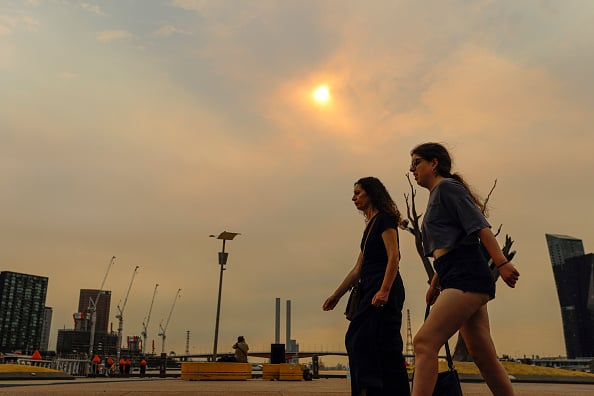
Cover photo: Women walking as the red sun casts an orange glow over Docklands in Melbourne, with smoke from fires visible in the sky. Smoke from multiple bushfires and grassfires burning the city in January affected air quality and visibility, turning the sky red. (Photo by Ye Myo Khant/SOPA Images/LightRocket via Getty Images)
In early January 2026 the Australian state of Victoria burned once again. Scorching heat from the arid center of the continent swept down into the southeast during the opening days of the new year. After successive days of 40C-plus temperatures, the firefronts multiplied. After a week, fast-moving grassfires had consumed 400,000 hectares and forced evacuations. Afterwards one man, a cattle farmer, had been killed—his remains found 100m from his car—more than 250 homes were destroyed, nearly 900 structures burned and 15,000 livestock were dead. Even when the weather turned, authorities reported ten major fire fronts continuing to burn across the state, and 32 active blazes.
And then two weeks later, it happened again as another heatwave across the southeast coast of the continent pushed temperatures close to 50C in parts of South Australia and saw fire force evacuations in the Otways, a sizable chunk of Victoria’s western coastline.
In the same weeks that the fires burned and the southern cities roasted in a heatwave, Tropical Cyclone Koji made landfall in Far North Queensland, bringing torrential rain and flash flooding. In the following weeks, New Zealand’s east coast was battered by storms. Though it was too early to put a dollar figure on the damage in Australia, the Insurance Council of Australia (ICA) estimated that extreme weather in 2025 caused $3.5bn in insured losses from 264,000 claims. Relying on work by the McKell Institute, the Council estimates that by 2050 insurance claims from “natural perils” will reach at least $35bn a year. Within weeks of the first round of fires, a rapid attribution study released by World Weather Attribution found climate change not only made the intense heatwave five times more likely but added 1.6C to the recorded temperatures. Speaking to reporters in a media briefing, Dr. Ben Clarke, a researcher from Imperial College London, said climate change meant heatwaves were becoming the norm for Australian summers.
“ We can estimate that climate change increased the likelihood of this particular event in southeastern Australia by about a factor of five in likelihood, and made it about 1.6C hotter, which in turn would've made it much more dangerous for some people,” Clarke said. “We also looked a little into the future, up to 2.6C of warming, so another 1.3C from today and found that in that world, heatwaves like this would increase by another two to three times in likelihood and a further one and a half degrees or so in intensity.”
The present reality illustrates the failure of the Australian government and the agencies it relied upon to imagine such a future and act accordingly. Cabinet documents, newly released under the 20-year-rule, show how in August 2005 the Australian government—led at the time by conservative prime minister John Howard—was warned that “the climate is changing and some observed changes are occurring more quickly than had been predicted”. Though the document noted that “many human and natural systems and economic activities in Australia are vulnerable to the potential impacts of climate change”, it also stressed “gaps remain in our knowledge of the timing, location and magnitude of these impacts.” In response, the government chose to do nothing.
The general indifference of the Howard government to climate change is well documented. New material obtained by Drilled from the National Archives of Australia, however, shows the extent to which the attitudes of the Howard years were enabled through the capture by industry of chokepoints within the Australian bureaucracy years before, under previous governments. These documents reveal how multinational oil and gas companies, acting at a moment when a globally-coordinated campaign to spread doubt and uncertainty about the science of climate change was at its peak, encouraged a key Australian government agency to approach the issue using their preferred framing, ideas and language. The agency went on to use economic jargon to rationalise inaction, and to make interventions into public discussions about climate change that emphasized the cost of action and uncertainty over potential harms from a breakdown in climatic systems. The result was a total failure to imagine the future many Australians now live—one that has arrived within the lifetimes of even those involved in writing these same reports.
As Drilled previously reported, the International Petroleum Industry Environmental Conservation Association (IPIECA), a UN-affiliated organization, helped seed the economic argument against acting on climate change. It did so partly with the help of a former Australian agricultural economist named Dr Brian Fisher, working within a tiny, innocuous government agency known as the Australian Bureau of Agricultural and Resource Economics (ABARE, pronounced “A-BEAR”). Under his leadership, the agency popularized and perfected the use of economic modelling as a specialization within the public service, and then applied this to questions about how to respond to climate change. The agency’s approach to modelling would be challenged in 1998 with a light-touch Ombudsman investigation—the only real accountability ABARE ever faced. This investigation found that fossil fuel producers had been involved in the development of ABARE’s modelling capacity. With time, many of its former staff filtered away into other areas of the public service, the private sector, universities or retired. A successor organization, ABARES, continues to operate today.
The previously unknown materials shed light on internal workings and attitudes within the agency that were previously unknown to critics of the agency at that time. When shown a sample of the materials which run to nearly 2000 pages, Dr Clive Hamilton, who fought ABARE over its approach to modelling in the mid-1990s said the documents provided evidence of what he understood at the time: “ABARE was actively in cahoots with the big polluters.”
“It had abandoned its role as a public service agency serving the public interest. Frank and fearless had left the building. It was scandalous. It was even more scandalous that governments allowed it to happen,” he said. “It engaged in highly political scare-mongering on behalf of the big greenhouse gas polluters. As a public service agency it had sold its soul.”
Hamilton added that “ABARE never faced any proper accountability or penalty for its secret collaboration with the fossil fuel industry” outside of the 1998 Ombudsman process which he said “pulled every punch”. It would, he said, be “brushed aside” by the agency and “ignored” by government.
“Like the new plaque beneath the picture of Ben Roberts-Smith at the War Memorial, there ought to be a plaque at the entrance of ABARES office building at 70 Northbourne Avenue acknowledging its past wrong-doing.”
ABARE’s transition from obscure government office generating agricultural statistics to a policy shop helping inform government policy in the late 1980s came at a heady time of budget cuts, restructures and pledges to run government agencies as private businesses. In many ways, ABARE would be set up to fail. The agency was born in 1988 when the Bureau of Resource Economics (BRE) and the Bureau of Agricultural Economics were amalgamated, and placed within the newly-created Department of Primary Industries and Energy. Through this process, the new agency faced changes to its funding structure that encouraged it to seek money elsewhere. External funding made up just 15% of ABARE’s budget in 1988, but according to Fisher, the agency was directed to operate similarly to peak scientific agency CSIRO and generate 40% of its budget from private sources. This created an internal incentive structure that appeared to drive the agency’s decision making for the next decade—and pushed it into the arms of oil, gas and coal producers.
Once confidential agency documents, released under the 20-years-rule and available from the National Archives of Australia show how fossil fuel producers were happy to take advantage. These materials show how, early on in ABARE’s formation, two fossil fuel majors, BHP Petroleum and Shell, nudged the fledgling agency towards investigating policy responses to climate change. Each year ABARE would undertake consultation with various stakeholders who relied on its work. During one round of consultation in 1988, Bob Foster, a former Shell geoscientist and General Manager of External Relations at BHP Petroleum, wrote to ABARE about “a relatively new issue that has caught our attention, and on which we have done some work recently: Greenhouse implications of meeting Australia’s electricity demand growth.”
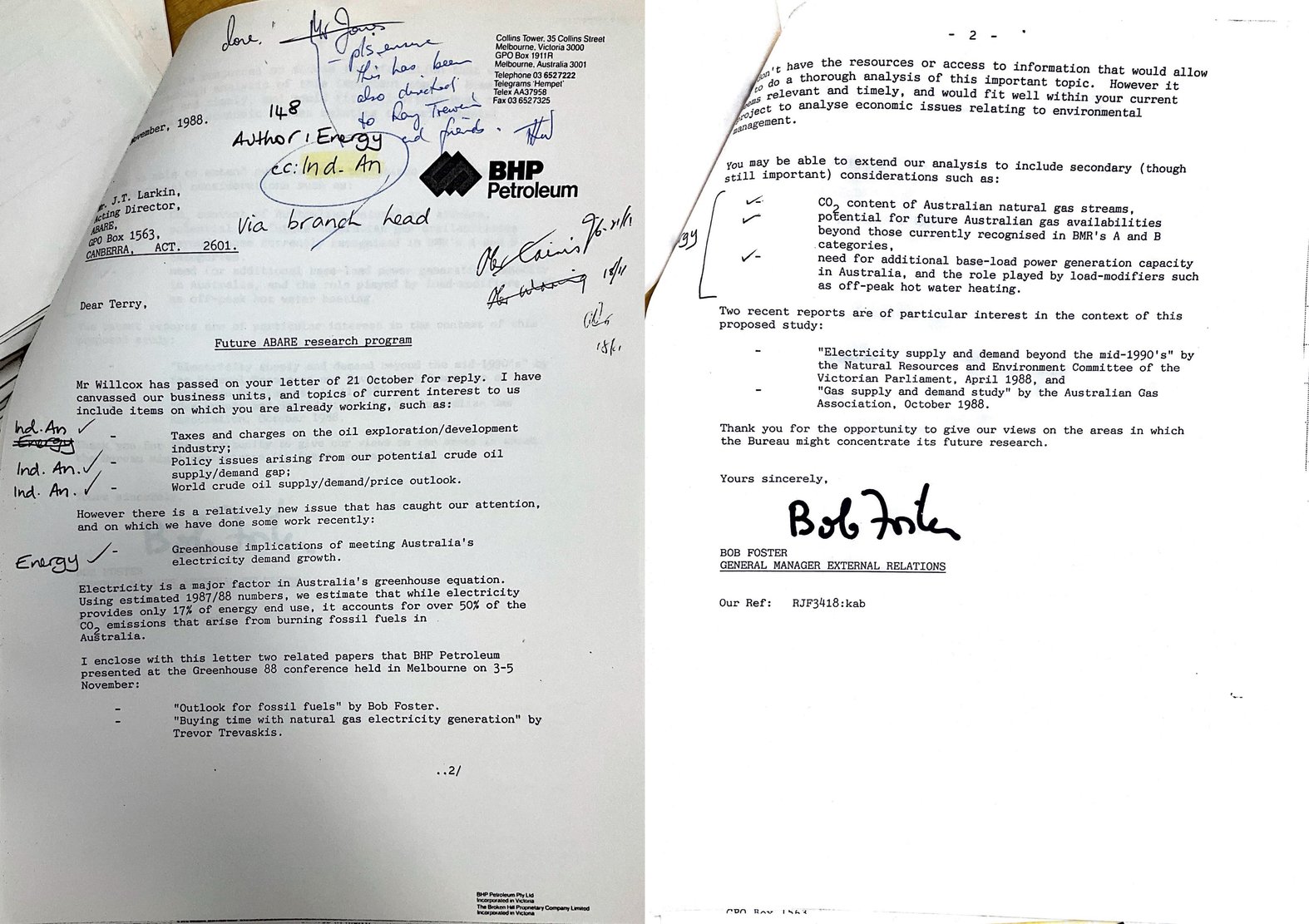
A copy of the letter sent by Bob Foster to ABARE in November 1988 retrieved from the National Archives of Australia.
Foster was a storied figure within Australia’s oil and gas industry. He would later become a prominent climate denier, acting as a founding director of the Lavoisier Group that attacked the science of climate change, before his death in 2014 where he was eulogized in an obituary published in The Sydney Morning Herald as “one of Australia’s most significant, erudite—and controversial scientists”. In his letter to ABARE, he outlined how BHP Petroleum estimated that “while electricity provides only 17% of energy and use, it accounts for over 50% of the CO2 emissions that arise from burning fossil fuels in Australia.” He cited two papers for further reading—one a copy of a speech he had given to an event on climate change in Melbourne earlier in 1988 hosted by the Commission of the Future—before suggesting that “it seems relevant and timely, and would fit well within your current project to analyze economic issues relating to environmental management.” ABARE might even consider going further, he offered, and “extend our analysis to include secondary (though still important) considerations” including the CO2 content of Australian gas resources, its availability across the Australian landmass, and the “need for additional base-load power generation capacity”.
His suggestions, however, do not appear to have been immediately taken up, likely because ABARE at that time was a mess. According to Fisher, it took three years to organize the agency into a coherent outfit thanks to a clash in work culture between staff from its predecessor agencies. The documents make clear, however, that the agency canvassed the industry for its input into its work program. Hand-written notes on one document at the start of ABARE's January 1990 consultation round among “major clients” selected seven influential figures within the Australian oil and gas industry as potential “cooperators”: Peter Willcox, Executive General Manager of BHP Petroleum; John Schubert, Chairman and Managing Director of Esso Australia; Keith Orchison, Executive Director of the Australian Petroleum Exploration Association; Jim Starkey, Executive Director of the Australian Institute of Petroleum; Paul Netherton Greenhalgh, General Manager of the Australian Gas Association; Kevan Gosper, Chairman and Executive Director of the Shell Company of Australia; John Shawley, President of BP Developments Australia Ltd.
A few months later, Richard Clarke of Shell Australia responded to a new request for input in a letter dated 8 March 1990. In it, he suggested the agency undertake two studies, the first modelling the demand for transportation fuels “with particular reference to analysis of the determinants of fuel efficiency” and the second, “a comparative analysis of the all-up costs and benefits of alternative fuels for power generation in Australia with a particular emphasis on coal and natural gas”. Both, he suggested, had “‘Greenhouse’ aspects”. He then went on to suggest: “More generally, we think it would be useful for the Bureau to give some consideration to the implications for the Australian resources and energy sectors of policies which may be adopted (both in Australia and overseas) in response to concern over greenhouse effects. For example, what are some of the possible consequences for: the level and composition of demand for transport fuels, Australia’s exports of coal and natural gas?”
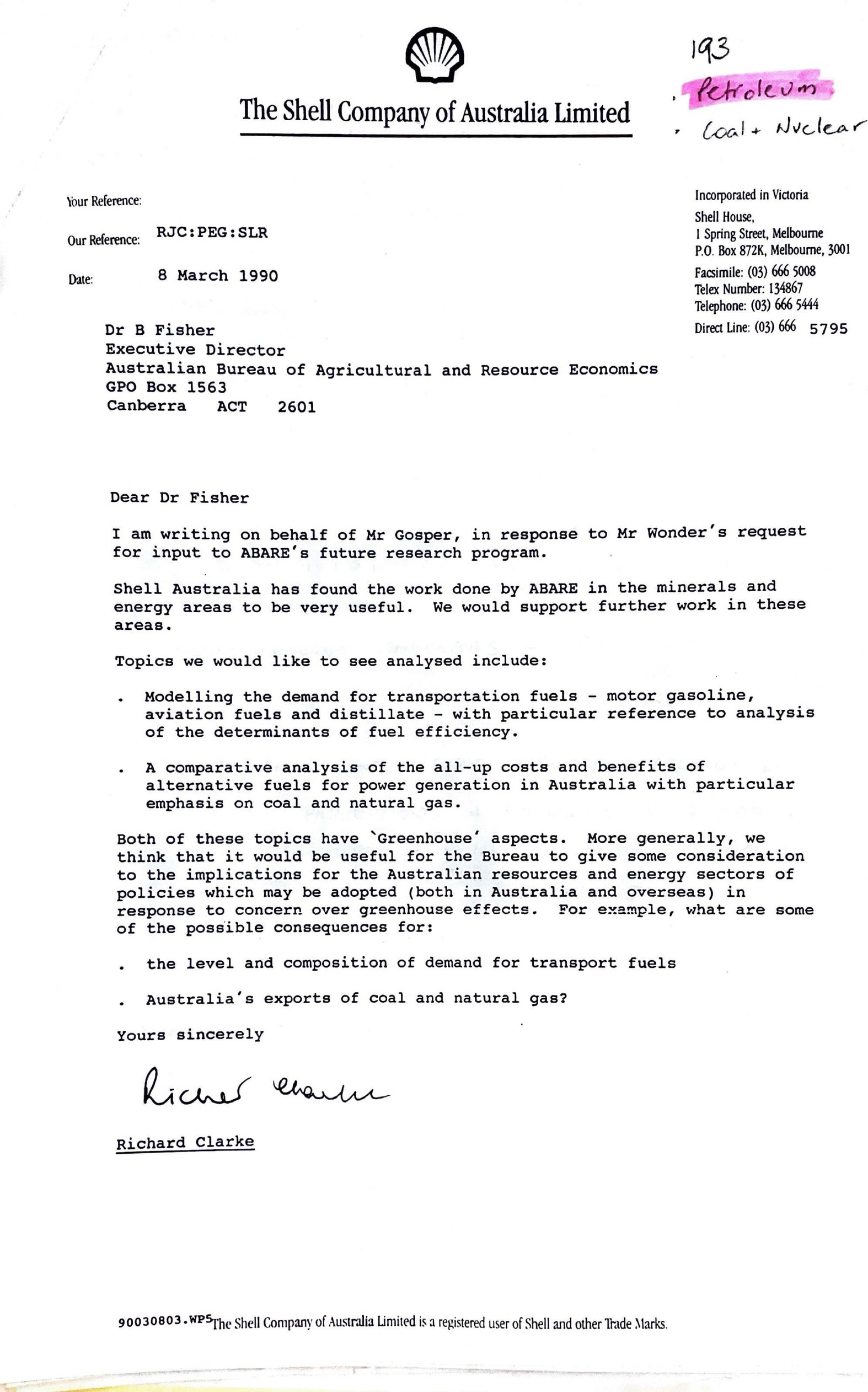
Copy of letter sent by Shell’s Richard Clarke to ABARE dated 8 March 1990 retrieved from the National Archives of Australia.
The final point was crucial. Clarke was, in effect, suggesting certain ideas be investigated, but also offering Shell’s—and the wider petroleum sector’s—preferred language and framing. This framed the issue not as an existential threat to a society that relied on stable and reliable climatic systems to function, but as one concerned with the economic cost to the country’s gas and coal exports. It was a conceptualization of the problem that, judging by ABARE’s output, appears to have been adopted internally without challenge.
This was thanks in part to a figure named Barry Jones. Jones, who shared a name with the Hawke-era science minister but was no relation, served as manager of the Petroleum Economics Section within ABARE’s energy division. Weeks after Shell sent its letter to the agency, Jones submitted his own five-page report outlining his thoughts on the future of the agency’s work program. In particular, he highlighted the need for work on “other general energy issues which transcend commodity boundaries, such as those relating to greenhouse and electricity” stating that “greenhouse”, as an issue “simply cannot be ignored.”
“Greenhouse issues are attaining a much higher priority, and ABARE has done little work to date,” he wrote. In a nod to the agency’s current direction, he suggested that “more broadly, for greenhouse and other purposes attention to energy-economy modelling may also be useful.”
Jones’ work within the agency would bring him into contact with key figures in the petroleum sector that would serve him well just a few years later. Having been passed over for promotion in the public service, he switched teams. He first ran Pulp and Paper Manufacturers Federation of Australia, once considered a proving ground for new industry association CEOs and the starting point in a line of succession through to more prestigious organizations, before later heading up the country’s oldest enduring oil and gas industry association, Australian Petroleum Production and Exploration Association (APPEA). The organization, originally founded as the Australian Petroleum Exploration Association (APEA), recently rebranded to become Australian Energy Producers (AEP). To avoid confusion, and owing to the time period being discussed, Drilled has used “APPEA” to refer to the organization throughout this story unless directly quoting or referring to a source document. During his time with APPEA, Jones helped coordinate lobbying by a cross-industry alliance of heavy emitters that sought to pressure the Howard government into not signing and ratifying the Kyoto Protocol.
During his years with ABARE, Jones agitated for the agency to work on climate change issues. When sharing his thoughts on its work program, Jones complained his team did not have enough resources to properly cover the issue. Later that year, Jones appears to have taken the initiative and sought extra resources for several projects related to greenhouse issues when Fisher was out of the office on holiday. The undated proposal, which was eventually endorsed by Fisher, asked for additional funds for model development, a project to “determine the least cost mix of energy production given information on available end-use technologies and transformation possibilities, assumed demand levels (including export demand) and a target level of greenhouse gas emissions”, and another to “enable the analysis of the potential for changing agricultural practices in the face of climate change and whether economic as well as trade benefits would flow from this”.
It also appears Jones was responsible for hard-wiring the industry’s preferred framing and logic into ABARE’s thinking when it approached projects on the issue. In August 1991, Jones’ name was attached to a foundational economics paper produced by ABARE that would be repeatedly referred to across the agency’s output over the next decade. The paper, “World energy markets and uncertainty to the year 2100: implications for greenhouse policy”, leaned heavily on the economic orthodoxy and lingo of its day to discuss what it called “optimal greenhouse gas emissions”. Opening with a foreword from Brian Fisher and twice citing William Nordhaus, the authors approached addressing climate change as a cost-benefit analysis. Though it was easier to measure the cost of acting on climate change, at best, they argued, it was only possible to guess at the cost of climate harms.
“The costs of these emissions is not known with any certainty. This uncertainty becomes even greater when assessing the effect of climate change on particular communities,” they said.
Timing was also an issue. Money spent today was a burden on those alive now, they argued. Even if action brought a benefit, or avoided harm, the people who would get to enjoy this advantage were those living “as much as fifty years into the future.” This raised the question, they suggested: was it worth it? If the money wasn’t spent, and the emissions released in the meantime were associated with rising living standards, they asked, what if that economic gain would be of greater benefit to future generations than the cost of securing a stable climate? It was an approach to risk management that found its apotheosis about fifteen years later in BP’s notorious “Three Little Piggies” memo. The thought experiment put a dollar value to the life of the three little pigs from the children’s fable to explore the circumstances under which they might be better off risking being eaten by a wolf and pocketing some extra cash, rather than spending to build a brick house.
The authors closed by arguing that any attempt to substitute out fossil fuels would be premature: “The conclusion to be drawn from this result is that the consequences of research and development efforts on, or calls to subsidize, certain technologies on the grounds they could lead to reduced greenhouse gas emissions need to be examined carefully. The full implications over time of such policy measures need to be measured against all alternatives.”
In an email responding to detailed questions from Drilled, Fisher declined to discuss Jones, who died after a brief illness in 2005, or any members of his staff from this time, except to say that he believed they “were all trying to do their jobs as effectively as they could given the constraints and bureaucratic culture in which they were operating.” He also rejected any suggestion that ABARE’s attention to climate change originated with staff, or from outside actors, saying the focus was always to develop ABARE’s expertise in modelling “with the aim of informing the government of its strategic options at the climate negotiations.”
“This work grew out of our ongoing research on freeing up global trade and it was largely our trade analysts who were involved in the CGE modelling (other than the coders and mathematicians),” he wrote.
Time, however, would prove the agency’s internal thinking catastrophically wrong. Today’s sophisticated satellite and computational data that underpins current climate science may not have existed at the time, but the report’s authors regularly grappled with the unknown. The models they ran to generate simulations of the economy relied on making “assumptions”. A crude but conceivable method could have been to find the average cost of fire and flood to Australian agriculture in insurance and productivity losses, for example, before making an informed assumption about the increase under climate change and applying it to get a result. There is nothing in the documents obtained by Drilled to show ABARE attempted to estimate the cost of failing to act on climate change in its reports. The price for that oversight would run into the billions. Three decades later, in September 2025, when Australia released its National Climate Risk Assessment, it estimated the cost of disaster recovery to increase to more than AUD$40billion (USD$28 billion) a year by 2050.
In the short term, Jones’ co-authored paper served a rhetorical and political function through the “anchoring effect”, climate transitions scholar Dr. Marc Hudson says. Reviewing a selection of materials, he said the paper acted as a foundational work that ensured certain arguments and a preferred way of thinking became “the anchoring point for all other debate.”
“Vested interests will always say a problem that challenges them is illusory,” Hudson says. “Once that no longer works, they do two things: they say the costs are too difficult to quantify exactly, and that in any case, it's a collective problem, with everyone to blame.”
“On climate change, the costs are not always easy to quantify exactly, for various reasons. ABARE would talk up the costs of acting, using any number of absurd tricks – many readily exposed at the time.”
Responding to criticism about his agency’s failure to model the effects of climate harms and mitigation, Fisher—who served as agency head under both centre-left Labor and conservative Coalition governments—said ABARE had been hamstrung by political shortsightedness. Under his leadership, he said the agency had undertaken a research program “aimed at developing a full integrated assessment model” that could “calculate damage costs as well as mitigation policy effects” but did not get any interest.
“Such models, if they are properly done, are complex, expensive to build and very time consuming to maintain,” he said. “I was not successful in interesting either the government or private industry in funding the necessary effort so the work didn’t get beyond the building of a prototype.”
Even acknowledging that ABARE was forced by its funding arrangements to cater to the interests of government and business, other materials reveal it still maintained a very close relationship to industry throughout the 90s. Planning documents for an early conference organized by the agency dating from 1989, a time when it was keen to court the petroleum sector, show it sought to facilitate a request by APPEA’s Keith Orchison to host an industry dinner during the event. Orchison would later host regular “executive dinners” that included the heads of industry associations representing heavy emitters. These acted as opportunities to discuss issues such as climate change, and to organize politically against government attempts to address it. In another example from 1993, Fisher authored a paper presented to the annual APPEA conference where, in promoting the use of the agency’s newly developed model, MEGABARE, he pointed directly to climate change as an example of how a lack of information led to uncertainty that made decision making more difficult.
“While it may be possible to determine the extent of greenhouse gas emissions resulting from a given level and mix of economic activity, the effect of those emissions on the level and mix of future economic activity is difficult to ascertain,” the paper said.
In 1995 APPEA commissioned ABARE to carry out a study to “quantify the economic net benefits of developing Australia’s petroleum resources.” At that time, the industry thought itself “underrated in the popular (and policy making) mind” partly because “its indirect economic benefits (including local content) are not well understood”—a perennial complaint within the Australian oil and gas sector. Among several objectives, the final project would include both “an evaluation of the industry’s contribution to regional economic growth” and a “cost-benefit analysis to evaluate the economic net benefits associated with capital investments made by the upstream petroleum industry.”
ABARE appears to have been aware it was being contracted to produce industry propaganda. Though the agency sought to broaden the scope of the report to include long-range production forecasts that may be objectively useful, an email from the Minerals and Energy Group Manager Tom Waring to a member of his team at 4.48pm on 30 June 1995 presented the commission as a lucrative business opportunity.
“Other industries may want similar jobs done on their economic worth, and it is definitely something other peak groups are always keen on. E.g. Mins Council is going to try to show how much the large and growing service sector derives,” Waring said, referring to the newly rebranded and influential Minerals Council of Australia.
Waring did however caution that “the challenge will be to give them something they can use without getting drawn into bad economics.”
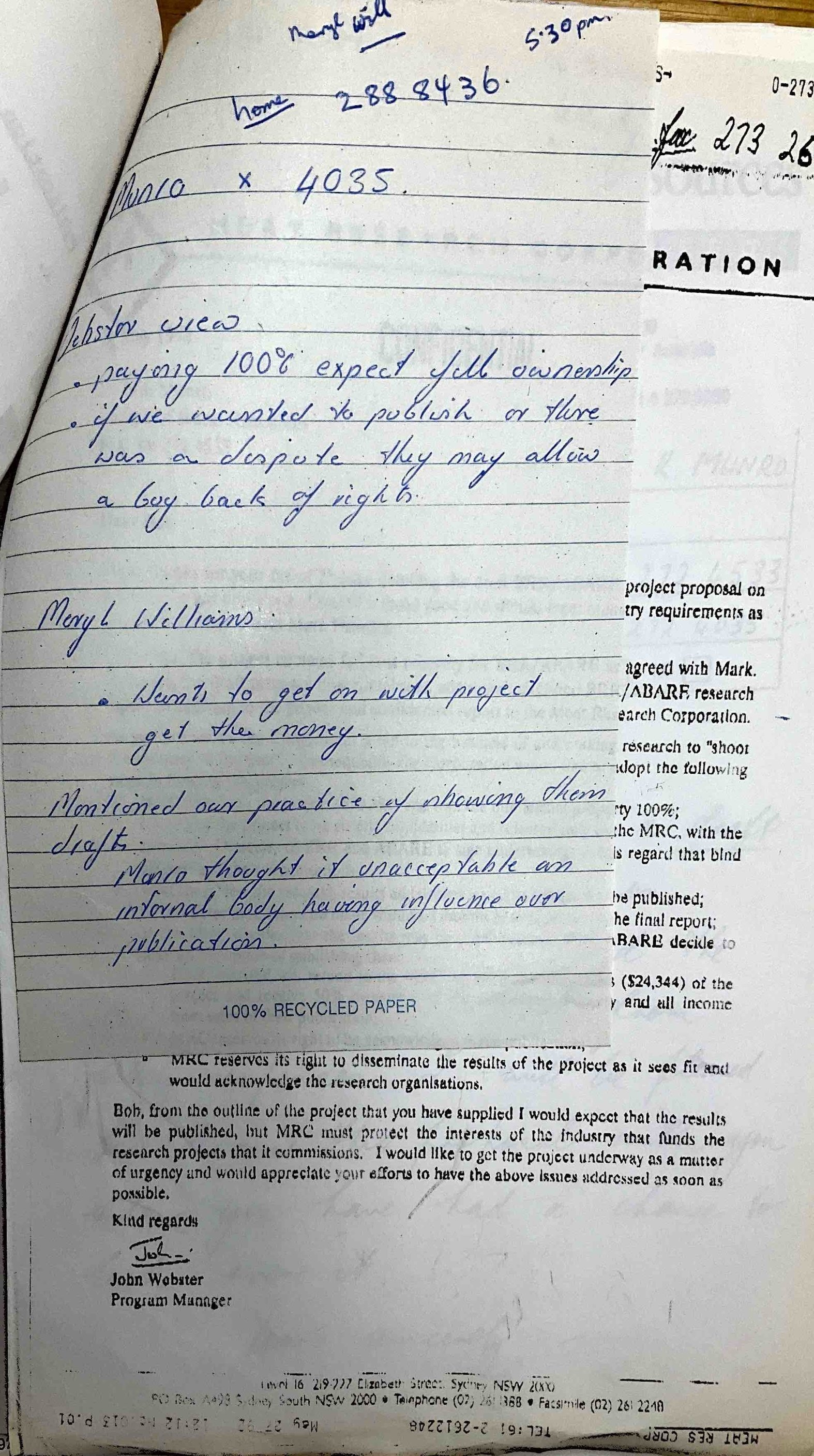
Copy of undated, handwritten note mentioning ABARE’s practice of sharing drafts retrieved from ABARE files in the National Archives of Australia.
Over the course of producing its report, ABARE would share drafts with APPEA’s then deputy chief executive Noel Mullen, an economist who previously worked for the Department of Primary Industries and Energy. Mullen offered edits on the paper in two separate letters. His chief complaint in the first letter was that ABARE had buried figures describing in dollars the economic benefit brought by oil and gas production to the Australian economy at the back of the document and asked this “area of crucial interest” be “brought forward” or highlighted in an executive summary “that brings to a reader's attention the key findings.” In a separate letter, BHP Petroleum’s Fiscal Policy Advisor, Anthony H Baird, offered his thoughts across a four page letter marked “urgent and confidential” dated 13 May 1996. Andrew Coles, Commercial Coordinator of Esso Australia’s Planning Department, offered more suggestions in a five page letter on the same day. He followed this up with additional thoughts in another letter dated 27 May 1996. Many of these suggestions appear to have been taken up or accommodated in some form in the final report, with particularly contentious sections presumably re-written or removed. Mullen, Coles and Baird were acknowledged for their “contributions and comments”, along with figures from other government departments.
This practice came dangerously close to qualifying as “ghost management” in academia and scientific fields, which raises ethical questions about the independence of a paper and its authors. Other ABARE materials from separate projects suggest the sharing of drafts was not a one off and was used to placate overbearing industry groups with specific agendas. In one example, a letter from John Webster, program manager at the Meat Research Corporation (MRC), a precursor to what is today known as Meat & Livestock Australia, was frank about its motivation for commissioning the Bureau of Resource Sciences (then called the Bureau of Rural Resources) and ABARE to undertake a climate-related study in 1992.
“As you are aware, the Corporation is not in the business of undertaking research to ‘shoot industry in the foot’,” he said in the letter marked confidential and dated 26 May 1992. Later in the same letter, he stressed that “MRC must protect the interests of the industry that funds the research projects that it commissions.”
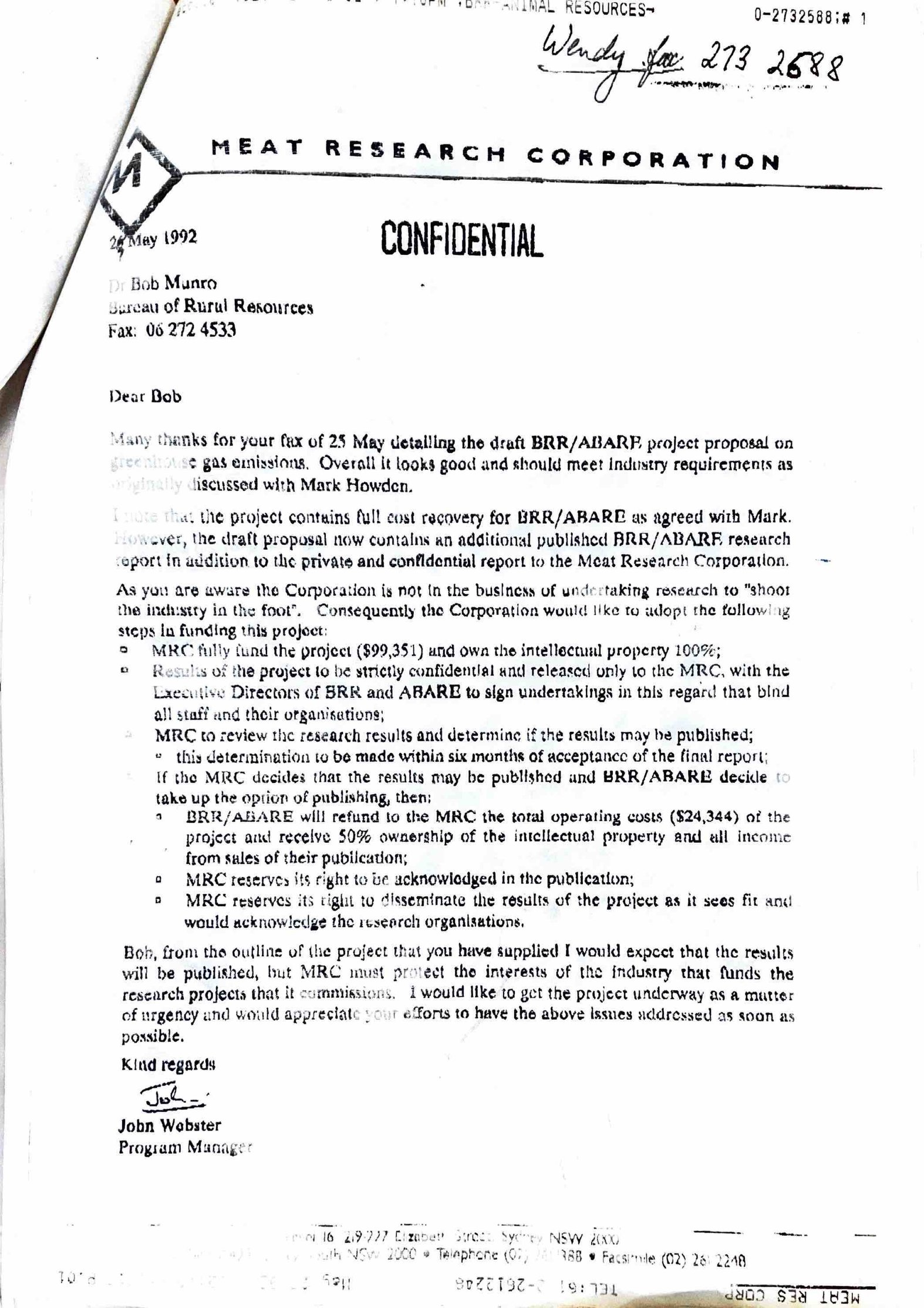
Copy of a faxed letter sent to the Bureau of Rural Resources and found in ABARE files, dated 26 May 1992 from John Webster retrieved from the National Archives of Australia.
Ultimately, the MRC study would be completed as a confidential report, with the final product delivered by November 1992. Along with its partner agencies, ABARE itself would be responsible for Chapters 1, parts 3 and 4, Chapters 5, 6, and 9, and contribute to Chapter 10 and 11. The report sought to address “various claims that livestock industries based around ruminant animals, particularly cattle, are significant emitters of gases that have been identified as major contributors to the greenhouse effect”. Among its conclusions, it found that “the main source of on-farm carbon dioxide emissions are from tree clearing (10Mt/CO2/year) but this loss is largely offset by carbon sequestration from woody weeds and tree planting (5Mt/CO2/year), and soils (4Mt/CO2/year).” One section of the report discussed “optimal levels of greenhouse gas emission” that argued “much uncertainty remains as to the nature and, indeed, the extent of the climatic changes expected to result from the increase in greenhouse gases” and that “changes in climate cannot yet be predicted with adequate accuracy.” At points, it referred to the earlier 1991 paper to which Barry Jones’ had contributed.
“Hence, the global cost of the enhanced greenhouse effect cannot be estimated with any certainty,” it said. “The uncertainty becomes even greater when assessing the effect of climate change on particular regions.”
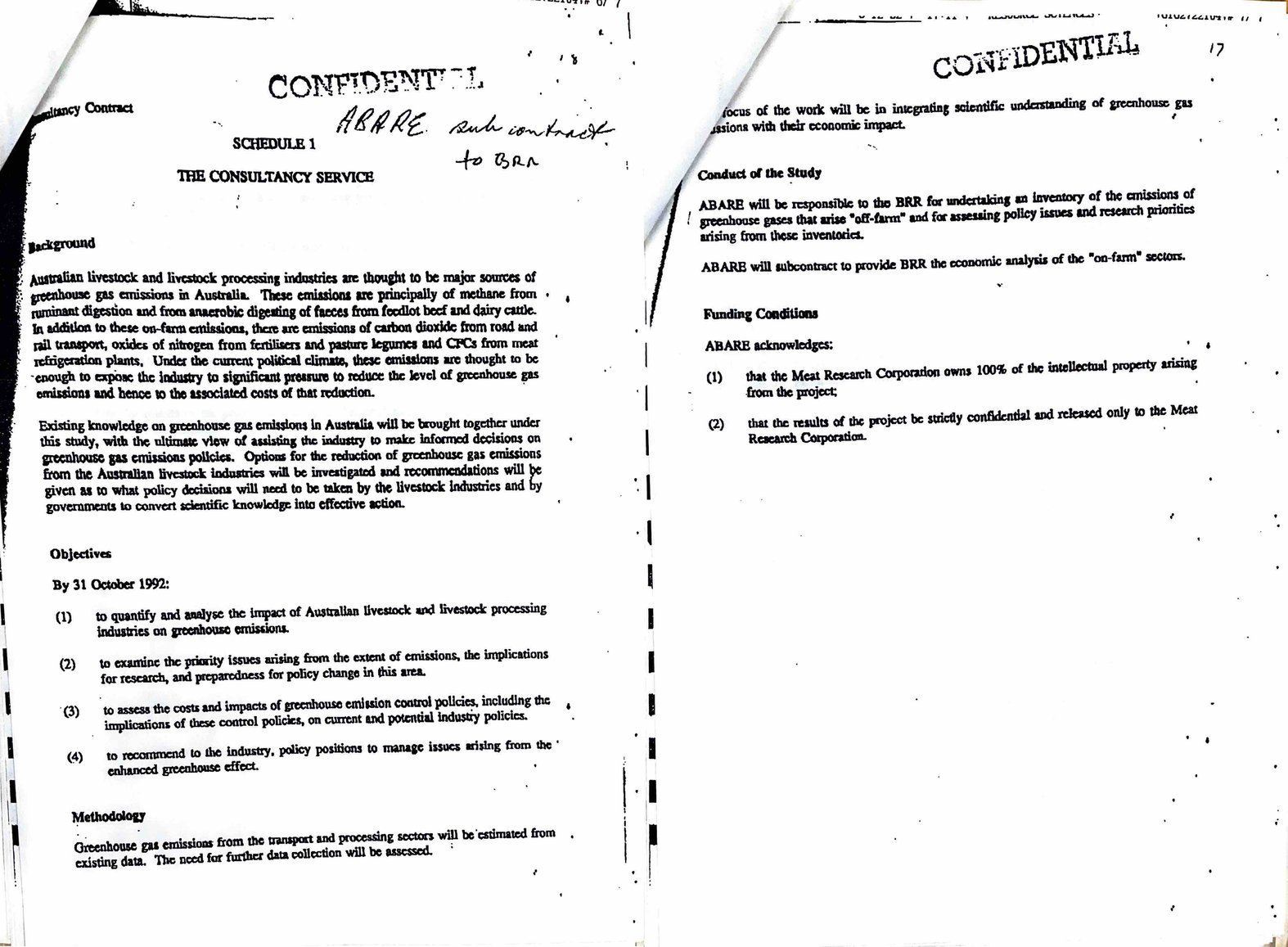
Schedule 1 of ABARE’s contract with MRC outlining the conditions of the arrangement that the agency checked before republishing, as found in the National Archives of Australia.
Under contract, ABARE had agreed to give MRC total ownership of the intellectual property in the report and to keep it confidential. On delivery, ABARE asked Webster about publication. He responded that MRC will “review the issue of publication” noting that “the report is currently not authored” and that “authorship is at your discretion[...]subject to the decision on publication.” From around March 1993, ABARE reworked, remodeled, and re-titled its original report, and made no mention of MRC. On 12 April 1994, around the time the centre-left Keating government began discussing the possibility of introducing a carbon tax, it announced the publication of this second report in a press release titled: “Reducing greenhouse gas emissions from agriculture could cost farmers $652 million.” The release suggested Australian farmers would take that financial hit were emissions reductions of 20 percent achieved under a carbon tax. A quote attributed to Fisher argued that “if a direct approach such as an emissions tax were used to reduce greenhouse emissions from crops and livestock, farmers would face significant costs.”
“An alternative approach to reducing greenhouse gas emissions from agriculture, in all states and regions, would be to concentrate first on encouraging the adoption of low emission farming technologies and the buildup of carbon sinks which absorb carbon dioxide in the soil,” he said.
Rod Campbell, research director at The Australia Institute, having reviewed a selection of the materials about ABARE’s broader activities, suggested they were an example of what some refer to as “policy washing”, where industry groups “launder” preferred policy positions through a public agency in order to secure preferred outcomes from the government.
“What we’re really seeing here is the complete, and willing, capture of a government agency by industry,” he said. “An agency tasked with producing research to advance the public interest that would instead produce advocacy that advanced industry interests.”
During this period ABARE’s contribution served to “divert academic and media attention away from urgent action” on climate change, using “technocratic, tedious arguments full of econobabble”, Campbell said, noting that little has changed. “Many of the same figures who were active in the nineties continue to shape public discussion about how to approach fossil fuel producers in the present, with the same issues – taxes, gas as a transition fuel and the ‘supply/demand gap’—still counted among “Australia’s hottest political topics today.”
In response to criticism of ABARE’s output under his leadership, Fisher said the agency was only acting to fill a demand. The governments it served, he said, had certain priorities that sharpened the closer events moved towards the Kyoto climate conference in 1997.
“At the time the government’s focus was on the climate negotiations and particularly on the costs to Australia of the then proposed uniform reduction targets, regardless of the economic structure of each economy,” he said. “The stupidity of this proposal is best illustrated by the destruction it would have caused to the tiny economy of Iceland where despite its sourcing power for its aluminum smelters from renewables its industry would have been wiped out because of taxes on F gases while coal-fired aluminum smelting continued apace elsewhere in the world.”
“I’m sure that many people won’t agree but I think that we contributed to progress in the climate negotiations by advocating differentiated targets at Kyoto. I believe that the negotiations at Kyoto would have failed without the introduction of the concept of differentiated targets and without success at Kyoto, perhaps as small as that success was, we would have made even less subsequent progress, even if that progress has been both very slow and halting.”
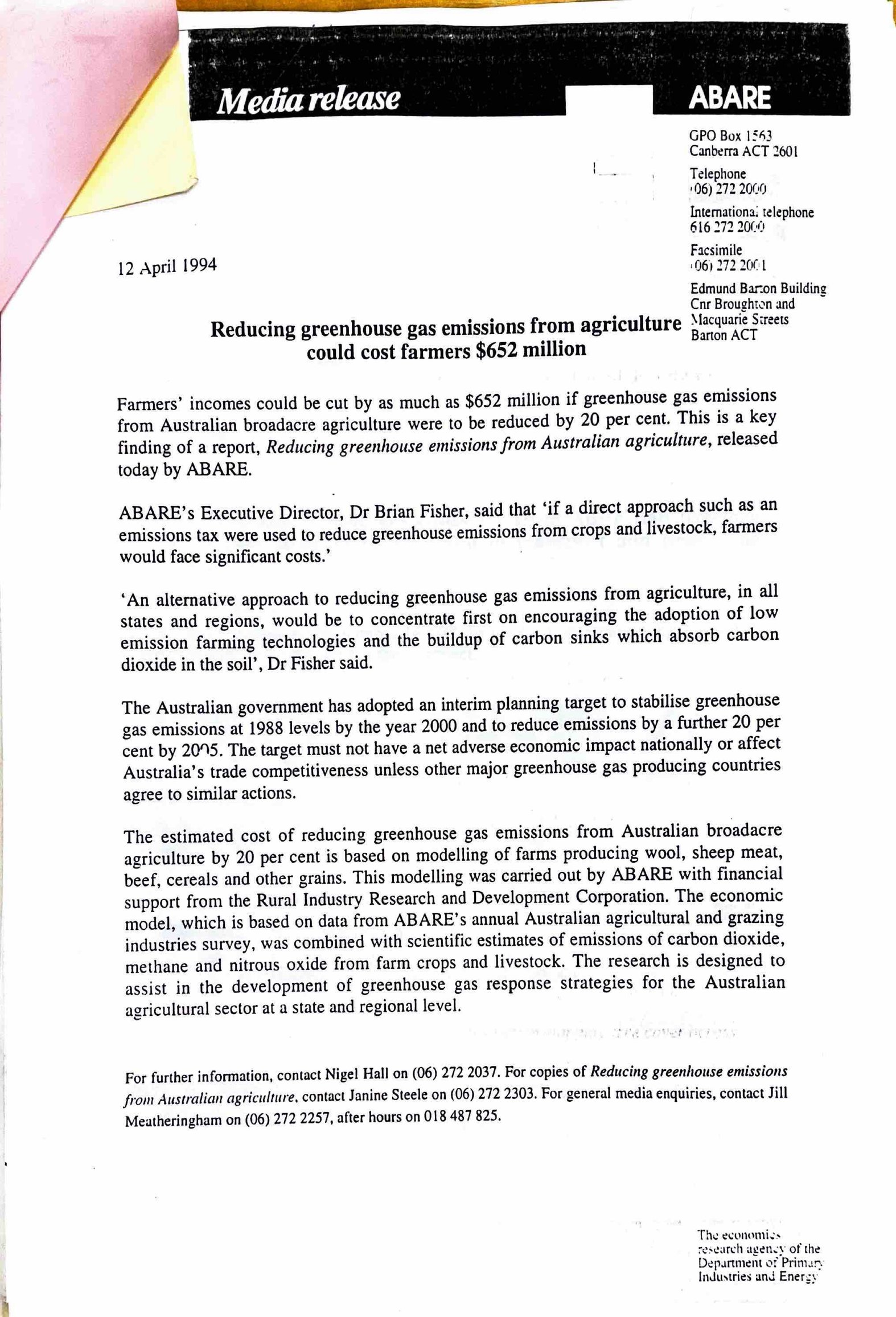
Copy of ABARE press release dated 12 April 1994 obtained from the National Archives of Australia.
ABARE’s 1994 press release, however, suggests that ABARE was not entirely a neutral actor. The timing and content of this release amounted to a direct political invention into public debate. Setting policy might be a matter for government ministers, but ABARE existed to give these initiatives life by building models, supplying numbers, and framing issues in a way that both justified certain action or inaction, and set the boundary for what was considered acceptable public debate. ABARE’s closeness with industry during this time meant it functioned as a portal through which fossil fuel producers and other heavy emitting industries could step into the realm of government decision making—a dynamic that would bring his agency into conflict with other arms of the Australian government.
Around the time the press release dropped, Fisher was contributing as a lead author with the Intergovernmental Panel on Climate Change (IPCC) and ABARE was contracted by the Department of the Environment, Sport and Territories (DEST) to undertake some projects for them, beginning with one titled “Equitable Burden Sharing Project: Australia’s national circumstances in a climate change context.” ABARE, however, framed and interpreted its numbers by reference to what the results meant for fossil fuel production and what the agency considered Australia’s narrow national interest. Project materials outlining the scope and approach to be taken emphasized how “there are a number of characteristics of the Australian economy in general and the energy sector in particular which make the cost of meeting mooted emissions reductions in Australia relatively high by OECD standards” and that “current and possible future commitments in the [UNFCCC] are likely to impose a disproportionate adjustment burden on Australia.” This theme—that any action on climate change was unfair to Australia due to its current dependence on fossil fuel exports—would be repeated at least three more times by the end of the page.
The report, however, would not be finished. A later draft, overseen by Vivek Tulpule, today head of economics at Rio Tinto, drew heavy criticism from DEST. DEST described ABARE’s approach as “unnecessary and potentially confusing”, arguing that “identification of the driving factors behind emissions does not require reference to the costs of meeting emissions targets.” DEST, in a follow-up letter sent a few months later doubled down on its criticism, highlighting its “concern that too often economic modelling results are interpreted as representing what will occur in reality.”
“DEST therefore supports the practice adopted by natural scientists, who generally present their results with appropriate caveats,” it said. “This practice ensures that policy makers using the information are well aware of the model’s limitations and their implications for the given results.”
ABARE’s general approach to modelling was criticized at the time, particularly for its habit of talking with total certainty about the cost of action as it emphasized doubt and uncertainty of with respect to climate harms. The scale of this error is best illustrated by a single factoid in its aborted attempted study on “equitable burden sharing.” In one draft, ABARE suggested that solar power would only contribute a small amount to Australia’s electricity grid. When challenged on this by DEST, who asked why no explanation was given to justify this conclusion, ABARE found a more recent study that suggested renewables might contribute “in the region” of ten percent to Australian power generation by 2019. As it turned out, when the year 2019 arrived, renewables contributed 21% to the Australian energy grid and 36% of total power generation as of 2024—numbers wholly inconceivable to the world as viewed through ABARE’s models. That, perhaps, betrays the greatest, costliest failing of the agency and decision-makers at that time: a total failure of imagination.