Colombia and the Netherlands are co-hosting the first international conference on transitioning away from fossil fuels later this month, which after decades of gridlock could be a game changer for climate diplomacy and action. At least 50 states, including fossil fuel producers from the global north and south, will participate in the six-day (24-29 April) event in Santa Marta, a major coal-exporting city on Colombia’s northern Caribbean coast. Legislators will be joined by hundreds of state and city officials, Indigenous peoples, peasant farmers, scientists, lawyers, youth, women’s groups, and health workers. The conference is billed as the first gathering of those committed to eliminating fossil fuel from our food, transport, energy and economic systems in a just, equitable and orderly way. It is a space not to discuss whether the world must transition off oil, gas and coal, but rather how those ready to move forward can implement evidence-based policies and pathways that align with the recent climate change ruling from the International Court of Justice.
The Santa Marta conference comes amid unprecedented geopolitical tensions as illegal wars initiated by Israel, the US and Russia have led to surging greenhouse gas emissions and energy and food costs, and pushed international justice and multilateralism to the brink of collapse. It is not an alternative to the annual Conference of the Parties to the UN Framework Convention on Climate Change (COPs) nor the Paris Agreement, which emerged out of the 2015 COP, but an initiative to build momentum around a shared vision of a fossil fuel-free future without the inherent restraints of UN consensus-based negotiations, which were in part architected by the industry itself and have paralyzed global action on climate change despite more than 30 years of annual negotiations, treaties and conventions.
But with more than two thirds of countries not taking part, including the US, China, Russia, India and other major fossil fuel producers and consumers, there is some skepticism about the legitimacy and potential of the Santa Marta conference. Still, some of the best and brightest climate justice experts and leaders are optimistic that Santa Marta is a historic first step towards meaningful climate action which is the “biggest democratic issue of our times because it reflects how we concentrate money and power,” said Denise Dora, special envoy on human rights and a just transition appointed by the COP30 presidency in Brazil. Drilled will be at Santa Marta, looking to answer one big question: after three decades of bad faith negotiations and corporate capture of the UN process, could this much smaller gathering lead to transformative change or will it be more of the same?
Do we need another climate conference?
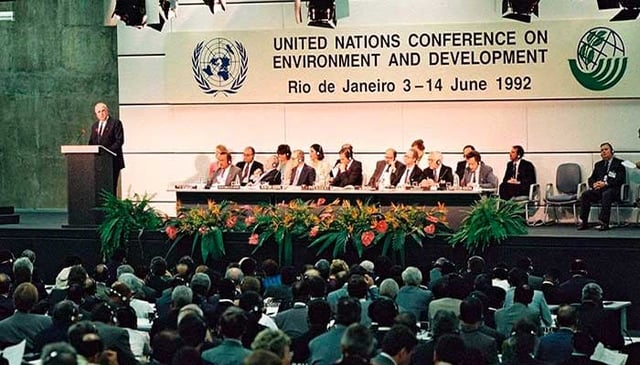
The current international climate diplomacy regime dates back to the 1992 UN Rio Earth Summit, which established the UN Framework Convention on Climate Change, or UNFCCC. 154 countries, representing nearly 80 percent of nation states, signed on to the charter, agreeing to work together to do something about climate change. Since then fossil fuels have only been mentioned once in a COP agreement (2023), despite overwhelming scientific evidence that emissions from the production, transport and burning of oil, gas and coal are the primary drivers of deadly climate disasters, biodiversity loss and premature deaths. The UN’s consensus-based approach, which requires that proposals have no formal objections before they can move forward, has allowed a small handful of countries to delay and obstruct the transition, which last year led to more than 80 countries in Belém, Brazil, speaking out about how the COP process was being abused and failing to deliver. Colombia then announced the Santa Marta conference, which builds on proposals by the fossil fuel non-proliferation treaty, a civil society initiative backed by 18 nation states including Colombia and hundreds of subnational governments.
The Santa Marta conference will obviously not solve the climate crisis, but time is running out to curtail global heating, and no country can transition away from fossil fuels alone given the interconnected and unequal structure of our energy, food and economic systems. The wealthy nations mostly responsible for global heating must do more to help developing countries, which are struggling with crippling debts, to access finance and technologies to transition off fossil fuels. International cooperation, structural change and best practice solutions require countries to come together. “Santa Marta is not a negotiation so it offers creative space to reflect on solutions out of that high stakes [COP] environment. We desperately need that,” said Amiera Sawas, head of research and policy at the Fossil Fuel Non-Proliferation Treaty. “We really believe that Santa Marta is a historic turning point in climate diplomacy.”
Who is going and what topics are on the table?
At least 50 countries and the EU have confirmed participation, which is ostensibly restricted to those ready to move forward with the transition away from fossil fuels. This includes major producers from the global north including Canada, Germany, the UK and France, as well as global south countries whose economies are currently dependent on fossil fuel production such as Brazil, Mexico, Tanzania and Vietnam. The high-level talks, scheduled for the final two days of the conference, will bring together ministers and civil society representatives to drill down on the solutions and pathways proposed through written submissions and refined through virtual dialogues and summits in the preceding days by a broad spectrum of experts ranging from biodiversity and climate scientists, medical and human health experts to other knowledge holders including Indigenous peoples, peasant farmers, youth groups, gender and human rights experts, private sector and workers, subnational governments and parliamentarians. The objective is to come up with pilots and actionable policies based on the best available evidence centred around three thematic pillars: overcoming economic dependence on fossil fuels; transforming energy supply and demand; and enhancing international cooperation and climate diplomacy. The solutions will address some major barriers to the transition including fossil fuel subsidies and other perverse incentives; national debt and access to finance and technologies for global south countries; petrochemicals; and investor-state dispute settlements.
How is it different from COP?
Organizers are at pains to stress that Santa Marta is not an alternative to the UNFCCC process nor the fossil fuel roadmap that the COP30 presidency Brazil will deliver in Turkey at COP31 in November. Rather the focus is on implementation, so not whether to transition away from fossil fuels but how. The conference is inspired by historic successes on earlier seemingly intractable global problems such as landmines and nuclear weapons, when a critical mass of countries came together and built momentum that helped break the deadlock in consensus-based UN negotiations. There is a genuine attempt to produce bottom-up knowledge and solutions from across civil society to help states phase out fossil fuels, in stark contrast to the COP process which has largely kept scientists, health experts, Indigenous people and other knowledge holders on the sidelines.
“The intention is to support the objectives of the international climate regime as interpreted by the ICJ, help willing states make progress, and feed back into the climate COP without being held hostage by it,” said Elisa Morgera, UN special rapporteur on climate change. “Ultimately, Santa Marta holds the promise of co-developing [solutions], building an alternative, more effective and inclusive multilateral space that can help hold the COP accountable.”
What will success look like?
Unlike COP, there will be no negotiated agreement, which proponents hope will foster honest and difficult conversations that encourage ambition. The co-hosts will produce a final report with a menu of solutions for implementing the transition across the three thematic pillars. A new advisory panel of experts will also be created to provide states and cities with the best available evidence for making public policies. But perhaps the overriding mark of success will be expanding the coalition of states and subnational governments ready to cooperate to eliminate fossil fuels from the global economy, building momentum that could help break the current gridlock on climate action.
Nikki Reisch, climate & energy program director at the Centre for International Environmental Law (Ciel), said: “Santa Marta is not the end point, but it can be a turning point where a coalition of doers, committed to continuing a dedicated forum on fossil fuels, takes steps toward removing legal barriers like investment protections for oil, gas, and coal that make fossil phaseout prohibitive, and opening new legal avenues, like a Fossil Fuel Treaty, to govern a coordinated transition to a fossil-free future.”
What happens next?
Santa Marta is the first step towards developing an alternative, implementation-focused climate diplomacy structure, using a pilot methodology that will likely need to be tweaked and refined going forward. It's unclear how or if it will influence COP31 in Turkey, but the Brazilian COP30 president has said the roadmap his team is set to deliver at COP31 will consider outcomes of the Santa Marta conference. Tuvalu, a Pacific island state, has already announced that it will host the second conference next year.
“For years, our urgent demands in the consensus-based forum have been vetoed and diluted by wealthy nations and interests,” said Maina Talia, Tuvalu’s minister for home affairs, climate change and environment. “Santa Marta is different, it is a space conceived and led by the nations most impacted. We will not be at the back of the room, but setting the agenda at the head of the table and moving past the blockers to build practical cooperation that we desperately need.”